
Send for Paul Temple [The Green Finger] **½ (1946, Anthony Hulme, Joy Shelton, Tamara Desni, Jack Raine, Beatrice Varley) – Classic Movie Review 4,488
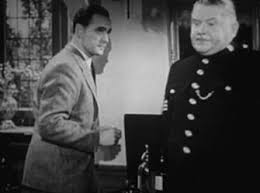
John Argyle’s 1946 British mystery thriller Send for Paul Temple [The Green Finger] gets the Francis Durbridge film series off to a feisty if rather shaky start. Anthony Hulme and Joy Shelton star as novelist sleuth Paul Temple and a reporter called Steve.
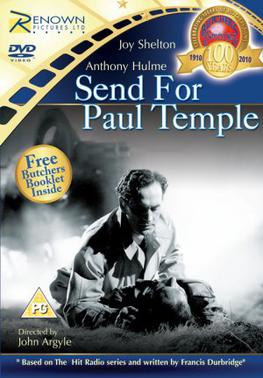
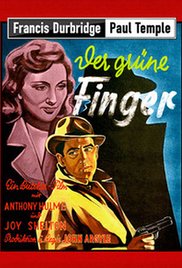
Writer-producer-director John Argyle’s 1946 British black and white mystery thriller Send for Paul Temple [The Green Finger] gets the Francis Durbridge Paul Temple film series off to a breathless and feisty if rather shaky start. The film is a heavily abridged version of the first Paul Temple radio serial, Send for Paul Temple, broadcast in April and May 1938 in eight episodes on the BBC Midland Regional Programme. Hugh Morton played Paul, and Steve was played by Bernadette Hodgson.
The radio script was by the 25-year-old Francis Durbridge, who collaborated with John Thewes on a novelisation, published in June 1938. The story was the first of the 20 Paul Temple serials Durbridge wrote for radio over three decades. John Argyle had to cut the 200-minute serial into an 83-minute film running time, a herculean task, no doubt. Out went much of Durbridge’s dialogue, characters and plotting, and of course his cliff-hanger endings.
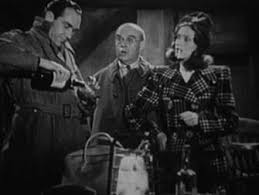
Anthony Hulme and Joy Shelton star as novelist and brilliant amateur sleuth Paul Temple and a woman newspaper reporter calling herself Steve Trent (though she is actually Louise Harvey), who combine efforts to uncover and bring to justice a ring of English smash and grab robbery gem-thieves who have killed the reporter’s investigating brother, Chief Inspector Harvey (Melville Crawford).
The organised criminal syndicate is known as the ‘Midlands Gang’, because they are working in the English Midlands. The film starts with a daring daylight robbery on a jeweller’s shop in Derby. Thus the film retains the serial’s origins as a BBC Midland Regional Programme.
The acting is conscientious if none too thrilling in this rather weak and often unconvincing first cinema outing in a franchise of four for British radio’s famous sleuth Paul Temple, based on the serial by Francis Durbridge. It turned out to be Anthony Hulme and Joy Shelton’s sole appearances as Paul and Steve, with John Bentley taking over the lead role in future instalments (Calling Paul Temple in 1948, Paul Temple’s Triumph in 1950 and Paul Temple Returns in 1952.
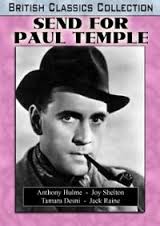
Despite a good original radio serial and Durbridge working on the screenplay with the producer-director John Argyle, the script is far too melodramatic, the production cheap looking, and Hulme makes insufficient impact as Temple, with not quite enough charisma and insufficient rapport with Joy Shelton, who is nice but rather ill at ease. They don’t have the Nick and Nora thing from The Thin Man going, so the ending when Steve and Paul drive off together to get married is more of a shock than a surprise. It’s not really the actors’ fault. The dialogue isn’t strong enough to support them, though they don’t have the corny lines some of the other actors are stuck with.
Jack Raine plays Scotland Yard’s Sir Graham Forbes amusingly enough – and survives to return for the sequel. Tamara Desni overacts impressively as the villainous Diana Thornley (aka Ludmilla), while Beatrice Varley is most enjoyable, giving the film’s best performance as Miss Amelia Marchment (who isn’t who seems to be either). Philip Ray is entertaining as the Green Finger’s tippling pub landlord Horace Daley, and Hylton Allen manages the right note of villainy as Dr Milton, Diana Thornley’s ‘uncle’.
The film is not particularly good or distinguished but nevertheless it is still quite likeable, diverting and fun in its campy sort of way, a faded relic of long-ago. British movie mysteries. Everybody drinks, everybody smokes, everybody carries guns! People swan around in open-top sports cars (cars supplied by Rootes Securities and Armstrong Siddeley Motors). Nobody seems a bit surprised when the person they’ve just been talking to is suddenly dead. People utter enigmatic words of useful clues just before they croak. Temple has a valet named Rikki (Charles Wade), whom he treats with some lofty disdain. There are ancient inns with silly named all over place (The Green Finger and The First Penguin), some having changed their name in the long-ago past, some are abandoned, but still usable, all seem to have secret cellars and cupboards. A totally different era. Life seems far more devil-may-care, carefree, careless. It’s a crazy, fictional fantasy world, escaping from reality for 83 minutes, and welcome for that then and now.
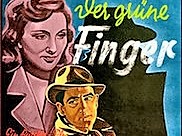
Also in the cast are Tamara Desni as Diana Thornley, Beatrice Varley as Miss Amelia Marchment, Hylton Allen as Dr Milton, Maire O’Neill as Mrs Neddy, Philip Ray as Horace Daley, Olive Sloane as Ruby, and Michael Golden as Dixie, with Richard Shayne as Chief Inspector Richard Dale, Melville Crawford as Chief Inspector Gerald Harvey, Edward V Robson as Inspector Merritt and Norman Pierce as Sergeant Morrison, and Charles Wade as Temple’s valet Rikki.
It is filmed at Nettlefold Studios, Walton-on-Thames, Surrey, England.
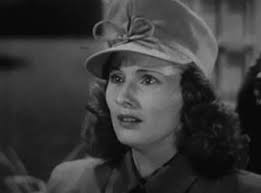
Send for Paul Temple [The Green Finger] is directed by John Argyle, runs 83 minutes, is made and distributed by Butcher’s Film Service, is written by John Argyle and Francis Durbridge, based on the radio thriller and novel by Francis Durbridge, is produced by John Argyle, shot in black and white by Geoffrey Faithfull, scored by Sidney Torch, and designed by George Paterson.
Release date: 23 December 1946.
The cast
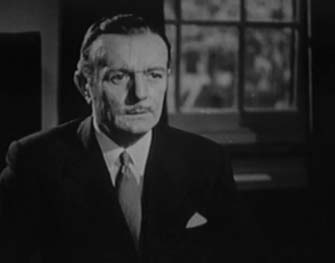
The cast are Anthony Hulme as Paul Temple, Joy Shelton as Steve Trent, Tamara Desni as Diana Thornley, Jack Raine as Sir Graham Forbes, Beatrice Varley as Miss Marchmont, Hylton Allen as Dr Milton, Maire O’Neill as Mrs Neddy, Philip Ray [Phil Ray] as Horace Daley, Olive Sloane as Ruby, Melville Crawford as Chief Inspector Gerald Harvey, Michael Golden as Dixie, Norman Pierce as Sgt Morrison, Richard Shayne as Chief Inspector Richard Dale, Edward V Robson as Inspector Merritt and Norman Pierce as Sergeant Morrison, and Charles Wade as Temple’s valet Rikki.
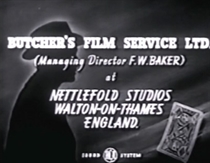
Opening credits, Send for Paul Temple (1946).
It is followed by Calling Paul Temple (1948), Paul Temple’s Triumph (1950) and Paul Temple Returns (1952), in which Anthony Hulme was replaced as Paul Temple by John Bentley and John Argyle was replaced as director by Maclean Rogers.
Films from Francis Durbridge’s works
Films from Francis Durbridge’s works: the 1946 Send for Paul Temple (with Anthony Hulme as Paul Temple), the 1948 Calling Paul Temple (based on Send for Paul Temple Again, with John Bentley as Paul Temple), the 1950 Paul Temple’s Triumph (based on News of Paul Temple, with John Bentley as Paul Temple), the 1952 Paul Temple Returns (based on Paul Temple Intervenes, with John Bentley as Paul Temple), the 1953 The Broken Horseshoe (based on the 1952 BBC TV series), the 1953 Operation Diplomat (based on the 1952 BBC TV series), the 1954 The Teckman Mystery (based on The Teckman Biography), the 1955 Portrait of Alison (US: Postmark for Danger) (based on Portrait of Alison), and the 1957 The Vicious Circle.
© Derek Winnert 2016 Classic Movie Review 4,488
Check out more reviews on http://derekwinnert.com

Recent articles
- Johnny One-Eye **½ (1950, Pat O’Brien, Wayne Morris, Dolores Moran) – Classic Movie Review 13,98523 Jul 2026
- Crosstrap * (1962, Laurence Payne, Jill Adams, Zena Marshall, Gary Cockrell) – Classic Movie Review 13,98422 Jul 2026
- Leprechaun * (1993, Warwick Davis, Jennifer Aniston, Ken Olandt, Mark Holton, Robert Gorman) – Classic Movie Review 13,98321 Jul 2026
- Quatermass [The Quatermass Conclusion] *** (1979, John Mills, Simon McCorkindale, Margaret Tyzack, Barbara Kellerman, Brewster Mason, Brenda Fricker) – Classic Movie Review 13,98220 Jul 2026
- Plunder Road ***½ (1957, Gene Raymond, Jeanne Cooper, Wayne Morris, Elisha Cook Jr, Stafford Repp, Steven Ritch, Nora Hayden, Don Garrett, Jim Canino) – Classic Movie Review 13,98120 Jul 2026
Recent comments
- The President’s Lady ** (1953, Charlton Heston, Susan Hayward, John McIntire, Fay Bainter) – Classic Movie Review 13,846 | Derek Winnert on The Buccaneer *** (1958, Yul Brynner, Claire Bloom, Charles Boyer, Inger Stevens, Henry Hull, Charlton Heston) – Classic Movie Review 13,844
- Straight Up *** (2019, James Sweeney, Katie Findlay, Dana Drori, James Scully, Tracie Thoms, Betsy Brandt, Randall Park) – Classic Movie Review 13,839 | Derek Winnert on Twinless **** (2025, Dylan O'Brien, James Sweeney, Aisling Franciosi) – Classic Movie Review 13,838
- Phantom Killer ** (1942, Dick Purcell, Joan Woodbury, John Hamilton, Warren Hymer) – Classic Movie Review 13,837 | Derek Winnert on The Sphinx ** (1933, Lionel Atwill, Sheila Terry, Theodore Newton) – Classic Movie Review 13,836
- Detour ***** (1945, Tom Neal, Ann Savage, Claudia Drake, Edmund MacDonald) – Classic Movie Review 1,547 | Derek Winnert on The Last Crooked Mile *** (1946, Don Barry, Ann Savage, Adele Mara, Tom Powers, Sheldon Leonard, Nestor Paiva) – Classic Movie Review 13,834
- Big ***** (1989, Tom Hanks, John Heard, Jared Rushton, Robert Loggia, David Moscow, Mercedes Ruehl, Jon Lovitz, Josh Clark, Kimberlee M Davis, Elizabeth Perkins) – Classic Movie Review 287 | Derek Winnert on 18 Again! *** (1988, George Burns, Charlie Schlatter, Tony Roberts, Anita Morris, Red Buttons, Pauly Shore) – Classic Movie Review 13,815