
The House with Laughing Windows [La Casa dalle Finestre che Ridono] *** (1976, Lino Capolicchio, Francesca Marciano, Gianni Cavina)
Co-writer/ director Pupi Avati’s 1976 Italian giallo thriller horror film stars Lino Capolicchio as a young art restorer who arrives in an isolated northern Italy village to restore a horrific fresco on a rotting wall of the local church.
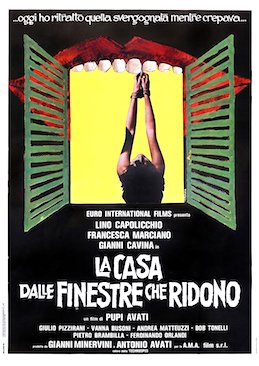
Co-writer/ director Pupi Avati’s 1976 Italian giallo thriller horror film stars Lino Capolicchio, Francesca Marciano, Gianni Cavina.
Lino Capolicchio stars as young art historian Stefano, who fatefully arrives in an isolated northern Italy village where he is to restore a horrific controversial fresco depicting what appears to be the martyrdom of Saint Sebastian that was painted on a rotting wall of the local church by a mysterious, long-dead artist named Legnani.
It turns out that Legnani was a madman who derived his art from life. Assisted by his two insane sisters, he had brutally tortured people to death to inspire his horrific paintings, including the one Stefano is restoring.
The House with Laughing Windows is a posh, arty slow burn, and mostly surprisingly low on the kind of slasher horror excitements it might suggest. But it is extremely moody and atmospheric, using the locations to huge advantage, and quite formally beautiful thanks to Pasquale Rachini’s cinematography. Pupi Avati builds his sense of menace and fear steadily and remorselessly through a fairly long running time of 101 minutes, ending with a decently grisly climax. Overall, though, it’s a film that suggests horror rather than shows it, maybe not really a horror film at all, possibly a rumination on art and death.
Starting from a story Pupi Avati heard as a child involving the exhumation of a priest in the village of Sasso Marconi (Bologna, Emilia-Romagna), and developing into its screen story from there, it is unusual, bordering on the unique, though it brings to mind both Don’t Look Now (art and death) and The Wicker Man (stranger confronting a community of murderous locals).
Its success starts with the engrossing and astute screenplay by Pupi Avati, Antonio Avati, Gianni Cavina and Maurizio Costanzo. That’s the bottom layer, In the middle of the sandwich there is Pasquale Rachini’s cinematography, and at the top end there is Amedeo Tommassi’s eerie, unsettling score to cover it all.
There’s very little to say about the acting. It’s a director’s movie not a performance led one. Pupi Avati has not cast any stars. However, Lino Capolicchio gives a very decent tortured performance as the main character, virtually the only developed character in the film. Francesca Marciano looks pretty but is a side issue as the new young teacher who makes the mistake of helping the hero and beginning a romance with him. The writers’ hearts don’t seem to be in this romance at all. The females they are interested in are the deceased painter’s two sisters, whose former house he is currently staying in.
Despite the typically bizarre and teasing title The House with Laughing Windows, this time we do actually get to see one, and very pretty it is too. Hooray! There’s a strong surreal element in the movie that helps to make it so attractive.
The film was shot over five weeks between April and May 1976 in Lido degli Scacchi in the Ferrara province of the Emilia-Romagna region in northern Italy. It was released on 16 August 1976 (Italy).
Pupi Avati also notably directed the similar horror film Zeder (1983) and the dissimilar Bix (1991), about the final years of cornet player Bix Beiderbecke.
Giuseppe ‘Pupi’ Avati (born 3 November 1938)
© Derek Winnert 2026 – Classic Movie Review 14,034
Check out more reviews on http://derekwinnert.com

Recent articles
- The House with Laughing Windows [La Casa dalle Finestre che Ridono] *** (1976, Lino Capolicchio, Francesca Marciano, Gianni Cavina)09 Sep 2026
- I Want Your Sex *** (2026, Olivia Wilde, Cooper Hoffman, Margaret Cho, Johnny Knoxville, Mason Gooding, Chase Sui Wonders, Daveed Diggs, Charli XCX) – Classic Movie Review 14,03308 Sep 2026
- La Corta Notte delle Bambole di Vetro [Short Night of Glass Dolls] *** (1971, Ingrid Thulin, Jean Sorel, Barbara Bach, Mario Adorf) – Classic Movie Review 14,03207 Sep 2026
- Bitter Christmas [Amarga Navidad] **** (2026, Bárbara Lennie, Leonardo Sbaraglia, Aitana Sánchez-Gijón, Victoria Luengo, Patrick Criado, Milena Smit, Quim Gutiérrez, Rossy de Palma) – Classic Movie Review 14,03107 Sep 2026
- Hooked *** (2017, Conor Donnally, Sean Ormond, Terrance Murphy, Katie McClellan) – Classic Movie Review 14,03007 Sep 2026
Recent comments
- The President’s Lady ** (1953, Charlton Heston, Susan Hayward, John McIntire, Fay Bainter) – Classic Movie Review 13,846 | Derek Winnert on The Buccaneer *** (1958, Yul Brynner, Claire Bloom, Charles Boyer, Inger Stevens, Henry Hull, Charlton Heston) – Classic Movie Review 13,844
- Straight Up *** (2019, James Sweeney, Katie Findlay, Dana Drori, James Scully, Tracie Thoms, Betsy Brandt, Randall Park) – Classic Movie Review 13,839 | Derek Winnert on Twinless **** (2025, Dylan O'Brien, James Sweeney, Aisling Franciosi) – Classic Movie Review 13,838
- Phantom Killer ** (1942, Dick Purcell, Joan Woodbury, John Hamilton, Warren Hymer) – Classic Movie Review 13,837 | Derek Winnert on The Sphinx ** (1933, Lionel Atwill, Sheila Terry, Theodore Newton) – Classic Movie Review 13,836
- Detour ***** (1945, Tom Neal, Ann Savage, Claudia Drake, Edmund MacDonald) – Classic Movie Review 1,547 | Derek Winnert on The Last Crooked Mile *** (1946, Don Barry, Ann Savage, Adele Mara, Tom Powers, Sheldon Leonard, Nestor Paiva) – Classic Movie Review 13,834
- Big ***** (1989, Tom Hanks, John Heard, Jared Rushton, Robert Loggia, David Moscow, Mercedes Ruehl, Jon Lovitz, Josh Clark, Kimberlee M Davis, Elizabeth Perkins) – Classic Movie Review 287 | Derek Winnert on 18 Again! *** (1988, George Burns, Charlie Schlatter, Tony Roberts, Anita Morris, Red Buttons, Pauly Shore) – Classic Movie Review 13,815