
The High and the Mighty **** (1954, John Wayne, Claire Trevor, Laraine Day, Robert Stack, Robert Newton, Jan Sterling, Phil Harris) – Classic Movie Review 8,995
The 1954 American film The High and the Mighty stars John Wayne on top form in one of the original and best of the aviation disaster movies with a plane-load of stars boarding a Honolulu flight to San Francisco destined for an unscheduled stop at fear.
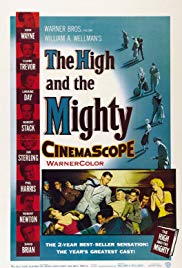
Director William A Wellman’s 1954 CinemaScope and WarnerColor action adventure drama film The High and the Mighty is written by Ernest K Gann and based on his bestselling novel. It was nominated for five Oscars and composer Dimitri Tiomkin won an Oscar for Best Original Music Score, while Jan Sterling won a Golden Globe as Best Supporting Actress Motion Picture, with Karen Sharpe as Most Promising Newcomer – Female.
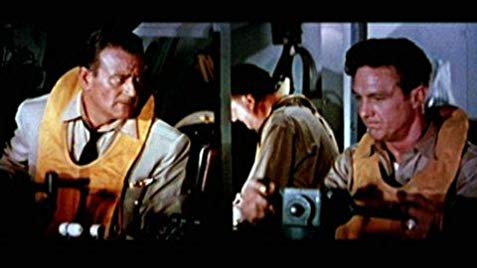
It stars John Wayne, who is on top form in one of the original and best of the airborne disaster films with a plane-load of stars boarding a Honolulu flight to San Francisco that is destined for an unscheduled stop at fear – even though nervy old veteran airline first officer Dan Roman (Wayne) and over-confident young John Sullivan (Robert Stack) are in the cockpit when their airliner has a catastrophic engine failure while crossing the Pacific Ocean.
Every jolt is expected, but it is all carried off with such aplomb by the top-rank cast (also Claire Trevor, Laraine Day, Jan Sterling, Phil Harris and Robert Newton) and production team (especially cinematographer Archie J Stout and set designer Alfred Ybarra) that it comes through with flying colours.
Wayne’s Stagecoach (1939) co-star Claire Trevor is the top-billed actress, giving her world-weary turn one more useful outing, as jaded former actress May Holst, who literally kisses her mink coat goodbye when they have to dump luggage from the airliner to lose weight. Sadly, Claire Trevor called it ‘a dreary picture to make’ because most of the cast had to sit in the passenger cabin for weeks during filming
Dimitri Tiomkin’s rousing music score won him a deserved Oscar. And Tiomkin’s title song was also nominated for an Oscar for Best Song (lyrics by Ned Washington), though it does not appear in the release print or in the later restoration. In real life, the title song was used at Wayne’s funeral in June 1979.
Also in the cast are Robert Newton, Doe Avedon, Laraine Day, Jan Sterling, Phil Harris, Sidney Blackmer, John Howard, David Brian, Paul Kelly, Julie Bishop, Pedro Gonzales-Gonzales, Wally Brown, William Campbell, John Qualen, Ann Doran, Paul Fix, Joy Kim, George Chandler, Michael Wellman, Douglas Fowley, Regis Toomey, Carl Switzer, Robert Keys, William Hopper, William Schallert, Julie Mitchum, Karen Sharpe, John Smith, Robert Easton, Dorothy Ford, Douglas Kennedy, Walter Reed and Philip Van Zandt.
Wayne was initially solely a producer, but was cast in the film after Spencer Tracy dropped out. Wellman said Tracy found the script ‘lousy’ while assistant director Andrew McLaglen said Tracy’s friends told the actor he was ‘in for an ego-bruising ride’. Wellman convinced Wayne to star, but Wayne later said he did not like his performance. McLaglen recalled: ‘He said “Well, it never had any love story”.’
Wayne wanted his actor pilot friend Robert Cummings as the captain, but Robert Stack got the role after he convinced Wellman that a non-pilot could effectively portray the drama of a cockpit conflict.
It follows Wayne’s 1953 aviation disaster film Island in the Sky, which shares many of the same cast and production crew. Ernest K Gann wrote both screenplays.
Soldier of Fortune (1955) is also written by Ernest K Gann and based on his novel.
The High and the Mighty is directed by William A Wellman, runs 147 minutes, is made by Wayne-Fellows Productions, is released by Warner Bros, is written by Ernest K Gann, based on his novel, is shot in CinemaScope and WarnerColor by Archie J Stout and William Clothier, is produced by John Wayne and Robert Fellows, is scored by Dimitri Tiomkin, and is designed by Alfred Ybarra.
It was shot from 16 November 1953 to 11 January 1954 on a lot at Goldwyn Pictures and on Warner Bros soundstages in Hollywood.
It premiered on May 27, 1954 in Los Angeles and was released on July 3, 1954 (US).
Wayne pushed for the use of CinemaScope, although Wellman considered it ‘bulky and unwieldy’ during filming. The format also limited use in cinemas, but the film grossed $8.5 million and was the sixth most popular film of 1954 in North America.
For two decades, the film languished in the Wayne vault, where it suffered major water damage and portions of the film stock’s colour had faded. But in the early 2000s John Wayne’s estate, through Gretchen Wayne, the widow of his late son Michael, made a deal with Cinetech (film) and Chace Productions (sound) to restore it along with Island in the Sky. Restoration took more than a year, and three months to fix the sound. It was shown on TV in July 2005, and appeared on DVD in August 2005.
© Derek Winnert 2019 Classic Movie Review 8,995
Check out more reviews on http://derekwinnert.com

Recent articles
- Black Patch *** (1957, George Montgomery, Diane Brewster, Tom Pittman, Leo Gordon, Sebastian Cabot, Lynn Cartwright) – Classic Movie Review 14,02131 Aug 2026
- Sorry Angel [Plaire, aimer et courir vite] ****(Pierre Deladonchamps, Vincent Lacoste, Denis Podalydès, Thomas Gonzalez, 2018) – Classic Movie Review 14,02030 Aug 2026
- Date with Disaster *** (1957, Tom Drake, William Hartnell, Shirley Eaton, Maurice Kaufmann, Michael Golden, Richard Shaw) – Classic Movie Review 14,01929 Aug 2026
- Travis Mc Gee *** (1983, Sam Elliott, Richard Farnsworth, Gene Evans, Barry Corbin, Geoffrey Lewis, Amy Madigan, Vera Miles, Katharine Ross, Marshall R Teague) – Classic Movie Review 14,01825 Aug 2026
- Tethered Wings [Les ailes collées] *** (2025, Roby Schinasi, Jérémy Kapone, Émilie Caen, Max Libert, Alexis Rosenstiehl) – Classic Movie Review 14,01723 Aug 2026
Recent comments
- The President’s Lady ** (1953, Charlton Heston, Susan Hayward, John McIntire, Fay Bainter) – Classic Movie Review 13,846 | Derek Winnert on The Buccaneer *** (1958, Yul Brynner, Claire Bloom, Charles Boyer, Inger Stevens, Henry Hull, Charlton Heston) – Classic Movie Review 13,844
- Straight Up *** (2019, James Sweeney, Katie Findlay, Dana Drori, James Scully, Tracie Thoms, Betsy Brandt, Randall Park) – Classic Movie Review 13,839 | Derek Winnert on Twinless **** (2025, Dylan O'Brien, James Sweeney, Aisling Franciosi) – Classic Movie Review 13,838
- Phantom Killer ** (1942, Dick Purcell, Joan Woodbury, John Hamilton, Warren Hymer) – Classic Movie Review 13,837 | Derek Winnert on The Sphinx ** (1933, Lionel Atwill, Sheila Terry, Theodore Newton) – Classic Movie Review 13,836
- Detour ***** (1945, Tom Neal, Ann Savage, Claudia Drake, Edmund MacDonald) – Classic Movie Review 1,547 | Derek Winnert on The Last Crooked Mile *** (1946, Don Barry, Ann Savage, Adele Mara, Tom Powers, Sheldon Leonard, Nestor Paiva) – Classic Movie Review 13,834
- Big ***** (1989, Tom Hanks, John Heard, Jared Rushton, Robert Loggia, David Moscow, Mercedes Ruehl, Jon Lovitz, Josh Clark, Kimberlee M Davis, Elizabeth Perkins) – Classic Movie Review 287 | Derek Winnert on 18 Again! *** (1988, George Burns, Charlie Schlatter, Tony Roberts, Anita Morris, Red Buttons, Pauly Shore) – Classic Movie Review 13,815