
The Killing ***** (1956, Sterling Hayden, Coleen Gray, Vince Edwards, Jay C Flippen, Marie Windsor, Ted de Corsia, Elisha Cook Jr, Timothy Carey) – Classic Movie Review 359
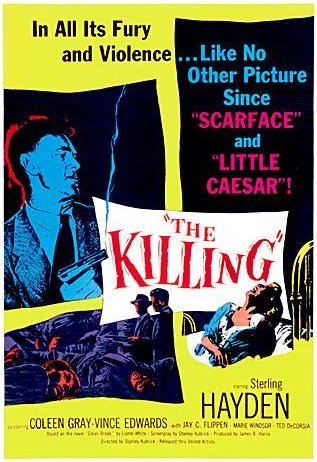
Stanley Kubrick’s exhilarating 1956 masterpiece The Killing is a taut, fast-paced, atmospheric B-movie film noir thriller.
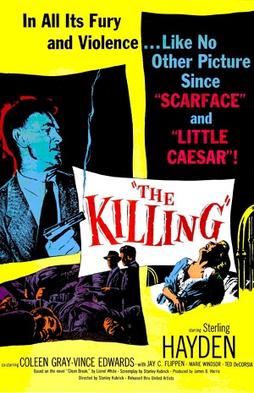
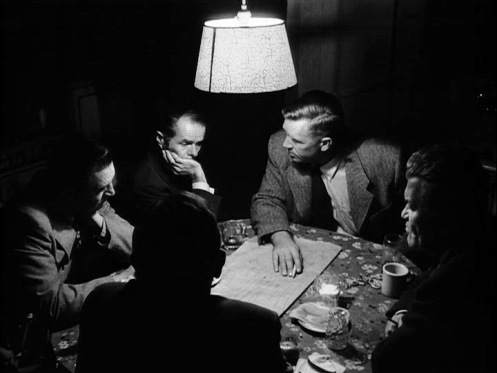
Stanley Kubrick’s exhilarating youthful 1956 masterpiece – his third feature made when he was 28 – is a taut, fast-paced, atmospheric B-movie noir thriller. It gets top mileage from its carefully delineated characters of hoods and molls and its driving plot about thieves falling out over a complex horse-racing bet takings robbery, an inside-job that goes badly wrong.
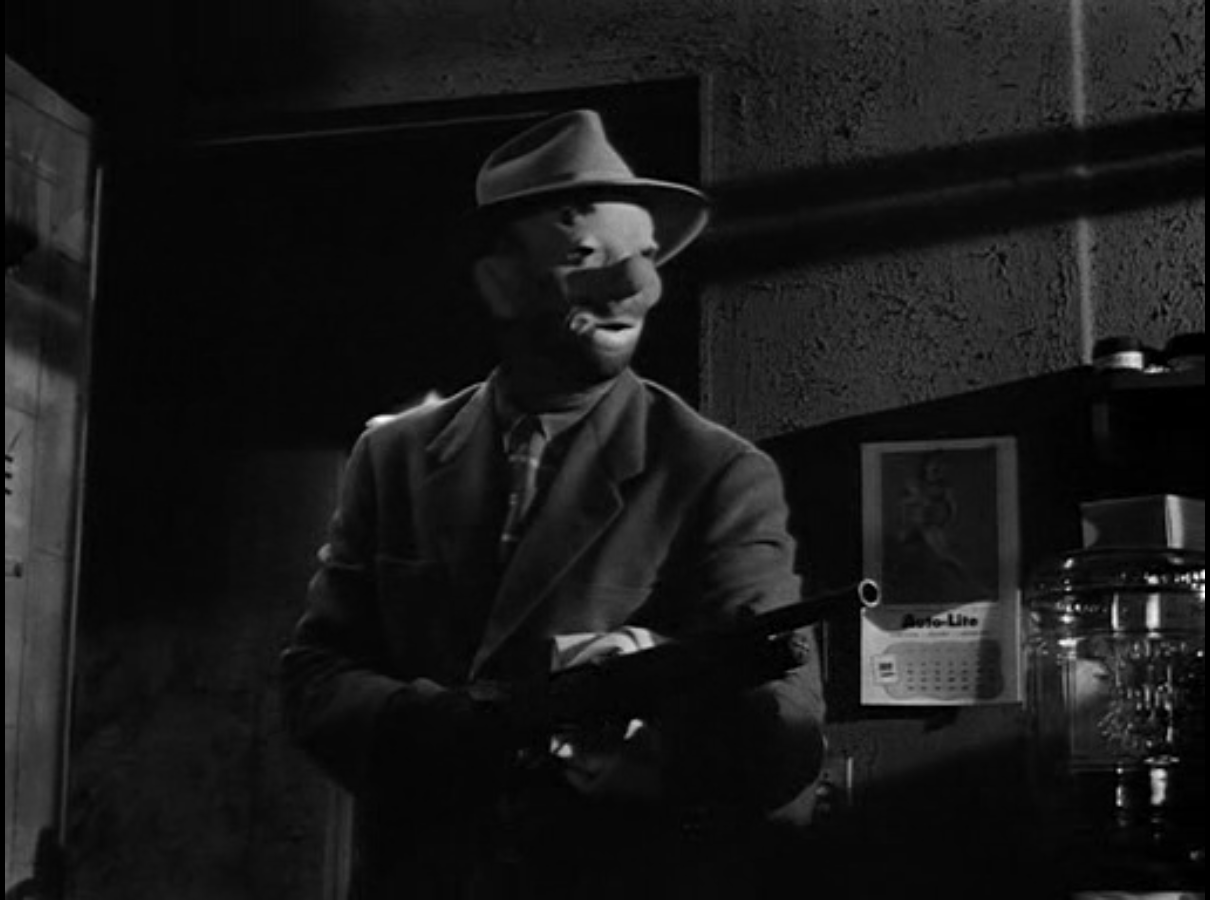
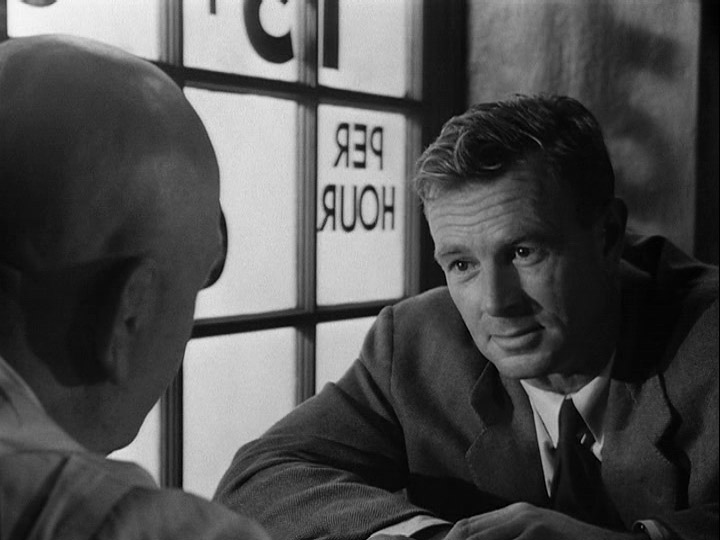
Sterling Hayden stars as an ex-con called Johnny Clay, just freed from jail and reunited with his down-home sweetheart Fay (Coleen Gray). Hayden sets about to mastermind one more, final, job – a daring, complex $2 million heist on a racetrack, unwittingly and unfortunately recruiting a bunch of doomed losers as his gang.
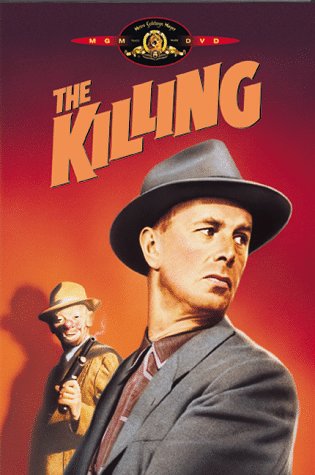
But, hey, the best laid plans… Spanners inevitably get into the works of the heist, thanks to Sherry Peatty (Marie Windsor), the wife of the teller George Peatty (Elisha Cook Jr) who is part of the heist, the wife’s boyfriend, airport regulations and a little dog.
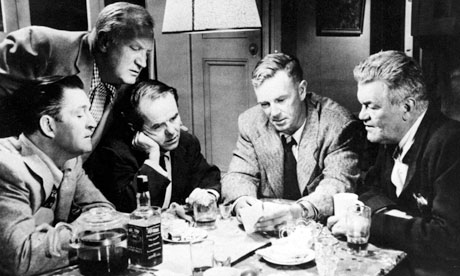
The Killing is lit up by resonant performances from a tasty cast that highlights strong silent Hayden, brash femme fatale Windsor, her mousey husband Cook Jr, retired buddy Jay C Flippen, bartender Joe Sawyer, hitman Timothy Carey and cop Ted de Corsia, all combining to portray a beautifully etched rogue’s gallery.
Lucien Ballard’s stark cinematography is startling and imaginative, conjuring up perfectly the seedy petty-crook milieu and racetrack atmosphere, also captured ideally in Jim Thompson’s hard-bitten dialogue.
Kubrick had planned to be his own phototographer but the union told him he could not direct and shoot, so veteran cinematographer Lucien Ballard was hired. Inevitably, Kubrick often clashed with Ballard over camera placement and technical details.
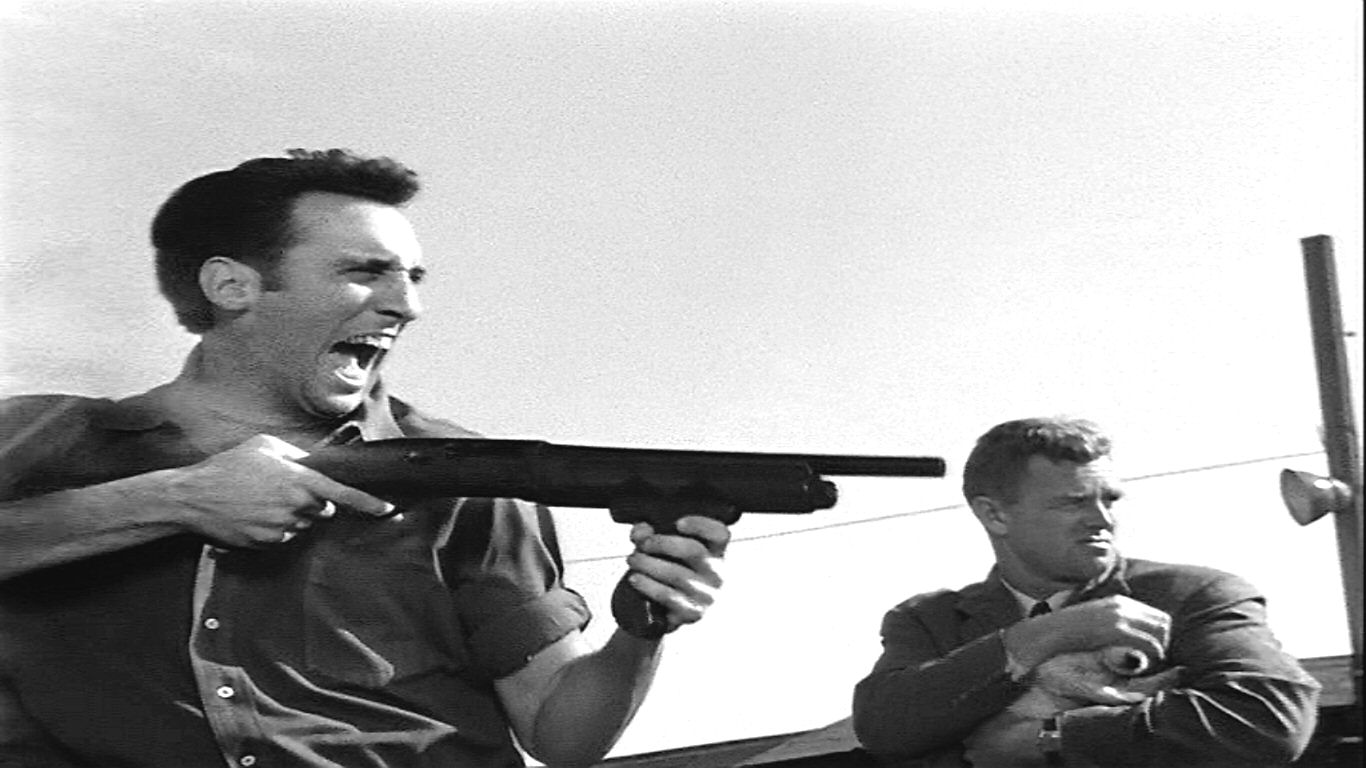
Kubrick dares to spend time building up character and leaves the camera facing just two characters for extended dialogue sequences, then bursts into fast movement, panning and tracking, and sudden (sometimes violent) action.
Only the portentous voice-over by Art Gilmore as The Narrator announcing the complicated time-shifting scene setting, the odd phoney back-projection, and the irritatingly insistent score by Gerald Fried – all very much of their time – sound false notes.
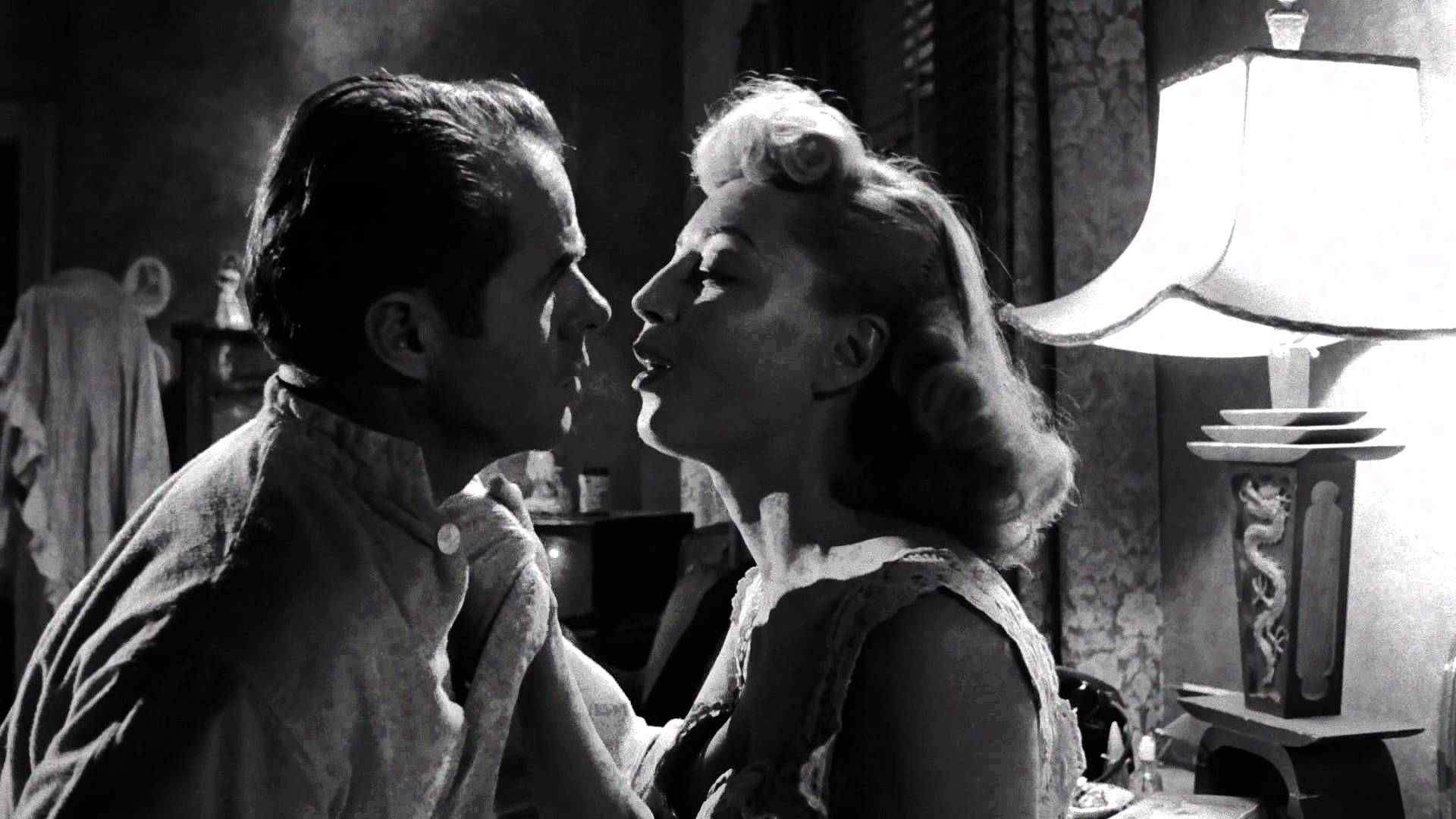
But Kubrick’s non-chronological narration of the story by a time-scrambling juggling act with the sequences for interconnecting flashbacks is clever and modern, allowing him to examine the processes of planning, robbery and aftermath out of sequence with no fat and no loss of comprehension.
Above all, the ultra-meticulous, painstaking Kubrick gets the detail right in a film that is stylised and set-bound, yet documentary-like and always believable.
Much admired and imitated, this seminal movie is an influence on Reservoir Dogs.
Kubrick and Thompson wrote their hard-boiled screenplay adapted from Lionel White’s pulp novel Clean Break, whose screen rights producer James B Harris bought for $10,000.
Obsessive chess player Kubrick and Harris met while playing chess in New York City’s Washington Square, and in 1955 formed the Harris-Kubrick Pictures Corporation, which produced the film. Kubrick suggested they hire Jim Thompson, who did most of the scriptwriting, though on screen Kubrick is credited for the screenplay and Thompson for dialogue. It is the first of three films Harris and Kubrick collaborated on, followed by Paths of Glory (1957), and Lolita (1962).
Hayden, Ted de Corsia and Timothy Carey all appeared the previous year in the film noir Crime Wave.
The film’s art director Ruth Sobotka was Kubrick’s wife.
The budget was $330,000, of which United Artists provided $200,000 and Harris used $80,000 of his own money and a $50,000 loan from his father. But without a proper US release, belatedly playing as a second feature to Robert Mitchum’s film Bandido!, The Killing recorded a loss of $130,000. Sterling Hayden was paid $40,000 but United Artists thought he was not a big enough star and, box office-wise, maybe they were right.
Film producer Max Youngstein of United Artists considered Kubrick and Harris ‘not far from the bottom’ of the pool of new talent, but MGM producer Dore Schary liked The Killing and offered them $75,000 to write, direct and produce another film, which became Paths of Glory.
Release date: May 19, 1956 (New York City).
Runtime: 84 minutes.
The cast
The cast are Sterling Hayden as Johnny Clay, Coleen Gray as Fay, Vince Edwards as Val Cannon, Jay C Flippen as Marvin Unger, Elisha Cook Jr as George Peatty, Marie Windsor as Sherry Peatty, Ted de Corsia as Policeman Randy Kennan, Joe Sawyer as Mike O’Reilly, James Edwards as Track Parking Attendant, Timothy Carey as Nikki Arcane, Tito Vuolo as Joe ‘Piano’, Joe Turkel as ‘Tiny’, Jay Adler as Leo the loanshark, Kola Kwariani as Maurice Oboukhoff, Dorothy Adams as Mrs Ruthie O’Reilly, and Art Gilmore as The Narrator.
Sterling Hayden is also memorable as General Jack D Ripper in Kubrick’s Dr Strangelove or: How I Learned to Stop Worrying and Love the Bomb (1964).
James B Harris (born August 3, 1928)
© Derek Winnert 2013 Classic Movie Review 359
Check out more reviews on http://derekwinnert.com

Recent articles
- Sorry Angel [Plaire, aimer et courir vite] ****(Pierre Deladonchamps, Vincent Lacoste, Denis Podalydès, Thomas Gonzalez, 2018) – Classic Movie Review 14,02030 Aug 2026
- Date with Disaster *** (1957, Tom Drake, William Hartnell, Shirley Eaton, Maurice Kaufmann, Michael Golden, Richard Shaw) – Classic Movie Review 14,01929 Aug 2026
- Travis Mc Gee *** (1983, Sam Elliott, Richard Farnsworth, Gene Evans, Barry Corbin, Geoffrey Lewis, Amy Madigan, Vera Miles, Katharine Ross, Marshall R Teague) – Classic Movie Review 14,01825 Aug 2026
- Tethered Wings [Les ailes collées] *** (2025, Roby Schinasi, Jérémy Kapone, Émilie Caen, Max Libert, Alexis Rosenstiehl) – Classic Movie Review 14,01723 Aug 2026
- Child in the House ** (1956, Eric Portman, Phyllis Calvert, Stanley Baker, Mandy Miller) – Classic Movie Review 14,01622 Aug 2026
Recent comments
- The President’s Lady ** (1953, Charlton Heston, Susan Hayward, John McIntire, Fay Bainter) – Classic Movie Review 13,846 | Derek Winnert on The Buccaneer *** (1958, Yul Brynner, Claire Bloom, Charles Boyer, Inger Stevens, Henry Hull, Charlton Heston) – Classic Movie Review 13,844
- Straight Up *** (2019, James Sweeney, Katie Findlay, Dana Drori, James Scully, Tracie Thoms, Betsy Brandt, Randall Park) – Classic Movie Review 13,839 | Derek Winnert on Twinless **** (2025, Dylan O'Brien, James Sweeney, Aisling Franciosi) – Classic Movie Review 13,838
- Phantom Killer ** (1942, Dick Purcell, Joan Woodbury, John Hamilton, Warren Hymer) – Classic Movie Review 13,837 | Derek Winnert on The Sphinx ** (1933, Lionel Atwill, Sheila Terry, Theodore Newton) – Classic Movie Review 13,836
- Detour ***** (1945, Tom Neal, Ann Savage, Claudia Drake, Edmund MacDonald) – Classic Movie Review 1,547 | Derek Winnert on The Last Crooked Mile *** (1946, Don Barry, Ann Savage, Adele Mara, Tom Powers, Sheldon Leonard, Nestor Paiva) – Classic Movie Review 13,834
- Big ***** (1989, Tom Hanks, John Heard, Jared Rushton, Robert Loggia, David Moscow, Mercedes Ruehl, Jon Lovitz, Josh Clark, Kimberlee M Davis, Elizabeth Perkins) – Classic Movie Review 287 | Derek Winnert on 18 Again! *** (1988, George Burns, Charlie Schlatter, Tony Roberts, Anita Morris, Red Buttons, Pauly Shore) – Classic Movie Review 13,815