
Night Train to Munich **** (1940, Margaret Lockwood, Rex Harrison, Paul Henreid, Basil Radford, Naunton Wayne, James Harcourt, Felix Aylmer, Roland Culver) – Classic Movie Review 1,832
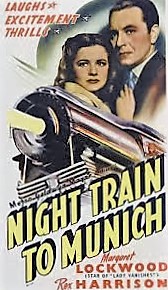
Carol Reed’s fast-moving, enjoyable 1940 thriller film Night Train to Munich is written by Frank Launder and Sidney Gilliat. It brings back Margaret Lockwood as the heroine, and Basil Radford and Naunton Wayne as cricket-mad Brits Charters and Caldicott.

Director Carol Reed’s fast-moving, enjoyable 1940 British wartime thriller film Night Train to Munich is written by the reliable team of Frank Launder and Sidney Gilliat, who try to repeat the trick of their script for Alfred Hitchcock’s The Lady Vanishes and nearly succeed.
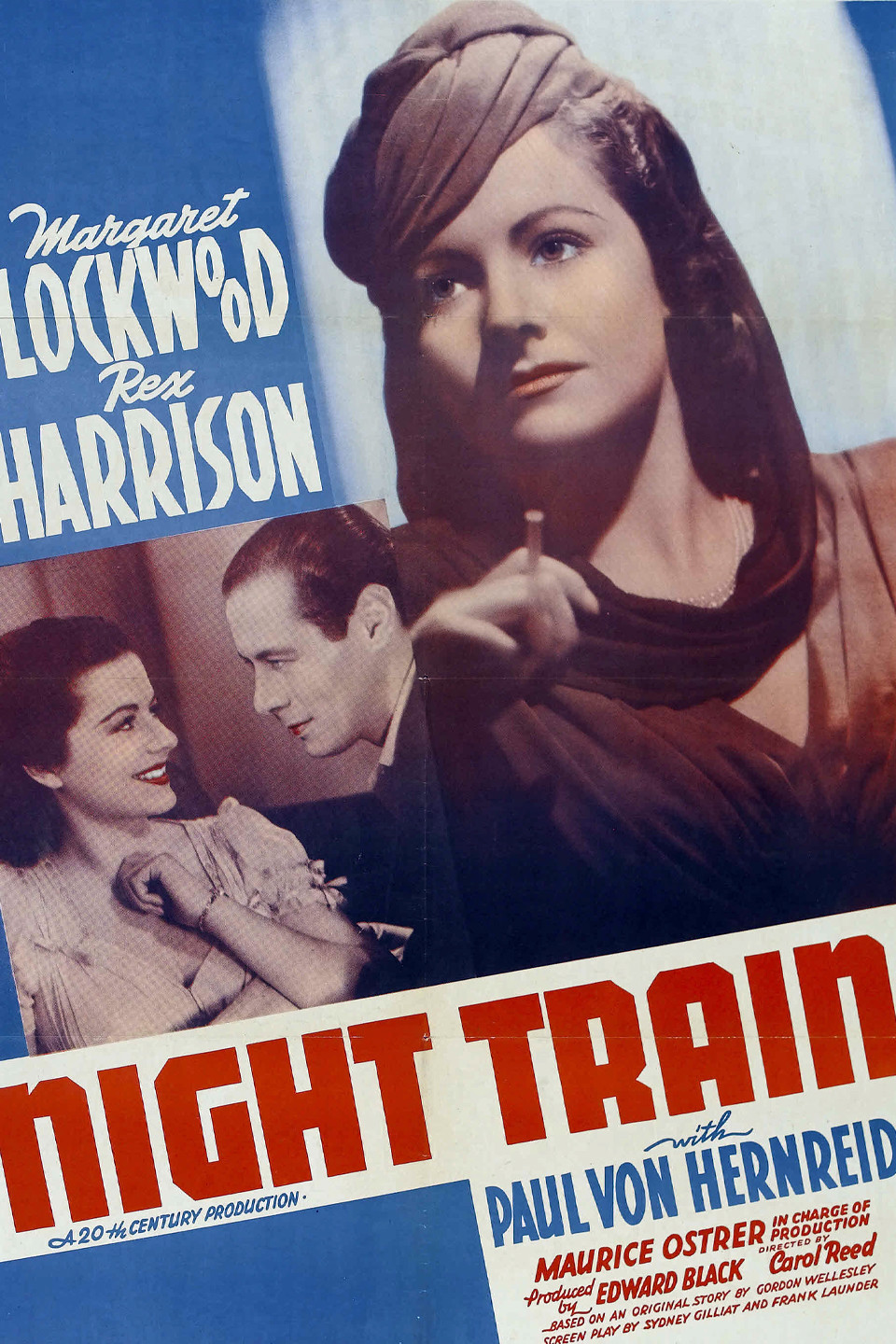
There’s a 24-carat sparkle in another repeat outing for three of that movie’s main and best elements – (1) an exciting train ride, (2) another star turn for Margaret Lockwood as the heroine and (3) new capers for the same duo of quirky cricket-mad Brits Charters and Caldicott, played again by the irreplaceable Basil Radford and Naunton Wayne.

Unfortunately, this time the yarn, based on Gordon Wellesley’s Oscar-nominated original 1939 short story Report on a Fugitive, is harder to swallow. But it doesn’t spoil the fun.
Sidney Gilliat claimed that Wellesley’s story constituted only the first ten minutes of the film, and that the rest of the story came from him and Launder. If so, they were probably fed up that Wellesley was the film’s sole nominee for the 1942 Oscar for Best Writing, Original Story.
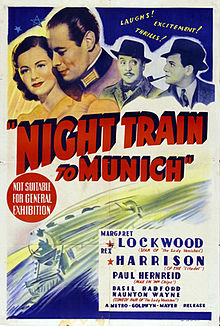
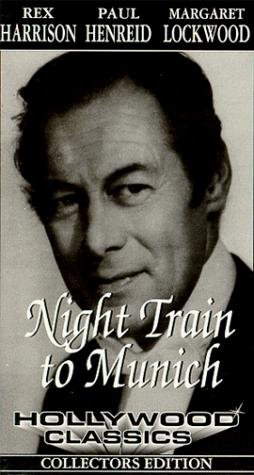
Rex Harrison gives his usual impeccably polished performance as British secret service agent Dickie Randall, who masquerades as a senior German army officer, the fictional Nazi Ulrich Herzog, to snatch an elderly Czech scientist, armour-plating inventor Dr Axel Bomasch (James Harcourt), and his daughter Anna (Lockwood) from the Nazis to safety in Switzerland.
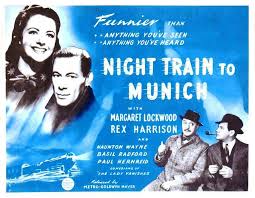
Early on in the film, Anna and her father have fled separately from Czechoslovakia to England.
Bomasch is flown to Britain just as German forces take over Czechoslovakia in March 1939, but Anna is arrested and sent to a concentration camp. There she is befriended by fellow prisoner Karl Marsen (Paul Henreid), and they escape and make their way to London. But Marsen is a Gestapo agent out to gain her trust and locate her father.
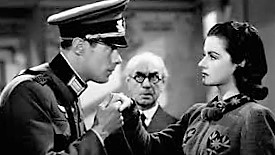
Anna contacts Dickie Randall (Rex Harrison), a British intelligence officer working undercover as seaside entertainer Gus Bennett. Randall reunites Anna with her father, but when the Gestapo kidnap them back to Berlin, Dickie Randall follows in disguise in Nazi uniform as Major Ulrich Herzog of the Corps of Engineers, and then pretends to enlist Anna over to the Germans’ cause, making them believe he was Anna’s lover years ago and can persuade her to get her father to co-operate.
It takes a lot of convoluted plotting to get the characters actually on the Night Train to Munich. When the Bomasches are ordered to be sent to Munich with Karl Marsen, Dickie Randall finds a way to accompany them and arrange their escape. At the railway station, they meet Charters and Caldicott, who are leaving Germany. Caldicott recognises Randall as a former college mate. Now the film takes a distinctly comedic turn, recovering as a thriller for the final set piece at an aerial tramway between German and neutral Switzerland. It says much for the skills of Launder and Gilliat that this climax is entirely preposterous but totally entertaining.
There is an immense amount of breathless inventive plotting in just 95 minutes. And there is a big helping of energetic wartime adventure entertainment, as well as plenty of high spirits from the actors and taut suspense conjured up by Carol Reed, the director of The Third Man and Odd Man Out.
Carol Reed brings out the best and most exuberant in Lockwood and Harrison, both looking and acting young, vibrant and attractive. Though good, the Lockwood and Harrison teaming isn’t quite as classy or successful as the Lockwood and Michael Redgrave pairing in The Lady Vanishes, leaving Harrison to romp away with the film. It’s hard to buy Lockwood as a Czechoslovak scientist’s daughter sent to a concentration camp, but the actress works her socks off to try to convince.
The movie starts with the Germans invading Austria, then Poland, then the Sudetenland, and then Czechoslovakia (all in the first two or three minutes), and still manages to be a high spirited comedy thriller, making fun of the Germans and the Nazis. Risky business in 1940, but Launder and Gilliat pull it off with a lot of cheek and style. With its topicality long gone, the film still seems fresh and relevant.
It is an ambitious, impressive project, a rather fine production. Several scenes stretch the UK wartime resources of 20th Century Fox to the limit. Some of it suffers from unconvincing toy models and studio backdrops, but much of it looks just great, visually appealing.
Launder and Gilliat love their Brit characters, quite rightly. Basil Radford and Naunton Wayne give the most polished of performances, Raymond Huntley is amusing as the bemused Kampenfeldt, and Irene Handl is a brief joy as the bossy station manager.
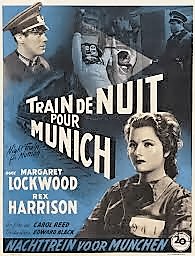
Paul Henreid [Paul von Hernried] also stars as Karl Marsen, while Kenneth Kent, Felix Aylmer, Roland Culver, Eliot Makeham, Raymond Huntley, Austin Trevor, C V France, Frederick Valk [Fritz Valk] and Wyndham Goldie co-star.
The film premiered at the Odeon Leicester Square in London on 26 July 1940 and on 29 December 1940 in the US.
See also the granddaddy of all train thrillers 1932’s Rome Express and Sleeping Car to Trieste (1948), both classic British train thrillers.
Sadly it was the last of several films Margaret Lockwood made for Carol Reed, after their professional relationship ended when she turned down the female lead role in his 1941 film Kipps.
Charters and Caldicott
Radford and Wayne’s four official Charters and Caldicott film appearances are in The Lady Vanishes (1938), Night Train to Munich (1940), Crook’s Tour (1941), and Millions Like Us (1943).
But they also appeared in The Next of Kin (1942) as careless talkers on train, Dead of Night (1945) as Parratt and Potter, A Girl in a Million (1946) as Prendergast and Fotheringham, Quartet (1948) as Garnet and Leslie, It’s Not Cricket (1949) as Bright and Early, Passport to Pimlico (1949) as Gregg and Straker, unnamed in Helter Skelter (1949), and Stop Press Girl (1949) as The Mechanical Types.
Intriguingly, Charters and Caldicott type characters called Carter and Tombs appeared in the first draft of Graham Greene’s screenplay for The Third Man but the characters were amalgamated into one, Crabbit, played by Wilfrid Hyde-White.
Paul Henreid
Paul Henreid [Paul Georg Julius Hernreid Ritter von Wassel-Waldingau] grew up in Vienna and went to London in 1935. Strongly anti-fascist, he was awkwardly cast as a Nazi Night Train to Munich. Paul’s banker father, Baron Karl Alphons Hernreid, was from a Jewish family from Slovakia and Prague.
The cast
The cast are Margaret Lockwood as Anna Bomasch, Rex Harrison as Dickie Randall / Gus Bennett / Ulrich Herzog, Paul Henreid as Captain Karl Marsen (credited as Paul von Hernried), Basil Radford as Charters, Naunton Wayne as Caldicott, James Harcourt as Axel Bomasch, Felix Aylmer as Dr John Fredericks, Wyndham Goldie as Charles Dryton, Roland Culver as Roberts, Eliot Makeham as Schwab, Raymond Huntley as Kampenfeldt, Austin Trevor as Captain Prada, Kenneth Kent as Controller, C V France as Admiral Hassinger, Frederick Valk (credited as Fritz Valk) as Gestapo Officer, Morland Graham as Teleferic Attendant, Hugh Griffith as Sailor, and Billy Russell as Adolf Hitler.
© Derek Winnert 2014 Classic Movie Review 1,832
Check out more reviews on http://derekwinnert.com/


Recent articles
- Scream 4 [SCRE4M] ** (2011, Neve Campbell, Courteney Cox, David Arquette, Hayden Panettiere, Anthony Anderson, Alison Brie, Adam Brody, Rory Culkin) – Classic Movie Review 13,86428 Feb 2026
- Best zombie movies27 Feb 2026
- King of the Zombies *** (1941, Dick Purcell, Joan Woodbury, Mantan Moreland, Henry Victor, John Archer) – Classic Movie Review 13,86326 Feb 2026
- The Lamp in Assassin Mews *** (1962, Francis Matthews, Lisa Daniely, Ian Fleming, Amy Dalby) – Classic Movie Review 13,86224 Feb 2026
- Strange River [Estrany riu] **** (2025, Jan Monter, Nausicaa Bonnín, Jordi Oriol, Francesco Wenz, Bernat Solé, Roc Colell) – Classic Movie Review 13,86121 Feb 2026
Recent comments
- The President’s Lady ** (1953, Charlton Heston, Susan Hayward, John McIntire, Fay Bainter) – Classic Movie Review 13,846 | Derek Winnert on The Buccaneer *** (1958, Yul Brynner, Claire Bloom, Charles Boyer, Inger Stevens, Henry Hull, Charlton Heston) – Classic Movie Review 13,844
- Straight Up *** (2019, James Sweeney, Katie Findlay, Dana Drori, James Scully, Tracie Thoms, Betsy Brandt, Randall Park) – Classic Movie Review 13,839 | Derek Winnert on Twinless **** (2025, Dylan O'Brien, James Sweeney, Aisling Franciosi) – Classic Movie Review 13,838
- Phantom Killer ** (1942, Dick Purcell, Joan Woodbury, John Hamilton, Warren Hymer) – Classic Movie Review 13,837 | Derek Winnert on The Sphinx ** (1933, Lionel Atwill, Sheila Terry, Theodore Newton) – Classic Movie Review 13,836
- Detour ***** (1945, Tom Neal, Ann Savage, Claudia Drake, Edmund MacDonald) – Classic Movie Review 1,547 | Derek Winnert on The Last Crooked Mile *** (1946, Don Barry, Ann Savage, Adele Mara, Tom Powers, Sheldon Leonard, Nestor Paiva) – Classic Movie Review 13,834
- Big ***** (1989, Tom Hanks, John Heard, Jared Rushton, Robert Loggia, David Moscow, Mercedes Ruehl, Jon Lovitz, Josh Clark, Kimberlee M Davis, Elizabeth Perkins) – Classic Movie Review 287 | Derek Winnert on 18 Again! *** (1988, George Burns, Charlie Schlatter, Tony Roberts, Anita Morris, Red Buttons, Pauly Shore) – Classic Movie Review 13,815