
Headline *** (1944, David Farrar, Anne Crawford, Merle Tottenham, John Stuart, Antoinette Cellier, William Hartnell) – Classic Movie Review 13,987
The 1944 British crime thriller film Headline stars David Farrar as newspaper crime reporter who investigates a murder intimately witnessed by the romantically involved wife of his boss.
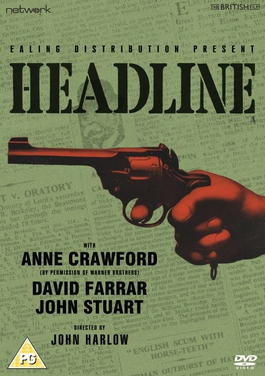
Director John Harlow’s 1944 British black and white thriller film Headline is based on the 1933 novel Reporter! by Ken Attiwill, and stars David Farrar, Anne Crawford, John Stuart, Antoinette Cellier, and William Hartnell.
The 1944 British crime thriller film Headline stars David Farrar as newspaper crime reporter who investigates a murder intimately witnessed by the wife of his boss.
David Farrar stars as British newspaper crime reporter ‘Brookie’ Brooks is instructed by his editor L B Ellington (John Stuart) to cover the story of a man who has shot dead a woman in a London flat. Brooks finds out that the man is Paul Grayson, who goes on the run. Then Brooks searches for the mystery woman who was in Paul Grayson’s flat at the time of the murder. It turns out she is Ellington’s wife, and she is now being blackmailed by Grayson.
Headline is a charming relic of a bygone age, with lots of creaky, rough edges, but even more sweet and lovely items. It’s not often you want to start by applauding a film’s production qualities, especially those of a independent wartime British thriller film are quite remarkable.
High on the list of good things are the super sets designed by the art director James Carter, which include the News Theatre at London’s Victoria Station and the combined street, flat and pub set. Next on on the list of good things are David Farrar and Anne Crawford as his newspaper office girl Friday and love interest Anne, who do really rather well as the main stars, keeping things going nicely, sprightly and vivacious. Also on the plus side are William Hartnell as chirpy rival newsman Dell, Richard Goolden as the eccentric clue solver Arthur Jones, Merle Tottenham as gossipy eternal movie maid Mrs Deans, Joss Ambler as the Chief Sub-Editor, and Elsie Wagstaff as Mrs Daly.
The script has its weakness and problems, but the story is solid, and the dialogue is amusing. The film risks taking a dark story of murder and blackmail mostly quite lightly, Hitchcock style. This means there is quite a lot of comedy, much of it clumsy and unwelcome, though even so the performers put it across gracefully. The serious basis of the story, based on the 1933 novel Reporter! by Ken Attiwill, is far more entertaining. And there is enough serious intent to rivet the attention in the screenplay written by Maisie Sharman (screenplay) and Ralph Gilbert Bettison (adaptation).
John Harlow was adept in delivering crime thriller genre potboilers, and this is a good one. He controls the pace, tension, suspense effectively, attending carefully to the newspaper office atmosphere and railway atmosphere, both of which now have period charm. The scenes in the pub, the News Theatre and on the train have the Hitchcock touch. And the climactic fight between the reporter and the killer on the fast-moving train is both suspenseful and thrilling. There’s even a little irony and subtlety in the conclusion.
It was shot at the Riverside Studios in Hammersmith, West London.
Running time: 75 minutes.
Release date: 24 January 1944.
© Derek Winnert 2026 – Classic Movie Review 13,987
Check out more reviews on http://derekwinnert.com

Recent articles
- Headline *** (1944, David Farrar, Anne Crawford, Merle Tottenham, John Stuart, Antoinette Cellier, William Hartnell) – Classic Movie Review 13,98725 Jul 2026
- The Snake Woman * (1961, Susan Travers, John McCarthy, Geoffrey Denton, Elsie Wagstaff, Arnold Marlé, John Cazabon) – Classic Movie Review 13,98624 Jul 2026
- Johnny One-Eye **½ (1950, Pat O’Brien, Wayne Morris, Dolores Moran) – Classic Movie Review 13,98523 Jul 2026
- Crosstrap * (1962, Laurence Payne, Jill Adams, Zena Marshall, Gary Cockrell) – Classic Movie Review 13,98422 Jul 2026
- Leprechaun * (1993, Warwick Davis, Jennifer Aniston, Ken Olandt, Mark Holton, Robert Gorman) – Classic Movie Review 13,98321 Jul 2026
Recent comments
- The President’s Lady ** (1953, Charlton Heston, Susan Hayward, John McIntire, Fay Bainter) – Classic Movie Review 13,846 | Derek Winnert on The Buccaneer *** (1958, Yul Brynner, Claire Bloom, Charles Boyer, Inger Stevens, Henry Hull, Charlton Heston) – Classic Movie Review 13,844
- Straight Up *** (2019, James Sweeney, Katie Findlay, Dana Drori, James Scully, Tracie Thoms, Betsy Brandt, Randall Park) – Classic Movie Review 13,839 | Derek Winnert on Twinless **** (2025, Dylan O'Brien, James Sweeney, Aisling Franciosi) – Classic Movie Review 13,838
- Phantom Killer ** (1942, Dick Purcell, Joan Woodbury, John Hamilton, Warren Hymer) – Classic Movie Review 13,837 | Derek Winnert on The Sphinx ** (1933, Lionel Atwill, Sheila Terry, Theodore Newton) – Classic Movie Review 13,836
- Detour ***** (1945, Tom Neal, Ann Savage, Claudia Drake, Edmund MacDonald) – Classic Movie Review 1,547 | Derek Winnert on The Last Crooked Mile *** (1946, Don Barry, Ann Savage, Adele Mara, Tom Powers, Sheldon Leonard, Nestor Paiva) – Classic Movie Review 13,834
- Big ***** (1989, Tom Hanks, John Heard, Jared Rushton, Robert Loggia, David Moscow, Mercedes Ruehl, Jon Lovitz, Josh Clark, Kimberlee M Davis, Elizabeth Perkins) – Classic Movie Review 287 | Derek Winnert on 18 Again! *** (1988, George Burns, Charlie Schlatter, Tony Roberts, Anita Morris, Red Buttons, Pauly Shore) – Classic Movie Review 13,815