
The Leopard Man **** (1943, Dennis O’Keefe, Margo, Jean Brooks) – Classic Movie Review 3,761
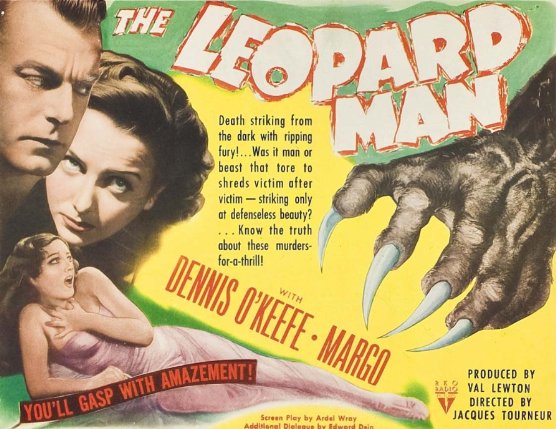
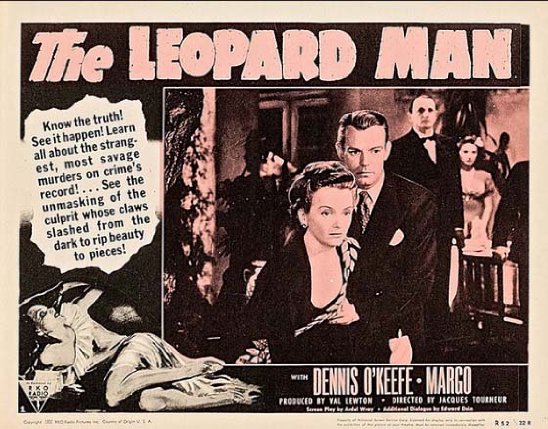
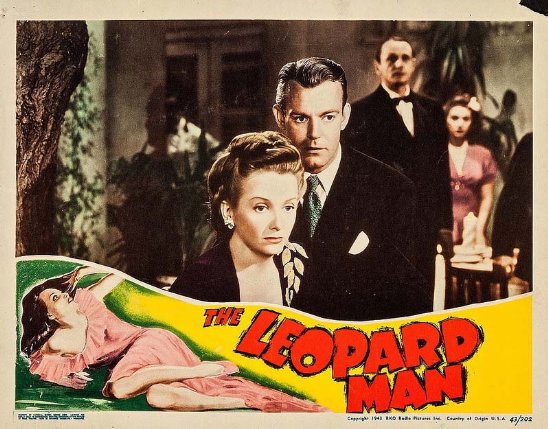
Dennis O’Keefe and Margo investigate when an escaped leopard and a serial killer are terrorising the villagers in New Mexico, in Jacques Tourneur’s brilliant 1943 film noir horror thriller The Leopard Man.
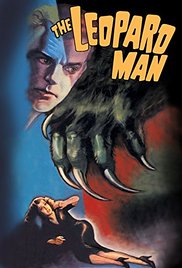
Director Jacques Tourneur’s brilliant 1943 film noir horror thriller The Leopard Man, made for producer Val Lewton, boasts a marvellously eerie atmosphere thanks to Tourneur’s skills and Robert De Grasse’s beautiful and evocative camerawork. And the music by Roy Webb and Constantin Bakaleinikoff (musical director), and the production designs by Albert S D’Agostino and Walter E Keller add enormously to the creepy mood.
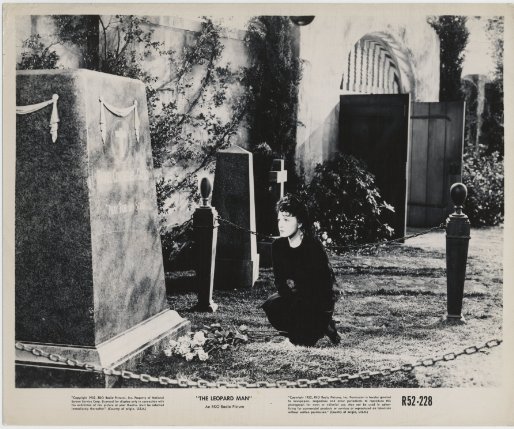
Ardel Wray and Edward Dean’s screenplay is based on the 1942 novel Black Alibi by Cornell Woolrich (The Bride Wore Black, Phantom Lady, The Window, Rear Window). In the story, an escaped leopard and a serial killer are terrorising the local villagers in a border town in New Mexico.
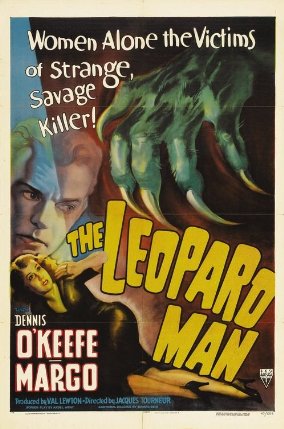
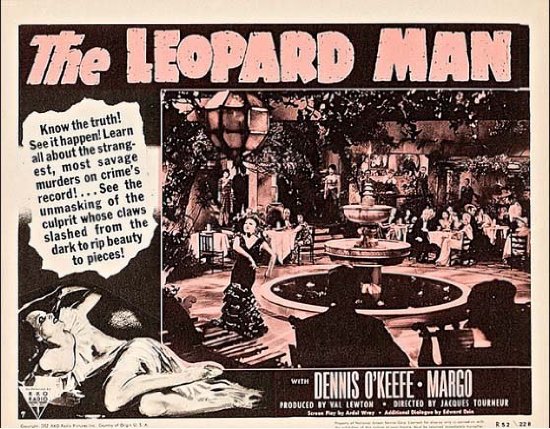
Jean Brooks plays Kiki Walker, a nightclub singer who used the leashed black leopard in her act at the behest of the club promoter PR publicity man Jerry Manning (Dennis O’Keefe), before her jealous rival Clo-Clo (Margo) terrified it off with her castanets. Then, locals in the vicinity are attacked and killed thereafter. But is it actually the escaped leopard that is doing the dirty deeds?
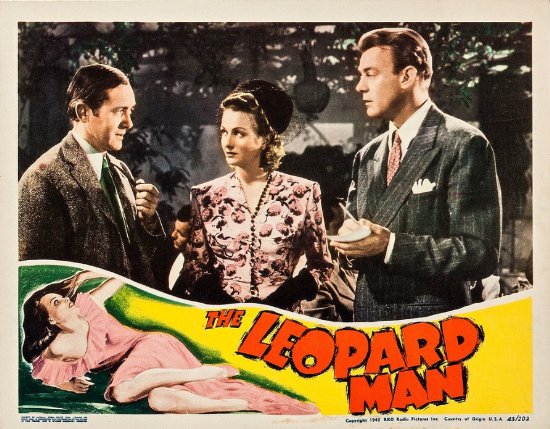
Kiki and Jerry start to think the leopard may not be responsible for the wave of killings after all, so Jerry and Clo-Clo (Margo) set out to investigate. After talking to local museum director Dr Galbraith (James Bell), Jerry starts to be convinced that it is a serial killer at work. Jerry has rented the leopard from travelling showman Charlie (Abner Biberman), who begins to think he might be responsible, killing after getting drunk and blacking out.
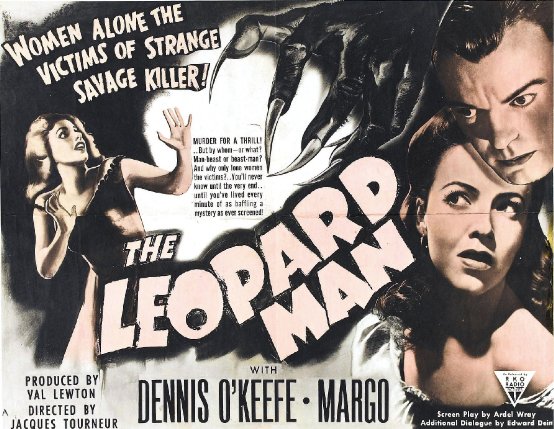
Jacques Tourneur said he didn’t like the film: ‘It was too exotic, it was neither fish nor fowl: a series of vignettes, and it didn’t hold together. There were some startling things in that story. But there were too many bad scenes, and even though we used an effective Mexican birthday song, the overall effect was spotty, uneven.’
Maybe he is right, there are several weak scenes and it doesn’t quite hold together. But there are many startling, exciting things in this splendidly exotic film, especially visually but also in its ideas and in its shock moments, and The Leopard Man is now considered a cult classic, included, if extravagantly, in many lists as one of the greatest horror films ever made. Crucially, it is notable as one of the first American films to attempt a realistic portrayal of a serial killer (even before the term was coined) and to explain the phenomenon.
Dennis O’Keefe is a sturdy hero, Margo is plenty exotic as ‘Clo-Clo’, Jean Brooks entertains as Kiki Walker, Isabel Jewell amuses as the doomy fortune teller Maria, and Abner Biberman and James Bell create memorable characters as Charlie and Dr Galbraith.
Though the score by Roy Webb plays a major role in the film’s success, Jacques Tourneur is happy to have long passages on the film without music, just natural sounds. This is very effective. The main triumph, though, is Robert De Grasse’s cinematography and Albert S D’Agostino and Walter E Keller’s set designs, all magnificently unreal, an imaginary, dream-like border town in New Mexico created in the RKO studio, where the cameras can prowl silently along with the serial killer.
Also in the cast are Isabel Jewell as the fortune teller Maria, James Bell as Dr Galbraith, Ben Bard as the Police Chief Roblos, Margaret Landry, Abner Biberman, Tuulikki Paananen [Tula Parma], Fely Franquelli, Ariel Heath, Richard Martin, Robert Anderson, Jacqueline deWit, John Dilson, Joe Dominguez, Elison Gamboa, William Halligan, Rose Higgins, Brandon Hurst, Kate Drain Lawson, Jacques Lory, Mary MacLaren, Ottola Nesmith, Tom Orosco, Rene Pedrini, John Piffle, Betty Roadman, George Sherwood, Bobby Spinola, Marguerita Sylva, John Trosa, Riota Varella and Russell Wade.
Short on friends to dedicate his novels to, Woolrich dedicated The Bride Wore Black to his Remington Portable typewriter.
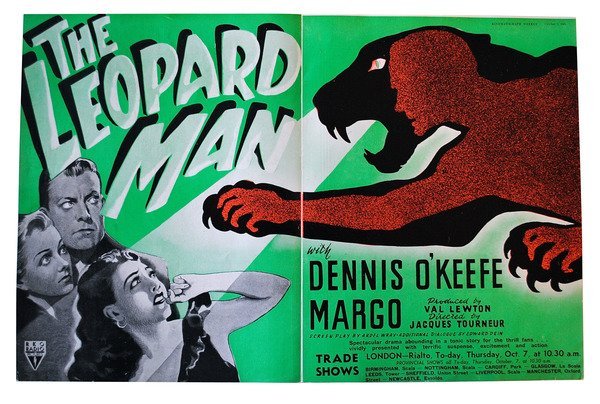
The Leopard Man is directed by Jacques Tourneur, runs 66 minutes, is made and released by RKO Radio Pictures, is written by Ardel Wray and Edward Dean, based on the novel Black Alibi by Cornell Woolrich, is shot in black and white by Robert De Grasse, is produced by Val Lewton, is scored by Roy Webb and Constantin Bakaleinikoff (musical director), and is designed by Albert S D’Agostino and Walter E Keller.
It was shot from February 9, 1943 to March 8, 1943, on a budget of $150,000.
Release date: May 8, 1943.
The cast
The cast are Dennis O’Keefe as Jerry Manning, Margo as Gabriella ‘Clo-Clo’, Jean Brooks as Kiki Walker, Isabel Jewell as the fortune teller Maria, Marguerite Sylva as Marta, Margaret Landry as Terésa Delgado, Abner Biberman as Charlie, James Bell as Dr Galbraith, Tuulikki Paananen [Tula Parma] as Consuelo Contreras, Richard Martin as Raoul Belmonte, Fely Franquelli as Rosita Contreras, Ariel Heath as Eloise, Ben Bard as the Police Chief Roblos, Margaret Landry, Abner Biberman as Charlie, Fely Franquelli, Ariel Heath, Robert Anderson, Jacqueline deWit, John Dilson, Joe Dominguez, Elison Gamboa, William Halligan, Rose Higgins, Brandon Hurst, Kate Drain Lawson, Jacques Lory, Mary MacLaren, Ottola Nesmith, Tom Orosco, Rene Pedrini, John Piffle, Betty Roadman, George Sherwood, Bobby Spinola, Marguerita Sylva, John Trosa, Riota Varella and Russell Wade.
© Derek Winnert 2016 Classic Movie Review 3,761
Check out more reviews on http://derekwinnert.com

Recent articles
- House of Boys *** (2009, Layke Anderson, Benn Northover, Udo Kier, Stephen Fry, Steven Webb) – Classic Movie Review 14,02301 Sep 2026
- Dry Wind [Vento Seco] ** (2020, Leandro Faria Lelo, Allan Jacinto Santana, Renata Carvalho, Rafael Teóphilo) – Classic Movie Review 14,02201 Sep 2026
- Black Patch *** (1957, George Montgomery, Diane Brewster, Tom Pittman, Leo Gordon, Sebastian Cabot, Lynn Cartwright) – Classic Movie Review 14,02131 Aug 2026
- Sorry Angel [Plaire, aimer et courir vite] ****(Pierre Deladonchamps, Vincent Lacoste, Denis Podalydès, Thomas Gonzalez, 2018) – Classic Movie Review 14,02030 Aug 2026
- Date with Disaster *** (1957, Tom Drake, William Hartnell, Shirley Eaton, Maurice Kaufmann, Michael Golden, Richard Shaw) – Classic Movie Review 14,01929 Aug 2026
Recent comments
- The President’s Lady ** (1953, Charlton Heston, Susan Hayward, John McIntire, Fay Bainter) – Classic Movie Review 13,846 | Derek Winnert on The Buccaneer *** (1958, Yul Brynner, Claire Bloom, Charles Boyer, Inger Stevens, Henry Hull, Charlton Heston) – Classic Movie Review 13,844
- Straight Up *** (2019, James Sweeney, Katie Findlay, Dana Drori, James Scully, Tracie Thoms, Betsy Brandt, Randall Park) – Classic Movie Review 13,839 | Derek Winnert on Twinless **** (2025, Dylan O'Brien, James Sweeney, Aisling Franciosi) – Classic Movie Review 13,838
- Phantom Killer ** (1942, Dick Purcell, Joan Woodbury, John Hamilton, Warren Hymer) – Classic Movie Review 13,837 | Derek Winnert on The Sphinx ** (1933, Lionel Atwill, Sheila Terry, Theodore Newton) – Classic Movie Review 13,836
- Detour ***** (1945, Tom Neal, Ann Savage, Claudia Drake, Edmund MacDonald) – Classic Movie Review 1,547 | Derek Winnert on The Last Crooked Mile *** (1946, Don Barry, Ann Savage, Adele Mara, Tom Powers, Sheldon Leonard, Nestor Paiva) – Classic Movie Review 13,834
- Big ***** (1989, Tom Hanks, John Heard, Jared Rushton, Robert Loggia, David Moscow, Mercedes Ruehl, Jon Lovitz, Josh Clark, Kimberlee M Davis, Elizabeth Perkins) – Classic Movie Review 287 | Derek Winnert on 18 Again! *** (1988, George Burns, Charlie Schlatter, Tony Roberts, Anita Morris, Red Buttons, Pauly Shore) – Classic Movie Review 13,815