
Ivy *** (1947, Joan Fontaine, Herbert Marshall, Patric Knowles, Richard Ney, Cedric Hardwicke, Lucile Watson, Sara Allgood, Henry Stephenson, Una O’Connor) – Classic Movie Review 12,345
The devilishly devious 1947 thriller film Ivy stars Joan Fontaine as ruthless Ivy, who plots to get rid of both her husband (Richard Ney) and her lover (Patric Knowles) to marry a rich old man (Herbert Marshall).
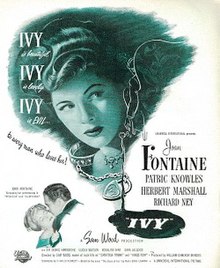
‘IVY… Pity the men in her life!.
Director Sam Wood’s devilishly devious 1947 Universal Pictures black and white thriller film Ivy is based on Marie Belloc Lowndes’s 1927 novel The Story of Ivy, and stars Joan Fontaine, Herbert Marshall, Patric Knowles, Richard Ney, Cedric Hardwicke, Lucile Watson, Sara Allgood, Henry Stephenson, and Una O’Connor.
Set in Edwardian England, in 1909, it is an American crime film noir mystery melodrama whose look is everything, and luckily it is designed up to the nines by its producer, the art director William Cameron Menzies, and its set designer Richard H Riedel, whose sets are photographed lovingly by Russell Metty. Joan Fontaine is done up to up to the nines too in gowns designed by Orry-Kelly.
William Cameron Menzies designed the production and storyboarded all the shots. He was the art director on Rebecca, by the way, which starred Joan Fontaine.
Entertaining, and striking looking though Ivy is, and it is, script writer Charles Bennett does surprisingly little with Marie Belloc Lowndes’s novel considering he was Alfred Hitchcock’s collaborator on Blackmail and The 39 Steps.
Joan Fontaine stars as greedy, ruthless Ivy Lexton, who wants to get rid of both her husband Jervis (Richard Ney), a man with poor prospects, and her infatuated lover Dr Roger Gretorex (Patric Knowles), in order to marry rich old Miles Rushworth (Herbert Marshall). The trouble is that Rushworth shows no interest in her because Ivy is already married, but she has a simple solution, well more of a complex solution…
Main star Fontaine is rock solid in the star role, and good value, but it’s Cedric Hardwicke as Inspector Orpington, Lucile Watson as Knowles’s mom Mrs Gretorex, and Una O’Connor as fortune-telling Mrs Matilda Thrawn that help most among a fine cast of exuberant stalwart players.
Ivy pays the wide-eyed fortune teller Mrs Thrawn one guinea and gets interesting news. Una O’Connor is very amusing. She is also of course fondly remembered for Bride of Frankenstein (1935), The Invisible Man (1933) and Witness for the Prosecution (1957),
Joan Fontaine’s real-life mother Lillian Fontaine plays Lady Flora. It is the first of two films in which Lillian Fontaine appears with her daughter Joan Fontaine, followed by the 1953 The Bigamist.
The song ‘Ivy’, written to promote the film by Hoagy Carmichael but not used on the soundtrack, is now a jazz standard.
It was shot from November 1946 to February 1947 at Universal Studios, California.
It premiered on 26 June 1947 in New York City.
After all the good, painstaking work, the film lost money for Universal, despite Joan Fontaine’s popularity at the time, having won an Oscar for Suspicion (1941). the only actress to have won an Oscar for acting in a Hitchcock film. She and her sister Olivia are the only siblings to win lead-acting Academy Awards.
It runs 99 minutes.
The film was adapted in 1951 for radio on NBC’s Screen Directors’ Playhouse, with Fontaine reprising her role.
Sam Wood
It is made by Sam Wood Productions. Sam Wood is remembered as director of A Night at the Opera, A Day at the Races, Goodbye, Mr Chips, The Pride of the Yankees, For Whom the Bell Tolls, Kings Row (1942) and Ivy (1947).
But there is something else he is remembered for. Sam Wood became an ardent Anti-Communist in the late 1940s. In 1944, he founded, and was first president of, the Motion Picture Alliance for the Preservation of American Ideals, ‘dedicated to seeking out and expelling those people it considered traitorous to American interests.’ It lobbied the House Un-American Activities Committee to examine alleged Communists in the movie industry. Wood kept a black notebook, noting those he considered subversive. He had a fatal heart attack after a 1949 Motion Picture Alliance meeting when he ranted over a liberal screenwriter suing the group for slandering him.
The cast
The cast are Joan Fontaine as Ivy Lexton, Patric Knowles as Roger Gretorex, Herbert Marshall as Miles Rushworth, Richard Ney as Jervis Lexton, Cedric Hardwicke as Inspector Orpington, Lucile Watson as Mrs Gretorex, Sara Allgood as Martha Huntley, Henry Stephenson as Judge, Rosalind Ivan as Emily, Lillian Fontaine as Lady Flora, Molly Lamont as Bella Crail, Una O’Connor as Mrs Matilda Thrawn, Isobel Elsom as Miss Chattle, Alan Napier as Sir Jonathan Wright, Paul Cavanagh as Doctor Berwick, Lumsden Hare as Doctor Lanchester, Norma Varden as Joan Rodney, C Montague Shaw as Stevens, Matthew Boulton, James Fairfax, Bess Flowers, Mary Forbes, Holmes Herbert, Lee Lenoir, James Logan, Charles Mendl, Gavin Muir, Wyndham Standing, David Thursby, Eric Wilton, Judith Woodbury, Clive Morgan, Harry Hays Morgan, Art Foster, Gerald Hamer, Jean Fenwick, Manuel Paris and Elsa Peterson.
Marie Belloc Lowndes
Four works of Marie Belloc Lowndes are adapted for the screen: The Chink in the Armour (published 1912; adapted for the screen 1922), The Lodger (1913; adapted several times), Letty Lynton (1931; adapted in 1932 as Letty Lynton starring Joan Crawford), and The Story of Ivy (1927; adapted into the 1947 film Ivy starring Joan Fontaine).
Her most famous novel, The Lodger (1913), is based on the Jack the Ripper murders of 1888,
The Lodger was filmed in 1927 by Alfred Hitchcock as The Lodger, and it was adapted again in 1932 as The Lodger, and in 1944 as The Lodger, and again as Man in the Attic (1953).
© Derek Winnert 2022 Classic Movie Review 12,345
Check out more reviews on http://derekwinnert.com

Recent articles
- Three Days to Live [Trois jours à vivre] ** (1957, Daniel Gélin, Jeanne Moreau, Lino Ventura, Georges Flamant) – Classic Movie Review 14,02503 Sep 2026
- Le cave se rebiffe [The Counterfeiters] [The Counterfeiters of Paris] **** (1961, Jean Gabin, Bernard Blier, Martine Carol, Franck Villard, Maurice Biraud, Françoise Rosay) – Classic Movie Review 14,02402 Sep 2026
- House of Boys *** (2009, Layke Anderson, Benn Northover, Udo Kier, Stephen Fry, Steven Webb) – Classic Movie Review 14,02301 Sep 2026
- Dry Wind [Vento Seco] ** (2020, Leandro Faria Lelo, Allan Jacinto Santana, Renata Carvalho, Rafael Teóphilo) – Classic Movie Review 14,02201 Sep 2026
- Black Patch *** (1957, George Montgomery, Diane Brewster, Tom Pittman, Leo Gordon, Sebastian Cabot, Lynn Cartwright) – Classic Movie Review 14,02131 Aug 2026
Recent comments
- The President’s Lady ** (1953, Charlton Heston, Susan Hayward, John McIntire, Fay Bainter) – Classic Movie Review 13,846 | Derek Winnert on The Buccaneer *** (1958, Yul Brynner, Claire Bloom, Charles Boyer, Inger Stevens, Henry Hull, Charlton Heston) – Classic Movie Review 13,844
- Straight Up *** (2019, James Sweeney, Katie Findlay, Dana Drori, James Scully, Tracie Thoms, Betsy Brandt, Randall Park) – Classic Movie Review 13,839 | Derek Winnert on Twinless **** (2025, Dylan O'Brien, James Sweeney, Aisling Franciosi) – Classic Movie Review 13,838
- Phantom Killer ** (1942, Dick Purcell, Joan Woodbury, John Hamilton, Warren Hymer) – Classic Movie Review 13,837 | Derek Winnert on The Sphinx ** (1933, Lionel Atwill, Sheila Terry, Theodore Newton) – Classic Movie Review 13,836
- Detour ***** (1945, Tom Neal, Ann Savage, Claudia Drake, Edmund MacDonald) – Classic Movie Review 1,547 | Derek Winnert on The Last Crooked Mile *** (1946, Don Barry, Ann Savage, Adele Mara, Tom Powers, Sheldon Leonard, Nestor Paiva) – Classic Movie Review 13,834
- Big ***** (1989, Tom Hanks, John Heard, Jared Rushton, Robert Loggia, David Moscow, Mercedes Ruehl, Jon Lovitz, Josh Clark, Kimberlee M Davis, Elizabeth Perkins) – Classic Movie Review 287 | Derek Winnert on 18 Again! *** (1988, George Burns, Charlie Schlatter, Tony Roberts, Anita Morris, Red Buttons, Pauly Shore) – Classic Movie Review 13,815