
Our Very Own ** (1950, Ann Blyth, Farley Granger, Joan Evans, Jane Wyatt, Ann Dvorak, Donald Cook, Natalie Wood) – Classic Movie Review 8,783
The good-hearted, sentimental 1950 drama film Our Very Own is lovingly crafted but largely wastes the talents of Ann Blyth, Farley Granger and a 12-year-old Natalie Wood.
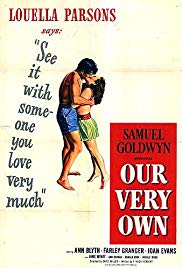
Director David Miller’s good-hearted, sentimental American drama film 1950 Our Very Own is lovingly crafted but largely wastes the talents of Ann Blyth, Farley Granger and a 12-year-old Natalie Wood.
Blyth goes through the motions as Gail Macaulay, a teenager who discovers that she has been adopted and therefore thinks that she is not her adoptive mother Jane Wyatt’s very own. Worse still, young Blyth finds her real mother Mrs Lynch (Ann Dvorak) at the wrong end of town, but, happily, then finds comfort in the arms of nice, gleamingly handsome young Chuck (Granger).
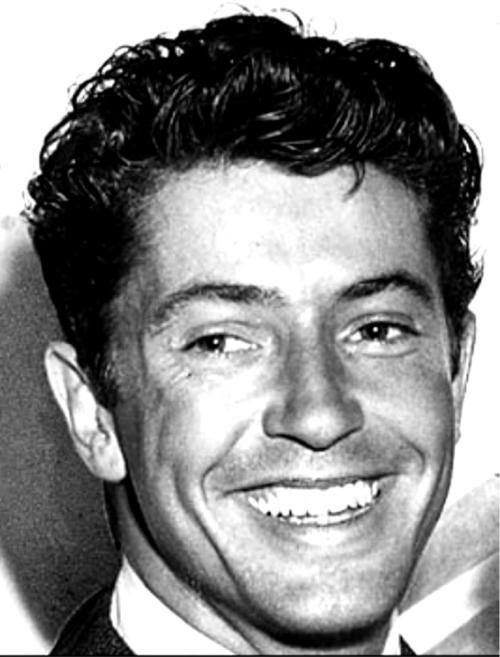
Farley Granger stars as the gleamingly handsome young Chuck.
Alas, this soggy saga of Middle American life did nothing for anyone’s career, but it does boast some charm, a nice 1950 period atmosphere and several appealing performances. Wood plays Blyth’s younger sister, Penny. Also in the cast are Joan Evans as Joan Macaulay, Jane Wyatt as Mrs Lois Macaulay, Donald Cook as Fred Macaulay, Martin Milner as Bert, Gus Schilling, Phyllis Kirk as Zaza, Jessica Grayson (in her final film) as Violet, Rita Hamilton, Ray Teal as Jim Lynch and Harold Lloyd Jr.
The main problem is the too soft and over-simple family values screenplay written by F Hugh Herbert. Farley Granger recalled the screenplay as ‘pointless and meandering’ and thought the director David Miller was ‘a perfectly nice man but no help to anybody’.
Jane Wyatt disliked her role as an advice-dispensing mother, until she was cast a few years later in the hit TV series Father Knows Best as a direct result of her performance in Our Very Own.
Universal lent Ann Blyth to Samuel Goldwyn Productions.
Release date: July 27, 1950.
It fared quite well at the box office, taking $2,050,000 in US rentals.
Our Very Own is directed by David Miller, runs 93 minutes, is made by The Samuel Goldwyn Company [Samuel Goldwyn Productions], is released by RKO Radio Pictures (1950), is written by F Hugh Herbert, is shot in black and white by Lee Garmes, is produced by Samuel Goldwyn, is scored by Victor Young, and is designed by Richard Day.
Ann Blyth (born Anne Marie Blythe on 16 August 1928)
© Derek Winnert 2019 Classic Movie Review 8,783
Check out more reviews on http://derekwinnert.com

Recent articles
- Black Patch *** (1957, George Montgomery, Diane Brewster, Tom Pittman, Leo Gordon, Sebastian Cabot, Lynn Cartwright) – Classic Movie Review 14,02131 Aug 2026
- Sorry Angel [Plaire, aimer et courir vite] ****(Pierre Deladonchamps, Vincent Lacoste, Denis Podalydès, Thomas Gonzalez, 2018) – Classic Movie Review 14,02030 Aug 2026
- Date with Disaster *** (1957, Tom Drake, William Hartnell, Shirley Eaton, Maurice Kaufmann, Michael Golden, Richard Shaw) – Classic Movie Review 14,01929 Aug 2026
- Travis Mc Gee *** (1983, Sam Elliott, Richard Farnsworth, Gene Evans, Barry Corbin, Geoffrey Lewis, Amy Madigan, Vera Miles, Katharine Ross, Marshall R Teague) – Classic Movie Review 14,01825 Aug 2026
- Tethered Wings [Les ailes collées] *** (2025, Roby Schinasi, Jérémy Kapone, Émilie Caen, Max Libert, Alexis Rosenstiehl) – Classic Movie Review 14,01723 Aug 2026
Recent comments
- The President’s Lady ** (1953, Charlton Heston, Susan Hayward, John McIntire, Fay Bainter) – Classic Movie Review 13,846 | Derek Winnert on The Buccaneer *** (1958, Yul Brynner, Claire Bloom, Charles Boyer, Inger Stevens, Henry Hull, Charlton Heston) – Classic Movie Review 13,844
- Straight Up *** (2019, James Sweeney, Katie Findlay, Dana Drori, James Scully, Tracie Thoms, Betsy Brandt, Randall Park) – Classic Movie Review 13,839 | Derek Winnert on Twinless **** (2025, Dylan O'Brien, James Sweeney, Aisling Franciosi) – Classic Movie Review 13,838
- Phantom Killer ** (1942, Dick Purcell, Joan Woodbury, John Hamilton, Warren Hymer) – Classic Movie Review 13,837 | Derek Winnert on The Sphinx ** (1933, Lionel Atwill, Sheila Terry, Theodore Newton) – Classic Movie Review 13,836
- Detour ***** (1945, Tom Neal, Ann Savage, Claudia Drake, Edmund MacDonald) – Classic Movie Review 1,547 | Derek Winnert on The Last Crooked Mile *** (1946, Don Barry, Ann Savage, Adele Mara, Tom Powers, Sheldon Leonard, Nestor Paiva) – Classic Movie Review 13,834
- Big ***** (1989, Tom Hanks, John Heard, Jared Rushton, Robert Loggia, David Moscow, Mercedes Ruehl, Jon Lovitz, Josh Clark, Kimberlee M Davis, Elizabeth Perkins) – Classic Movie Review 287 | Derek Winnert on 18 Again! *** (1988, George Burns, Charlie Schlatter, Tony Roberts, Anita Morris, Red Buttons, Pauly Shore) – Classic Movie Review 13,815