
Times Have Been Better [Le ciel sur la tête] *** (2006, Arnaud Binard, Bernard Le Coq, Charlotte de Turckheim, Olivier Guéritée) – Classic Movie Review 13,943
Arnaud Binard stars as a gay 30ish banker Jérémy who decides to come out his shocked, prejudiced parents (Bernard Le Coq and Charlotte de Turckheim), in the 2006 French comedy drama film Times Have Been Better.
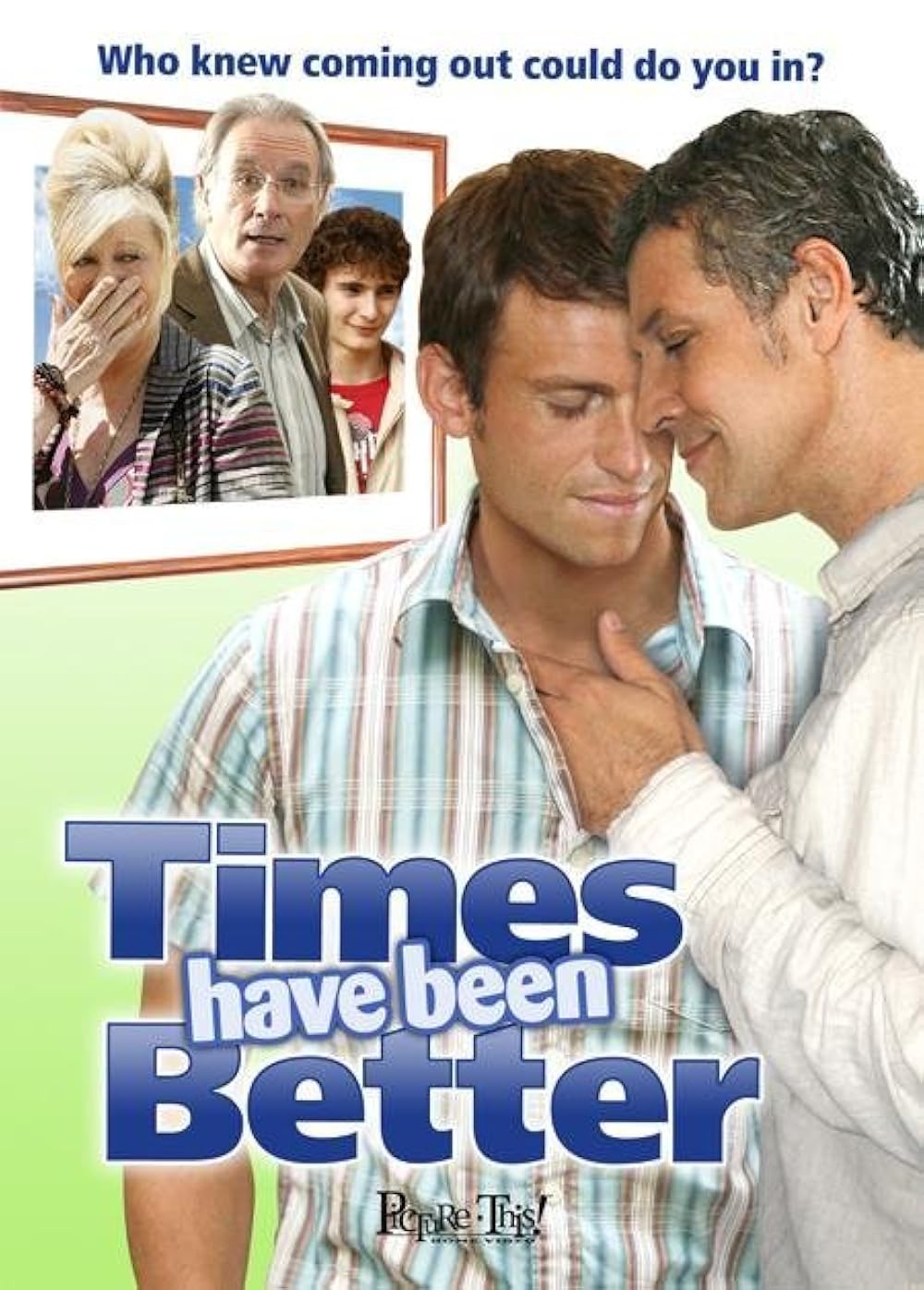
After moving in with his male lover in Paris, gay early-30ish banker Jérémy (Arnaud Binard) decides to visit his unsuspecting parents, Guy (Bernard Le Coq) and Rosine (Charlotte de Turckheim) in their countryside home where he grew up, and tell them that he’s gay. He leaves it till the very last moment of his visit, then swiftly clears off back to Paris.
Though the bourgeois couple are left wing and have always seen themselves as enlightened, the news staggers Guy and Rosine — who are determined to get to the root of Jérémy’s homosexuality. The problems, though, are all with them and their ludicrous reaction to the news. And there’s a much young brother, Robin (Olivier Guéritée), just 18, still living with his parents, who is supposed to be going to college after the lazy slacker summer, but gets offered work by a visiting film crew.
Times Have Been Better [Le ciel sur la tête] is billed as a comedy, but it has a solid serious base to build the comedy on. It’s all kind of sad, actually, very strange for a comedy. It is as perceptive as it is amusing, and it is both in plenty. It mixes farcical moments with comedic, serious and sentimental ones but, surprisingly, the main tone is serious. There might be a Cage aux Folles whiff to the set-up, but this is no Cage aux Folles French farce. In a way, it is not a gay film either. We see this story from the point of view of the straight characters.
The parents are the main characters, with most of the focus on them, and their dilemmas. Interesting to see this belated coming-out story from their point of view, and fascinating that they are the least ‘adult’, grown-up characters in the story. They’ve grown old without growing up. The father character is quite awful, the villain of the piece, the mother way too understanding and forgiving, though entirely appealing. The father’s friends and work colleagues are awful too, and the mother’s are that much better, though she has an over-weight gay boss who could help her if he wasn’t so queenie and bitchy. The three main gay characters (the two lovers and, unexpectedly, the gay boss) are wise, though not entirely appealing. We are on their side.
Are there sides? Maybe not. But this story isn’t that fond of straight people, or anybody much, it seems. The nicest character is the young son, Robin (Olivier Guéritée), still working things out. The next nicest character is the mother, long past the age of ever going to be to work things out. We wish them well.
It has a very French take on this ‘coming out could do you in’ story, but then it’s a French film with French characters, sometimes tiresome, sometimes pretentious, but mostly appealing. Are they, really?
Whether intentionally or not, the film sells the French lifestyle, both the countryside life of the parents and the Paris life of the gays. Wish you were here? Yes for the lifestyle, no for the mess people seem to be making of their bourgeois lives. It could all be so simple. They are making a ridiculous mountain out of a simple little molehill, but, if they weren’t, there would be a film, would there? Also prejudice runs deep. It’s still there at the end of the film.
[Spoiler alert] There is the chilliest of endings. The awful, prejudiced father stays awful and prejudiced, and the mother decides to stay with him in a loveless marriage, as the sons decide to move on. Even though they came together to give birth to us, parents ultimately aren’t our responsibility. We have our own lives to lead, our own happiness to try to find. The mother has her chance to break free but she hasn’t got what it takes to take it. The father can’t change. They walk off hand in hand as the kids walk off.
Olivier Guéritée, Stéphane Boucher, Thierry Desroses, Pierre Deny and Chantal Ravalec also star.
It is written by Nicolas Mercier, and directed by Régis Musset.
The film was screened at LGBT film festivals beginning in 2006, and won the award for Best Foreign Narrative Feature at the 2007 New York Lesbian and Gay Film Festival. In France, it premiered on TV on France 2 in April 2007 and was shown again in 2010.
Running time: 93 minutes.
Cert: PG.
Release date: 24 October 2006.
© Derek Winnert 2026 – Classic Movie Review 13,943
Check out more reviews on http://derekwinnert.com


Recent articles
- Darker than Amber **½ (1970, Rod Taylor, Suzy Kendall, Theodore Bikel, William Smith, Ahna Capri, James Booth, Jane Russell, Janet MacLachlan) – Classic Movie Review 14,00309 Aug 2026
- Eve Knew Her Apples ** (1945, Ann Miller, William Wright, Robert B Williams) – Classic Movie Review 14,00204 Aug 2026
- Like Sheep Among Wolves [Come pecore in mezzo ai lupi] ** (2023, Isabella Ragonese, Andrea Arcangeli, Clara Ponsot, Tommaso Ragno, Carolina Michelangeli, Gennaro Di Colandrea) – Classic Movie Review 14,00104 Aug 2026
- Leviticus *** (2026, Joe Bird, Stacy Clausen, Mia Wasikowska, Tyallah Bullock, Jeremy Blewitt, Ewen Leslie) – Classic Movie Review 14,00003 Aug 2026
- My Stepmother Is an Alien *** (1988, Kim Basinger, Dan Aykroyd, Jon Lovitz, Alyson Hannigan) – Classic Movie Review 13,99903 Aug 2026
Recent comments
- The President’s Lady ** (1953, Charlton Heston, Susan Hayward, John McIntire, Fay Bainter) – Classic Movie Review 13,846 | Derek Winnert on The Buccaneer *** (1958, Yul Brynner, Claire Bloom, Charles Boyer, Inger Stevens, Henry Hull, Charlton Heston) – Classic Movie Review 13,844
- Straight Up *** (2019, James Sweeney, Katie Findlay, Dana Drori, James Scully, Tracie Thoms, Betsy Brandt, Randall Park) – Classic Movie Review 13,839 | Derek Winnert on Twinless **** (2025, Dylan O'Brien, James Sweeney, Aisling Franciosi) – Classic Movie Review 13,838
- Phantom Killer ** (1942, Dick Purcell, Joan Woodbury, John Hamilton, Warren Hymer) – Classic Movie Review 13,837 | Derek Winnert on The Sphinx ** (1933, Lionel Atwill, Sheila Terry, Theodore Newton) – Classic Movie Review 13,836
- Detour ***** (1945, Tom Neal, Ann Savage, Claudia Drake, Edmund MacDonald) – Classic Movie Review 1,547 | Derek Winnert on The Last Crooked Mile *** (1946, Don Barry, Ann Savage, Adele Mara, Tom Powers, Sheldon Leonard, Nestor Paiva) – Classic Movie Review 13,834
- Big ***** (1989, Tom Hanks, John Heard, Jared Rushton, Robert Loggia, David Moscow, Mercedes Ruehl, Jon Lovitz, Josh Clark, Kimberlee M Davis, Elizabeth Perkins) – Classic Movie Review 287 | Derek Winnert on 18 Again! *** (1988, George Burns, Charlie Schlatter, Tony Roberts, Anita Morris, Red Buttons, Pauly Shore) – Classic Movie Review 13,815