
The Tell-Tale Heart **** (1960, Laurence Payne, Adrienne Corri, Dermot Walsh) – Classic Movie Review 13,495
The 1960 British black and white second feature Victorian Gothic horror film The Tell-Tale Heart stars Laurence Payne, Adrienne Corri and Dermot Walsh in a loose adaptation of the 1843 short story by Edgar Allan Poe.
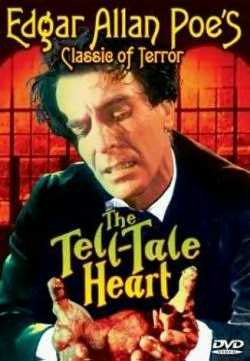
Director Ernest Morris’s 1960 British black and white second feature Victorian Gothic horror film The Tell-Tale Heart stars Laurence Payne, Adrienne Corri, and Dermot Walsh, and is a loose adaptation of the famous 1843 short story by Edgar Allan Poe. It is such a loose adaptation that they can’t be bothered to spell Poe’s name correctly at the start.
[Spoiler alert] Laurence Payne plays Edgar, who, in Rear Window fashion, spies on a new girl living across the road from him. She is the lovely Betty (Adrienne Corri), who starts a job selling flowers in a shop down the street. Edgar has a long-term best friend in Carl (Dermot Walsh), and make the fatal error of introducing him to Betty.
Edgar murders Carl (Dermot Walsh) with a poker, after he spots him canoodling with his would-be girlfriend Betty (Adrienne Corri), and puts the body under the floor, but then there are weird noises in the night.
Payne, Corri and Walsh are all ideally cast and quite tremendous in director Ernest Morris’s fascinating, well-played and suitably creepy and atmospheric 1960 British film version of the much-filmed tale by Edgar Allan Poe, The Tell-Tale Heart, with a smooth, efficient screenplay by Brian Clemens and Eldon Howard, though the plot differs very significantly from Poe’s 1843 short story, with the romantic triangle aspect to the fore, which doesn’t exist in the short story. But there is plenty of horror too, and rather well done, with a grisly murder (though not of an old man), hiding the body under the floorboards, and the thumping sound of the dead man’s beating heart all retained from the short story. Most of it is suggested, the sex and violence that is, but it feels quite graphic for its era. In any case, it makes it points impactfully, creepily, hauntingly. The murder is quite violent and Corri very provocative, suggesting passion and desire in a most un-English, un-Victorian fashion. She really wants to devour Walsh. Most un-English, eh?, but then Adrienne Corri was Adrienne Riccoboni, Scottish Italian, born and brought up in Scotland.
Payne looks spectacularly tormented and wrecked, Corri looks spectacularly lovely and alluring, and Walsh looks spectacularly shifty and dodgy. The film gives them a lot of space to do their stuff, an actor’s dream. It is Payne’s film, in a lot of almost silent film acting that works well in a Gothic chiller in a brio portrait of derangement. Corri really does look to die for, and her acting is strong. Walsh is quite alluring here too. You get why Corri falls for him, and not poor Payne.
There are three other excellent, well judged performances in support: Selma Vaz Dias as Edgar’s housekeeper Mrs Vine, John Scott as the police inspector, John Martin as the police sergeant. Actors acting not over-acting.
[Spoiler alert] There is a shock ending, turning the whole story into a nightmare, the main character’s on-going recurring life nightmare. It is very effective and satisfying. Also satisfying throughout is that the film achieves Poe’s subversive aim of portraying the main character (his unnamed narrator) in a way that allows us to identify with the him.
It is produced by the Danzigers: Edward J Danziger and Harry Lee Danziger, and economically shot at the New Elstree Studios, The Waterfront, Elstree, Hertfordshire, England. Economically shot it may be, but art directors Norman G Arnold and Peter Russell have put loving care into the Victorian backgrounds and Rene Jerrold Coke has done the same with the costumes. Payne, Corri and Walsh, comfortable in their costumes and surroundings, all look like Victorians. The location is the Rue Morgue, by the way. The score by Bill LeSage and Tony Crombie is a bit of a treat too, especially over the opening titles.
It was released in the UK in December 1960, and in the US in February 1962 as The Hidden Room of 1,000 Horrors. However, the Brigadier Films (US) print is called The Tell-Tale Heart and starts with an amusing warning to those who are squeamish or react nervously to shock. The print is currently in poor condition.
The Danzigers were making black and white feature films for around only £15,000, but this cost a significantly little more because of its period setting. They have made it look quite impressive and lavish enough on the low budget. No more money was needed, one prostitute or two, one gaslight or two, one carriage or two suggesting a whole world of them.
It is interesting that the housekeeper calls Laurence Payne’s character ‘Mr Poe’ three times at the beginning of the film, but for the rest of the film his name is Edgar Marsh.
It may recall the nightmare stories in Dead of Night (1945).
The cast
The cast are Laurence Payne as Edgar Marsh, Adrienne Corri as Betty Clare, Dermot Walsh as Carl Loomis, Selma Vaz Dias as Edgar’s housekeeper Mrs Vine, John Scott as police inspector, John Martin as police sergeant, Pamela Plant as manageress, Annette Carell as Carl’s landlady, Graham Ashley as Neston, David Lander as jeweller, Rosemary Rotheray as Jackie, Suzanne Fuller as Dorothy, Yvonne Buckingham as Mina, Richard Bennett as Mike, Elizabeth Paget as tart Elsie, Frank Thornton as barman, Joan Peart as street girl, Nada Beall as old crone, Patsy Smart as Mrs Marlow, Brian Cobby as young man, Madeline Leon as young woman, and David Courtney in bit part.
The Tell-Tale Heart is directed by Ernest Morris, runs 79 minutes, is made by Danziger Productions, is distributed by Warner-Pathé (UK) and Brigadier Films (US), is written by Brian Clemens and Eldon Howard, is shot in black and white by James Wilson [Jimmy Wilson], is produced by Edward J Danziger and Harry Lee Danziger, and is scored by Bill LeSage and Tony Crombie, and designed by Norman G Arnold and Peter Russell.
The Tell-Tale Heart
The 1843 short story by Edgar Allan Poe is told by an unnamed narrator who tries to affirm his sanity while describing his murder an old man with a filmy pale blue he lives with. He dismembers the body in the bathtub and hides it under the floorboards. But he ends up hearing a thumping sound of the dead man’s beating heart.
© Derek Winnert 2025 – Classic Movie Review 13,495
Check out more reviews on http://derekwinnert.com

Recent articles
- Frankenstein ** (2025, Oscar Isaac, Jacob Elordi, Mia Goth, Felix Kammerer, Christoph Waltz) – Classic Movie Review 13,86904 Mar 2026
- A Better Way to Die ** (2000, Andre Braugher, Scott Wiper, Lou Diamond Phillips, Natasha Henstridge, Joe Pantoliano) – Classic Movie Review 13,86804 Mar 2026
- A Better Tomorrow ***** (1986, Ti Lung, Leslie Cheung, Chow Yun-fat, Emily Chu, Waise Lee) – Classic Movie Review 13,86704 Mar 2026
- Hard Boiled **** (1992, Chow Yun-fat, Tony Leung, Teresa Mo, Philip Chan, Anthony Wong, Philip Kwok, Bowie Lam, Kwan Hoi-san) – Classic Movie Review 13,86603 Mar 2026
- Hammer the Toff *** (1952, John Bentley, Patricia Dainton, Valentine Dyall) – Classic Movie Review 13,86501 Mar 2026
Recent comments
- The President’s Lady ** (1953, Charlton Heston, Susan Hayward, John McIntire, Fay Bainter) – Classic Movie Review 13,846 | Derek Winnert on The Buccaneer *** (1958, Yul Brynner, Claire Bloom, Charles Boyer, Inger Stevens, Henry Hull, Charlton Heston) – Classic Movie Review 13,844
- Straight Up *** (2019, James Sweeney, Katie Findlay, Dana Drori, James Scully, Tracie Thoms, Betsy Brandt, Randall Park) – Classic Movie Review 13,839 | Derek Winnert on Twinless **** (2025, Dylan O'Brien, James Sweeney, Aisling Franciosi) – Classic Movie Review 13,838
- Phantom Killer ** (1942, Dick Purcell, Joan Woodbury, John Hamilton, Warren Hymer) – Classic Movie Review 13,837 | Derek Winnert on The Sphinx ** (1933, Lionel Atwill, Sheila Terry, Theodore Newton) – Classic Movie Review 13,836
- Detour ***** (1945, Tom Neal, Ann Savage, Claudia Drake, Edmund MacDonald) – Classic Movie Review 1,547 | Derek Winnert on The Last Crooked Mile *** (1946, Don Barry, Ann Savage, Adele Mara, Tom Powers, Sheldon Leonard, Nestor Paiva) – Classic Movie Review 13,834
- Big ***** (1989, Tom Hanks, John Heard, Jared Rushton, Robert Loggia, David Moscow, Mercedes Ruehl, Jon Lovitz, Josh Clark, Kimberlee M Davis, Elizabeth Perkins) – Classic Movie Review 287 | Derek Winnert on 18 Again! *** (1988, George Burns, Charlie Schlatter, Tony Roberts, Anita Morris, Red Buttons, Pauly Shore) – Classic Movie Review 13,815