
The Sleeping Cardinal [Sherlock Holmes’ Fatal Hour] **** (1931, Arthur Wontner, Ian Fleming, Norman McKinnel, Philip Hewland, Minnie Rayner, Leslie Perrins) – Classic Movie Review 4,478
The 1931 British mystery film The Sleeping Cardinal is the first in the 1931–37 crime series starring Arthur Wontner as Sherlock Holmes. A young London attaché is blackmailed by Professor Moriarty into transporting counterfeit money to Paris.
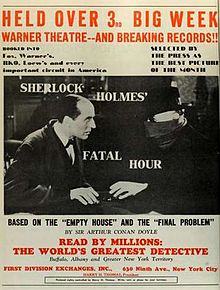
Director Leslie S Hiscott’s suspenseful 1931 British mystery thriller film The Sleeping Cardinal stars Arthur Wontner in the first of his five performances as Sherlock Holmes in a new screen story that finds the great detective on the trail of dastardly counterfeit money smugglers.
Of course it is no shock when Holmes discovers that Professor Moriarty (Norman McKinnel) is up to his old tricks, gleefully resorting to banknote forgery and murder.
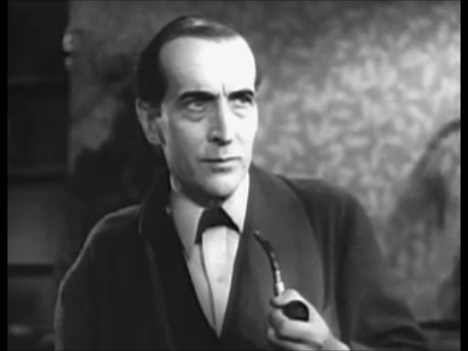
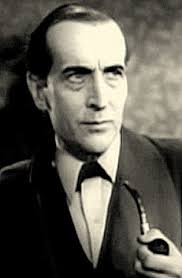
After being told for years that he looked like Arthur Conan Doyle’s creation, Wontner was finally cast as Holmes at the age of 56 and wore a toupée in the first three films to hide his bald spot and look younger, since Holmes retired at 50 in the novels.
Age apart, the ideally cast Wontner makes an excellent Holmes, serious and sombre, but with an inner twinkling sly sense of humour and of the ridiculous, and Ian Fleming a memorable, sincere-minded, plodding Dr Watson, though the movie is perhaps a rather basic production that sometimes lacks enough of the required doses of surprise and atmosphere.
Nevertheless, at other times it has plenty of surprise and atmosphere, and it is shot in some considerable style, with stark photography that is visually exciting while no doubt disguising some small, sparse and insignificant sets. The imaginative cinematography is by Sydney Blythe and William Luff, while James A Carter’s art direction also makes a lot out of a little.
Jane Welsh’s brittle performance as Adair’s worried sister Kathleen is one of its far-off time, and has faded. But McKinnel and Philip Hewland and are strong and fine as Moriarty and Inspector Lestrade (no comedy here thankfully), and Minnie Rayner is amusing as the chubby cheery Cockney housekeeper, Mrs Hudson (cue some gentle domestic comedy).
The film starts with a well-staged attempted robbery in stark black and white lighting at a London bank, where the strongroom vault is apparently unrobbed but the guard killed and a large piece of brown wrapping paper left inside. Then the scene shifts to a brother and sister who have fallen on hard times but recently fallen back on their feet.
In a notable change from Doyle’s character, London Foreign Office young diplomatic attaché Ronald Adair (Leslie Perrins) is a card cheat, who is abducted, held in a darkened room, and hears a voice from a lit-up painting of a cardinal threatening to expose him unless he joins a counterfeit money conspiracy.
At an evening of gambling at cards in their home, where the butler finds a spare ace of spades on the floor, Adair’s worried sister Kathleen (Jane Welsh) involves her friend Watson, and asks him to get Holmes to investigate. She’s worried that Adair’s cheating at high-stakes bridge, and winning too much and all the time. Soon, she’ll have something much worse to worry about.
Adair is called forcibly into what turns out to be a meeting with Moriarty and blackmailed into transporting counterfeit money in his diplomatic pouch from London to Paris. If he doesn’t agree, his career and life will be over. Moriarty has even conveniently left a gun for the purpose in an ornate box on a table.
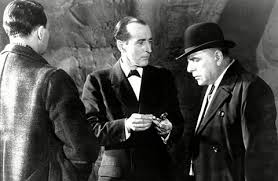
Though the screenplay by Cyril Twyford (adaptation), Leslie S Hiscott (writer) and H Fowler Mear (writer) is not based on any particular one of Conan Doyle’s Holmes stories, it draws inspiration from the 1903 short story The Empty House and the 1893 short story The Final Problem. On screen it says it is adapted from them. It says a lot that the splendidly far-fetched story is thoroughly satisfying, Like all Wontner’s films as Holmes, it has a then contemporary early Thirties setting, now looking satisfactorily vintage.
Also in the cast are Jane Walsh, Gordon Begg, William Fazan, Sidney King, Louis Goodrich, Charles Paton and Harry Terry.
The Sleeping Cardinal was a hit, so producer Julies Hagen rushed a second film into production, The Missing Rembrandt (now a lost film), reuniting Hiscott with Wontner, Fleming and Hewland, released in 1932. That was followed by The Sign of Four: Sherlock Holmes’ Greatest Case, The Triumph of Sherlock Holmes (1935) and the final film, Silver Blaze, in 1937.
All five star Wontner and Fleming, apart from The Sign of Four where Fleming was replaced by Ian Hunter, who was supposedly younger and more romantic looking to suit the story.
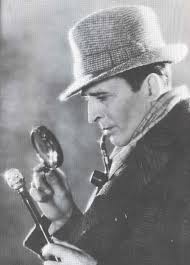
The cast are Arthur Wontner as Sherlock Holmes, Ian Fleming as Dr Watson, Philip Hewland as Inspector Lestrade, Jane Welsh as Kathleen Adair, Norman McKinnel as Professor Moriarty alias Colonel Henslowe, Minnie Rayner as Mrs Hudson, Leslie Perrins as Ronald Adair, Gordon Begg as the butler Marston, William Fazan as Thomas Fisher, Sydney King as Tony Rutherford, Louis Goodrich as Colonel Sebastian Moran,, Harry Terry as No 16, and Charles Paton as JJ Godfrey.
The Final Problem was first published in The Strand Magazine in the UK in 1893 and appears in book form as part of the collection The Memoirs of Sherlock Holmes. It introduces the criminal mastermind Professor Moriarty, and was intended to be the final Holmes story, ending with his death.
Public pressure made Conan Doyle revive Holmes. The Adventure of the Empty House is o the first Holmes story set after his supposed death at the Reichenbach Falls, as told in The Final Problem.
The Adventure of the Empty House is one of 56 Sherlock Holmes short stories written by Sir Arthur Conan Doyle, and one of 13 stories collected as The Return of Sherlock Holmes, first published in 1903.
The Wontner Sherlock Holmes series: The Sleeping Cardinal (1931), The Missing Rembrandt (1932), The Sign of Four (1932), The Triumph of Sherlock Holmes (1935), Silver Blaze (1937).
© Derek Winnert 2016 Classic Movie Review 4,478
Check out more reviews on http://derekwinnert.com

Recent articles
- Frankenstein ** (2025, Oscar Isaac, Jacob Elordi, Mia Goth, Felix Kammerer, Christoph Waltz) – Classic Movie Review 13,86904 Mar 2026
- A Better Way to Die ** (2000, Andre Braugher, Scott Wiper, Lou Diamond Phillips, Natasha Henstridge, Joe Pantoliano) – Classic Movie Review 13,86804 Mar 2026
- A Better Tomorrow ***** (1986, Ti Lung, Leslie Cheung, Chow Yun-fat, Emily Chu, Waise Lee) – Classic Movie Review 13,86704 Mar 2026
- Hard Boiled **** (1992, Chow Yun-fat, Tony Leung, Teresa Mo, Philip Chan, Anthony Wong, Philip Kwok, Bowie Lam, Kwan Hoi-san) – Classic Movie Review 13,86603 Mar 2026
- Hammer the Toff *** (1952, John Bentley, Patricia Dainton, Valentine Dyall) – Classic Movie Review 13,86501 Mar 2026
Recent comments
- The President’s Lady ** (1953, Charlton Heston, Susan Hayward, John McIntire, Fay Bainter) – Classic Movie Review 13,846 | Derek Winnert on The Buccaneer *** (1958, Yul Brynner, Claire Bloom, Charles Boyer, Inger Stevens, Henry Hull, Charlton Heston) – Classic Movie Review 13,844
- Straight Up *** (2019, James Sweeney, Katie Findlay, Dana Drori, James Scully, Tracie Thoms, Betsy Brandt, Randall Park) – Classic Movie Review 13,839 | Derek Winnert on Twinless **** (2025, Dylan O'Brien, James Sweeney, Aisling Franciosi) – Classic Movie Review 13,838
- Phantom Killer ** (1942, Dick Purcell, Joan Woodbury, John Hamilton, Warren Hymer) – Classic Movie Review 13,837 | Derek Winnert on The Sphinx ** (1933, Lionel Atwill, Sheila Terry, Theodore Newton) – Classic Movie Review 13,836
- Detour ***** (1945, Tom Neal, Ann Savage, Claudia Drake, Edmund MacDonald) – Classic Movie Review 1,547 | Derek Winnert on The Last Crooked Mile *** (1946, Don Barry, Ann Savage, Adele Mara, Tom Powers, Sheldon Leonard, Nestor Paiva) – Classic Movie Review 13,834
- Big ***** (1989, Tom Hanks, John Heard, Jared Rushton, Robert Loggia, David Moscow, Mercedes Ruehl, Jon Lovitz, Josh Clark, Kimberlee M Davis, Elizabeth Perkins) – Classic Movie Review 287 | Derek Winnert on 18 Again! *** (1988, George Burns, Charlie Schlatter, Tony Roberts, Anita Morris, Red Buttons, Pauly Shore) – Classic Movie Review 13,815