
The Sign of Four *** (1932, Arthur Wontner, Ian Hunter, Isla Bevan, Graham Soutten, Miles Malleson, Herbert Lomas) – Classic Movie Review 4,479
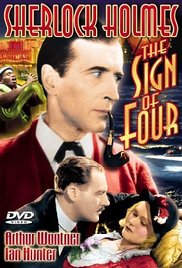
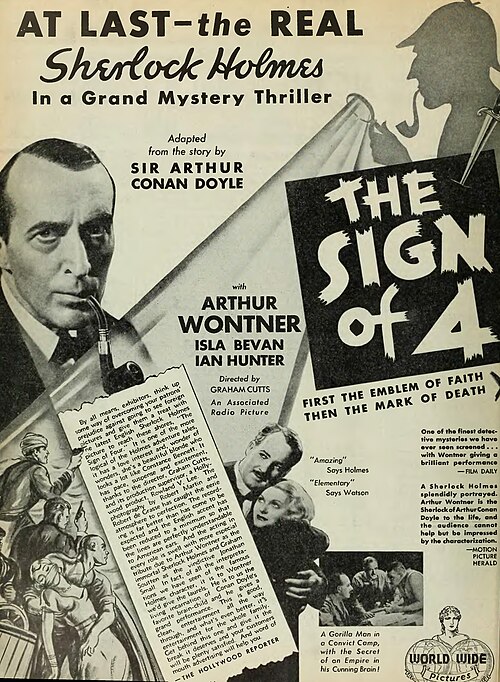
The Sign of Four (1932) is the engaging third film in the 1931–1937 British crime series starring Arthur Wontner as Sherlock Holmes, on the case of a lady in peril, a one-legged escaped killer, two murders, a string of pearls, and a stash of treasure.
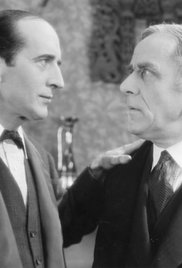
Director Graham Cutts’s 1932 British black and white mystery thriller film The Sign of Four again stars Arthur Wontner as a stirring Sherlock Holmes and Ian Hunter (replacing Ian Fleming) as a serviceable Dr Watson in a remake of a 1923 British silent movie with Eille Norwood as Holmes.
The Sign of Four showcases Wontner’s third Holmes performance after The Sleeping Cardinal, aka Sherlock Holmes’ Finest Hour (1931) and The Missing Rembrandt (now a lost film).
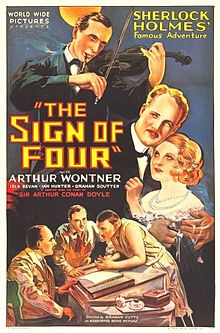
It is based on Sir Arthur Conan Doyle’s second Holmes story, one of his best tales, about a one-legged escaped prisoner (named Jonathan Small), a heavily-tattooed convict and a poisonous pygmy (called Tonga), a case that finds Watson unexpectedly falling helplessly for a young woman in peril called Mary Morstan (Isla Bevan), who is left alone with a missing father (Major John Sholto) and a mysterious string of valuable pearls, and menaced by the escaped prisoner killer seeking the lost treasure.
When Mary is kidnapped, thanks to Watson’s meddling and bungling, Holmes and Watson must join the criminal underworld to try to find and rescue her, not to mention the loot.
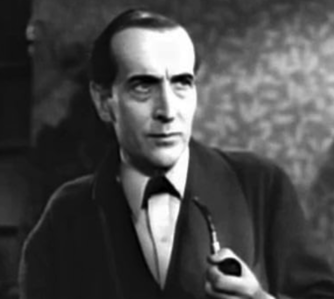
Arthur Wontner as Sherlock Holmes is so much better, classier than Ian Hunter as Dr Watson that the disparity is sometimes a bit painful. It is admirable how Wontner keeps his performance low key and conversational. The advertising claims ‘At last the real Sherlock Holmes’. Though Sherlock Holmes isn’t actually real, Wontner’s skilled performance keeps it real. Wontner’s Holmes shows his trademark mastery of disguises in a tremendous bar-room scene, serious and comic at the same time, when he beguiles and flatters the bar woman into giving him all the boating info he needs to find the escaped killer. Watson’s leering over the heroine is, er, awkward, he’s meant to be looking after her as a doctor after all.
Graham Soutten is satisfyingly menacing as the one-legged escaped killer Jonathan Small, Roy Emerton amuses as The Tattooed Man, and a youngish but still old-looking Miles Malleson is excellent as Thaddeus Sholto, bringing a bit of depth and dimension to his rather tragic, certainly misunderstood character. Isla Bevan can only faint and scream, talk posh and look lovely as the intended lady-in-peril victim Mary Morstan, but then that’s the role, Gilbert Davis struggles in a rotten role as the easily manipulated dumb Detective Inspector Atherly Jones, too stupid for words, and Clare Greet is thrown away with little to do as Mrs Hudson. Margaret Yarde hits the spot in her one nice little scene as the gossipy bar lady Mrs Smith.
[Spoiler alert] The river chase and deserted warehouse finale is well, and excitingly staged, and played out, surprisingly and effectively without music. Both Wontner and Hunter are good here. There is a satisfying wrap-up as Holmes reveals he’s got hold of the all-valuable string of pearls, Mary Morstan tells Holmes where the ‘sparklers’ are, and he hands them nonchalantly on to Inspector Jones in a case, apparently not knowing what’s inside. It’s all going so well that they have to mess it up with a coda of the besotted Watson proposing to Mary.
Some allowances, but not too many have to be made for this film’s great age, with some performances that haven’t aged well, and its obvious low budget with cramped sets and cheap production values. But, even so, the film is admirable, and a good version of Sign of Four, compressing a complex case into a compact, fast moving 75 minutes. Its rough edges are balanced with a quirky sense of humour that makes the film very appealing.
Also in the cast are Miles Malleson as Thaddeus Sholto, Herbert Lomas as Major Sholto, Roy Emerton as the Tattooed Man, Gilbert Davis as Atherly Jones, Graham Soutten as Jonathan Small, Edgar Norfolk, Clare Greet as Mrs Hudson and Kynaston Reeves as Bartholomew Sholto, with Ernest Sefton as Barrett, Margaret Yarde as Mrs Smith, Charles Farrell as funfair patron, and Moore Marriott as Mordecai Smith.
Doyle’s story is as exotic as it is complex. You don’t have to be Holmes to follow it, but it would help. Freely adapting the story, it is written by W P Lipscomb, who makes a success of unfolding the story chronologically. with the flashback scenes at the beginning, though this delays Holmes’s first entrance by 20 minutes. Lipscomb talks up Holmes’s deduction powers to an amusingly amazing level, amazing even Watson, who, to be fair is easily amazed. Hunter’s Watson is a simpleton, alas. When Watson makes a smart remark against Holmes to impress Mary, Holmes retaliates strongly, jealously. It is as amusing that Holmes can deduce that a letter has been written by a man with one leg based on handwriting alone and he can tell the source of a rope based on traces of malt on it. Yes, elementary.
Made by Associated Talking Pictures at Ealing Studios, it is also known as The Sign of Four: Sherlock Holmes’ Greatest Case, its full on-screen title. And, shock!, horror!, Holmes’s address is inexplicably moved from 221B Baker Street to 22A Baker Street.
It is in the public domain but it has been restored and released on DVD by the BFI and Studio Canal.
It was followed by The Triumph of Sherlock Holmes (1935) and the final film, Silver Blaze, in 1937.
Wontner was lured by Associated Talking Pictures from Twickenham Studios after The Sleeping Cardinal and The Missing Rembrandt and made three Sherlock Holmes film for Associated Radio Pictures.
It is remade for TV in 1968 with Peter Cushing and Nigel Stock as an episode in the BBC Sherlock Holmes series, then in 1983, with Ian Richardson donning the deerstalker as Sherlock Holmes and David Healy as Watson, and in 1987 for TV with Jeremy Brett and Edward Hardwicke, and in 2001 for TV with Matt Frewer and Kenneth Welsh.
Ian Richardson (7 April 1934 – 9 February 2007) played Sherlock Holmes in two TV movies The Sign of Four and The Hound of the Baskervilles.
Peter Cushing starred in two versions of The Hound of the Baskervilles, the 1959 Hammer version The Hound of the Baskervilles and the two-part TV episode in the BBC Sherlock Holmes series.
Wontner has a strong resemblance to Sidney Paget’s drawings of Sherlock Holmes featured in The Strand Magazine and he landed the role of Holmes thanks to his performance of Holmes imitation Sexton Blake in a 1930 stage production.
Wontner’s son was Sir Hugh Wontner, the hotelier and Lord Mayor of London.
The cast are Arthur Wontner as Sherlock Holmes, Isla Bevan as Mary Morstan, Ian Hunter as Dr John H Watson, Graham Soutten as Jonathan Small, Miles Malleson as Thaddeus Sholto, Herbert Lomas as Major John Sholto, Gilbert Davis as Detective Inspector Atherly Jones, Margaret Yarde as Mrs Smith, Roy Emerton as The Tattooed Man, Charles Farrell as Funfair Patron, Clare Greet as Mrs Hudson, Moore Marriott as Mordecai Smith, Edgar Norfolk as Captain Morstan, Kynaston Reeves as Bartholomew Sholto, Ernest Sefton as Barrett, Mr Burnhett as Tattoo Artist, and Togo as Tonga.
© Derek Winnert 2016 Classic Movie Review 4,479
Check out more reviews on http://derekwinnert.com

Recent articles
- Frankenstein ** (2025, Oscar Isaac, Jacob Elordi, Mia Goth, Felix Kammerer, Christoph Waltz) – Classic Movie Review 13,86904 Mar 2026
- A Better Way to Die ** (2000, Andre Braugher, Scott Wiper, Lou Diamond Phillips, Natasha Henstridge, Joe Pantoliano) – Classic Movie Review 13,86804 Mar 2026
- A Better Tomorrow ***** (1986, Ti Lung, Leslie Cheung, Chow Yun-fat, Emily Chu, Waise Lee) – Classic Movie Review 13,86704 Mar 2026
- Hard Boiled **** (1992, Chow Yun-fat, Tony Leung, Teresa Mo, Philip Chan, Anthony Wong, Philip Kwok, Bowie Lam, Kwan Hoi-san) – Classic Movie Review 13,86603 Mar 2026
- Hammer the Toff *** (1952, John Bentley, Patricia Dainton, Valentine Dyall) – Classic Movie Review 13,86501 Mar 2026
Recent comments
- The President’s Lady ** (1953, Charlton Heston, Susan Hayward, John McIntire, Fay Bainter) – Classic Movie Review 13,846 | Derek Winnert on The Buccaneer *** (1958, Yul Brynner, Claire Bloom, Charles Boyer, Inger Stevens, Henry Hull, Charlton Heston) – Classic Movie Review 13,844
- Straight Up *** (2019, James Sweeney, Katie Findlay, Dana Drori, James Scully, Tracie Thoms, Betsy Brandt, Randall Park) – Classic Movie Review 13,839 | Derek Winnert on Twinless **** (2025, Dylan O'Brien, James Sweeney, Aisling Franciosi) – Classic Movie Review 13,838
- Phantom Killer ** (1942, Dick Purcell, Joan Woodbury, John Hamilton, Warren Hymer) – Classic Movie Review 13,837 | Derek Winnert on The Sphinx ** (1933, Lionel Atwill, Sheila Terry, Theodore Newton) – Classic Movie Review 13,836
- Detour ***** (1945, Tom Neal, Ann Savage, Claudia Drake, Edmund MacDonald) – Classic Movie Review 1,547 | Derek Winnert on The Last Crooked Mile *** (1946, Don Barry, Ann Savage, Adele Mara, Tom Powers, Sheldon Leonard, Nestor Paiva) – Classic Movie Review 13,834
- Big ***** (1989, Tom Hanks, John Heard, Jared Rushton, Robert Loggia, David Moscow, Mercedes Ruehl, Jon Lovitz, Josh Clark, Kimberlee M Davis, Elizabeth Perkins) – Classic Movie Review 287 | Derek Winnert on 18 Again! *** (1988, George Burns, Charlie Schlatter, Tony Roberts, Anita Morris, Red Buttons, Pauly Shore) – Classic Movie Review 13,815