
The Painted Smile [Murder Can Be Deadly] *** (1962, Liz Fraser, Kenneth Griffith, Peter Reynolds, Tony Wickert, Craig Douglas, Nanette Newman, Ray Smith, David Hemmings) – Classic Movie Review 11,956
A club ‘hostess’ (Liz Fraser) and her partner in crime (Peter Reynolds), using their charm and good looks for a confidence scam, fall foul of a London killer (Kenneth Griffith).
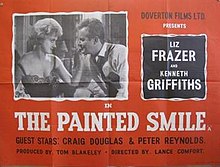
Director Lance Comfort’s 1962 British thriller film The Painted Smile [Murder Can Be Deadly] stars Liz Fraser, Kenneth Griffith, Peter Reynolds and Tony Wickert. It is written by Pip Baker and Jane Baker, based on an original idea by Brock Williams.
A small-time crook and club ‘hostess’ called Jo Lake (Liz Fraser) and her partner in crime Mark Davies (Peter Reynolds), using their charm and good looks for a confidence scam, fall foul of a sinister London killer by the name of Kleinie (Kenneth Griffith).
Jo and Mark agree to quit the racket next day, after finding one more victim before they leave. She goes to the club where she operates as a ‘hostess’ and lures drunken student Tom (Tony Wickert), who has just won £100, back to her flat for some nookie. She likes the look of him, and the coast is clear, she thinks.
But then Tom is suspected of murder after Jo discovers a dead body in her bedroom and Tom rushes over to it and touches the murder weapon. The victim is Jo’s partner, stabbed to death by the Soho gang leader Kleinie, who has called Jo to tell her that he murdered her partner, and must dispose of the body.
Instead, Jo persuades the still drunk Tom that he must drive off and dispose of the body or she will shop him to the police as the killer. Tom flees on foot after his erratic driving gets him stopped by police. His student friends Glynn (Ray Smith) and Roy (David Hemmings) call on his outraged uptight fiancée Mary (Nanette Newman), after reading in the newspaper about the body found in his car and that the police are after him. Tom arrives, Mary slaps him, and Glynn and Roy set out to find Jo, who has fled her flat but Lucy (Grazina Frame), another hostess at the club, tells them she has probably headed off back home north, and to search for her at St Pancras Railway Station, where Tom joins them and they find Jo at the station cafe. The police arrive, Tom and Jo escape to the station exterior, but club barman has tipped Kleinie off, and they are bundled into his car as his marked-for-death prisoners.
This suspensefully sinister and elaborately plotted London-set short B-movie suspense thiller from the early Sixties has a lot going for it, with a decent premise, plenty of atmosphere, exotic characters and plenty of action too. It has three good stars in Liz Fraser, Kenneth Griffith and Peter Reynolds plus the little-known Tony Wickert, with comedy actress Liz Fraser particularly impressing in her serious role as the astonishingly sexy, venal, selfish Jo, though Griffith and Reynolds are too canny to let their chances slip by either. Unfortunately Reynolds is a guest star, and bites the dust way too early, shame because he is his usual good spiv value. On this form, Liz Fraser could have been a movie star, and of course that excellent actor Kenneth Griffith is in his element as the slimy villain, keeping an extravagant role as low key as possible, going for creepily sinister and menacing rather than just plain evil.
Director Lance Comfort keeps his film fast moving, the conversation pieces interrupted by scenes of breathless movement, and the writers Pip Baker and Jane Baker sure keep it busy, with plenty of plot invention and quirky detail, a cynical eye on the world, and a commendably dark view of humanity. Given its obvious budget and running time limitations, it is a job really rather well done.
The Painted Smile also certainly has its period charms, notably the location filming at London’s St Pancras Railway Station, and it is very nice to see all the iconic players in their prime, including an impressive statuesque Nanette Newman, an eager-to-please skinny little David Hemmings and the smooth popular English pop singer Craig Douglas (born Terence Perkins, 13 August 1941). He sings ‘Another You’ (composed by Norrie Paramor) in the nightclub, which is okay, and the title track ‘Painted Smile’ (composed by Martin Slavin) that plays too often over and over again from the title sequence onwards.
Craig Douglas also starred in the 1962 film It’s Trad, Dad. He enjoyed nine Top 40 UK singles. Later, he continued to perform, and toured venues across the UK until 2010. His UK chart-topper ‘Only Sixteen’ (1959) sold more copies in the UK than Sam Cooke’s original US version.
Grazina Frame as the brassy fellow club ‘hostess’ Lucy and Harold Berens as the wily old bookseller Mikhala have likeable little turns too.
The Painted Smile received a Region 2 DVD release in 2009 in a double bill with Comfort’s 1961 film Rag Doll [Young, Willing and Eager].
It was shot as Shepperton Studios, Surrey, England, and on location at St Pancras Railway Station, Euston Road, London.
Why is it called The Painted Smile? Who knows, but that’s loads better than Murder Can Be Deadly, which doesn’t make any sense.
The cast
The cast are Liz Fraser as Jo Lake, Kenneth Griffith as Kleinie, Peter Reynolds as Mark, Tony Wickert as Tom, Craig Douglas as Nightclub Singer, Nanette Newman as Mary, Ray Smith as Glynn, David Hemmings as Roy, Harold Berens as Mikhala, Grazina Frame as Lucy, Richard McNeff as Police Inspector, Gerald Sim as Plain Clothes Policeman, Rosemary Chalmers as Gloria, Mia Karam as Dawn, Terence Maidment as Henchman, Bill Stevens as Henchman, Lionel Ngakane as Barman, and Ann Wrigg as Manageress.
The Painted Smile [Murder Can Be Deadly] is directed by Lance Comfort, runs 56 minutes, is made by Blakeley’s Films and Mancunian Film, is released by Planet Film Distributors (UK) and Colorama Features , is written by Pip Baker and Jane Baker, based on an original idea by Brock Williams, is shot by Basil Emmott, is produced by Tom Blakeley, and is scored by Martin Slavin.
US title: Murder Can Be Deadly.
Release date: May 1962 (UK). It was most commonly released as a double bill in UK cinemas in 1962 with the comedy The Fast Lady.
In the UK, it is shown on Talking Pictures TV.
Nanette Newman (born 29 May 1934)
Grazina Frame (born Lydia Anna Grazina Obrycha; 6 November 1941)
© Derek Winnert 2022 Classic Movie Review 11,956
Check out more reviews on http://derekwinnert.com

Recent articles
- Date with Disaster *** (1957, Tom Drake, William Hartnell, Shirley Eaton, Maurice Kaufmann, Michael Golden, Richard Shaw) – Classic Movie Review 14,01929 Aug 2026
- Travis Mc Gee *** (1983, Sam Elliott, Richard Farnsworth, Gene Evans, Barry Corbin, Geoffrey Lewis, Amy Madigan, Vera Miles, Katharine Ross, Marshall R Teague) – Classic Movie Review 14,01825 Aug 2026
- Tethered Wings [Les ailes collées] *** (2025, Roby Schinasi, Jérémy Kapone, Émilie Caen, Max Libert, Alexis Rosenstiehl) – Classic Movie Review 14,01723 Aug 2026
- Child in the House ** (1956, Eric Portman, Phyllis Calvert, Stanley Baker, Mandy Miller) – Classic Movie Review 14,01622 Aug 2026
- Death of a Corrupt Man [Mort d’un pourri] **** (1977, Alain Delon, Ornella Muti, Stéphane Audran, Klaus Kinski, Mireille Darc, Maurice Ronet) – Classic Movie Review 14,01522 Aug 2026
Recent comments
- The President’s Lady ** (1953, Charlton Heston, Susan Hayward, John McIntire, Fay Bainter) – Classic Movie Review 13,846 | Derek Winnert on The Buccaneer *** (1958, Yul Brynner, Claire Bloom, Charles Boyer, Inger Stevens, Henry Hull, Charlton Heston) – Classic Movie Review 13,844
- Straight Up *** (2019, James Sweeney, Katie Findlay, Dana Drori, James Scully, Tracie Thoms, Betsy Brandt, Randall Park) – Classic Movie Review 13,839 | Derek Winnert on Twinless **** (2025, Dylan O'Brien, James Sweeney, Aisling Franciosi) – Classic Movie Review 13,838
- Phantom Killer ** (1942, Dick Purcell, Joan Woodbury, John Hamilton, Warren Hymer) – Classic Movie Review 13,837 | Derek Winnert on The Sphinx ** (1933, Lionel Atwill, Sheila Terry, Theodore Newton) – Classic Movie Review 13,836
- Detour ***** (1945, Tom Neal, Ann Savage, Claudia Drake, Edmund MacDonald) – Classic Movie Review 1,547 | Derek Winnert on The Last Crooked Mile *** (1946, Don Barry, Ann Savage, Adele Mara, Tom Powers, Sheldon Leonard, Nestor Paiva) – Classic Movie Review 13,834
- Big ***** (1989, Tom Hanks, John Heard, Jared Rushton, Robert Loggia, David Moscow, Mercedes Ruehl, Jon Lovitz, Josh Clark, Kimberlee M Davis, Elizabeth Perkins) – Classic Movie Review 287 | Derek Winnert on 18 Again! *** (1988, George Burns, Charlie Schlatter, Tony Roberts, Anita Morris, Red Buttons, Pauly Shore) – Classic Movie Review 13,815