
The Interrupted Journey *** (1949, Valerie Hobson, Richard Todd, Christine Norden, Tom Walls, Ralph Truman, Vida Hope, Alexander Gauge, Dora Bryan) – Classic Movie Review 13,795
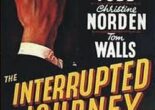
The 1949 British thriller film The Interrupted Journey stars Valerie Hobson, Richard Todd, Christine Norden, and Tom Walls. It is written by Michael Pertwee, based on a real-life train crash.

Director Daniel Birt’s 1949 British thriller film The Interrupted Journey stars Valerie Hobson, Richard Todd, Christine Norden, and Tom Walls, along with Ralph Truman, Vida Hope, Alexander Gauge, Dora Bryan. It is written by Michael Pertwee, based on a real-life train crash.
A stiff performance from the then new star Richard Todd (in his third film having hit the jackpot and become a star with his second, The Hasty Heart) holds back an intriguing if cheap-looking British chiller, which is fairly creepy and chugs along at a head of steam until the infuriating nightmare dénouement. Nevertheless, there are many support performance to enjoy (notably Vida Hope as the small hotel owner, Dora Bryan as the station buffet waitress, Arnold Ridley as Mr Saunders and Cyril Smith as barman George), while director of photography Erwin Hillier’s imaginative black and white cinematography makes it look quite stylish, disguising budget limitations.
Richard Todd plays struggling married writer John North, who runs off from his wife Carol (Valerie Hobson) to elope with his lover Susan Wilding (Christine Norden), who is married to his publisher Jerves Wilding (Alexander Gauge).
Uneasy and guilt-ridden, North pulls the emergency communication cord on the late-night train taking him and his publisher’s wife away, and jumps off the train and makes for his nearby house and his wife.
But North pulling the communication cord leads to a fatal train crash when a goods train collides with it, a murder, and a police manhunt.
Fascinatingly in retrospect, the film’s set-up follows the previous year’s real-life Winsford train crash. On 17 April 1948, 24 people died when the 17:40 Glasgow to London Euston train was stopped after the communication cord was pulled by a passenger. A soldier on leave, thought to be living near Winsford, was seen leaving the train after it had stopped. Tragically, the stopped train was run into by a following postal express. Not sure about turning a recent real-real tragedy into entertainment, but it is enterprising.
It is the final film of Tom Walls and the debut of Alexander Gauge (Jerves Wilding), while Roger Moore plays a soldier in the Paddington café.
Most of the people the newspaper lists killed in the train crash are film crew: Jack Hanbury (production assistant), Desmond Mavis (clapper loader Desmond Davis), Joan Davis (continuity), Erwin Hillier (director of photography), and Ivan King (art director).
Cast: Valerie Hobson as Carol North, Richard Todd as John North, Christine Norden as Susan Wilding, Tom Walls as Mr Clayton, Ralph Truman as Inspector Waterson, Vida Hope as Miss Marchment, owner of Danver’s hotel, Alexander Gauge as Jerves Wilding, Dora Bryan as station buffet waitress, Arnold Ridley as Mr Saunders, Cyril Smith as barman George, Arthur Lane as Constable Cowley, Nigel Neilson as Sergeant Sanger, Dora Sevening as Wilding’s mother, Elsie Wagstaff as Wilding’s maid, Alan Gordon as ticket inspector, Vincent Ball as 1st rescue worker, Jack Vyvian as 2nd rescue worker, Roger Moore as soldier in Paddington café, Gwynneth Vaughan as girl with soldier.
Release date: 12 October 1949.
It earned £126,179 (UK) against a budget of £96,700.
Anthony Havelock-Allen, who was married to top-billed Valerie Hobson, recalled: ‘I didn’t think much of the project. It had no success at all. Daniel Birt was obviously not going to be a great director.’
The railway scenes were shot at Longmoor in Hampshire.
Todd’s cinema career rapidly declined in the 1960s as social-realist dramas became fashionable in Britain. For the record, he was also an extra in the pre-war films: Good Morning, Boys, A Yank at Oxford, and Old Bones of the River.
Valerie Hobson (14 April 1917 – 13 November 1998) divorced Anthony Havelock-Allan in 1952 and gave up acting after she married Member of Parliament John Profumo in 1954. Hobson stood by Profumo when his ministerial career ended in disgrace in 1963 after revelations that he had lied to the House of Commons about his affair with Christine Keeler.
© Derek Winnert 2025 – Classic Movie Review 13,795
Check out more reviews on http://derekwinnert.com

Recent articles
- Hard Boiled **** (1992, Chow Yun-fat, Tony Leung, Teresa Mo, Philip Chan, Anthony Wong, Philip Kwok, Bowie Lam, Kwan Hoi-san) – Classic Movie Review 13,86603 Mar 2026
- Hammer the Toff *** (1952, John Bentley, Patricia Dainton, Valentine Dyall) – Classic Movie Review 13,86501 Mar 2026
- Scream 4 [SCRE4M] ** (2011, Neve Campbell, Courteney Cox, David Arquette, Hayden Panettiere, Anthony Anderson, Alison Brie, Adam Brody, Rory Culkin) – Classic Movie Review 13,86428 Feb 2026
- Best zombie movies27 Feb 2026
- King of the Zombies *** (1941, Dick Purcell, Joan Woodbury, Mantan Moreland, Henry Victor, John Archer) – Classic Movie Review 13,86326 Feb 2026
Recent comments
- The President’s Lady ** (1953, Charlton Heston, Susan Hayward, John McIntire, Fay Bainter) – Classic Movie Review 13,846 | Derek Winnert on The Buccaneer *** (1958, Yul Brynner, Claire Bloom, Charles Boyer, Inger Stevens, Henry Hull, Charlton Heston) – Classic Movie Review 13,844
- Straight Up *** (2019, James Sweeney, Katie Findlay, Dana Drori, James Scully, Tracie Thoms, Betsy Brandt, Randall Park) – Classic Movie Review 13,839 | Derek Winnert on Twinless **** (2025, Dylan O'Brien, James Sweeney, Aisling Franciosi) – Classic Movie Review 13,838
- Phantom Killer ** (1942, Dick Purcell, Joan Woodbury, John Hamilton, Warren Hymer) – Classic Movie Review 13,837 | Derek Winnert on The Sphinx ** (1933, Lionel Atwill, Sheila Terry, Theodore Newton) – Classic Movie Review 13,836
- Detour ***** (1945, Tom Neal, Ann Savage, Claudia Drake, Edmund MacDonald) – Classic Movie Review 1,547 | Derek Winnert on The Last Crooked Mile *** (1946, Don Barry, Ann Savage, Adele Mara, Tom Powers, Sheldon Leonard, Nestor Paiva) – Classic Movie Review 13,834
- Big ***** (1989, Tom Hanks, John Heard, Jared Rushton, Robert Loggia, David Moscow, Mercedes Ruehl, Jon Lovitz, Josh Clark, Kimberlee M Davis, Elizabeth Perkins) – Classic Movie Review 287 | Derek Winnert on 18 Again! *** (1988, George Burns, Charlie Schlatter, Tony Roberts, Anita Morris, Red Buttons, Pauly Shore) – Classic Movie Review 13,815