
The Colossus of Rhodes [Il Colosso di Rodi] *** (1961, Rory Calhoun, Lea Massari, Georges Marchal, Conrado San Martín, Ángel Aranda) – Classic Movie Review 8,106
Lea Massari is know for Michelangelo Antonioni’s L’Avventura (1960) and Louis Malle’s Souffle au Coeur (1971) but her career also includes Sergio Leone’s debut The Colossus of Rhodes [Il Colosso di Rodi] (1961).
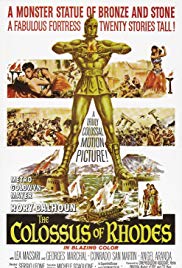
Co-writer/ director Sergio Leone’s 1961 Italian sword and sandal film The Colossus of Rhodes [Il Colosso di Rodi] is a colossus of a Sixties Euro-production historical epic, with sole American Rory Calhoun (acting with a constant piranha smile) as the outsider Greek military hero named Darios [Dario] who leads the slaves in a revolt, a clutch of Euro-actors, SupertotalScope and thousands of extras.
Unusually, the film is set in the Hellenistic era after Alexander the Great’s death (323 BC) and before the rise of the Roman Empire (27 BC).
In 280 BC, the ancient Greeks put up a vast statue of the god Apollo on the fortress Mediterranean island of Rhodes to honour their ruler, guard its harbour and repel the Phoenicians, but meanwhile the island’s slaves are revolting. A Greek military hero named Darios (Rory Calhoun) visits his uncle Lissipu (George Rigaud) on Rhodes, which is planning an alliance with Phoenicia, hostile to Greece.
Darios flirts with the beautiful Diala (Lea Massari), daughter of the statue’s mastermind Carete (Félix Fernández), and gets involved with rebels headed by Peliocles (Georges Marchal). The rebels seek to overthrow the tyrannical King Serse (Roberto Camardiel) as does Serse’s evil second-in-command Thar (Conrado San Martín).
The Colossus of Rhodes is impressively handsome on striking locations that contrast with vast setty-looking studio interiors that nevertheless do look spectacular. It was filmed in studios in Italy and Spain -Cinecitta, Rome, and C.E.A., Ciudad Lineal, Madrid – as well as various locations in Spain and in the Bay of Biscay in the Atlantic Ocean.
This big-scale, rather operatic movie is a bit campy and stagey, and sometimes slow-moving, but it is still enjoyable and entertaining, and it is also now a cult item as an early work of Leone, who moves his cameras to effect in the personal sequences and handles the big fight scenes in style.
The international version is dubbed into American (not too badly) but Calhoun seems to be speaking his own lines. ‘Spectacles always amuse me’, says Calhoun, and that goes for the film too.
Also in the cast are Lea Massari as Diala, Georges Marchal [George Marchal] as Peliocles, Conrado San Martín [Conrado Sanmartin] as Thar, Ángel Aranda as Koros, Mabel Karr as Mirte, Mimmo Palmara as Ares, Roberto Camardiel as King Serse, Alfio Caltabiano [Alf Randal] as Creonte, George Rigaud [Jorge Rigaud] as Lissipu, and Félix Fernández as Carete.
It is Leone’s first film as a credited director but he had already worked as replacement director for The Last Days of Pompeii and as secondary director for Ben-Hur and Quo Vadis. It is the least known of his seven films and is the only one without a score by Ennio Morricone. Instead, it is scored by Angelo Francesco.
Original star John Derek was fired in June 1960, after clashing with Sergio Leone and the crew. Leone preferred Rory Calhoun because of his comedic approach to the material and his air of ‘tired nonchalance’.
Exteriors were shot at the Laredo harbour, Cantabria, the Bay of Biscay, the Manzanares el Real and Ciudad Encantada at Cuenca.
MGM recorded a profit of $350,000.
The Colossus of Rhodes is directed by Sergio Leone, runs 128 minutes, is made by Procusa (Madrid), Produzioni Atlas Consorziate, Comptoir Français de Productions Cinématographiques (Paris) and Cine-Produzioni Associate (Rome), is released by MGM (US) and Produzioni Atlas Consorziate (Italy), is written by Ennio De Concini, Sergio Leone, Cesare Seccia, Luciano Martino, Ageo Savioli, Luciano Chitarrini, and Carlo Gualtieri, is shot in Eastmancolor and SupertotalScope widescreen by Antonio L Ballesteros, is produced by Michele Scaglione, Giuseppe Maggi and Mario Maggi, and is scored by Angelo Francesco.
Calhoun wears a wide bracelet on his left arm to hide his 20th-century tattoos.
Lea Massari, born Anna Maria Massatani (30 June 1933 – 23 June 2025) is known in art cinema as the missing woman in Michelangelo Antonioni’s L’Avventura (1960) and as the mother in Louis Malle’s Souffle au Coeur [Murmur of the Heart] (1971). Her career includes Sergio Leone’s debut The Colossus of Rhodes [Il Colosso di Rodi] (1961), The Things of Life [Les choses de la vie] (1970) and Francesco Rosi’s Christ Stopped at Eboli [Cristo si è fermato a Eboli] (1979), for which she won the Nastro d’Argento award for Best Supporting Actress.
© Derek Winnert 2019 Classic Movie Review 8106
Check out more reviews on http://derekwinnert.com

Recent articles
- Recoil *** (1953, Kieron Moore, Elizabeth Sellars, Edward Underdown) – Classic Movie Review 13,84013 Jan 2026
- Straight Up *** (2019, James Sweeney, Katie Findlay, Dana Drori, James Scully, Tracie Thoms, Betsy Brandt, Randall Park) – Classic Movie Review 13,83911 Jan 2026
- Twinless **** (2025, Dylan O’Brien, James Sweeney, Aisling Franciosi) – Classic Movie Review 13,83810 Jan 2026
- Phantom Killer ** (1942, Dick Purcell, Joan Woodbury, John Hamilton, Warren Hymer) – Classic Movie Review 13,83709 Jan 2026
- The Sphinx ** (1933, Lionel Atwill, Sheila Terry, Theodore Newton) – Classic Movie Review 13,83609 Jan 2026
Recent comments
- Straight Up *** (2019, James Sweeney, Katie Findlay, Dana Drori, James Scully, Tracie Thoms, Betsy Brandt, Randall Park) – Classic Movie Review 13,839 | Derek Winnert on Twinless **** (2025, Dylan O'Brien, James Sweeney, Aisling Franciosi) – Classic Movie Review 13,838
- Phantom Killer ** (1942, Dick Purcell, Joan Woodbury, John Hamilton, Warren Hymer) – Classic Movie Review 13,837 | Derek Winnert on The Sphinx ** (1933, Lionel Atwill, Sheila Terry, Theodore Newton) – Classic Movie Review 13,836
- Detour ***** (1945, Tom Neal, Ann Savage, Claudia Drake, Edmund MacDonald) – Classic Movie Review 1,547 | Derek Winnert on The Last Crooked Mile *** (1946, Don Barry, Ann Savage, Adele Mara, Tom Powers, Sheldon Leonard, Nestor Paiva) – Classic Movie Review 13,834
- Big ***** (1989, Tom Hanks, John Heard, Jared Rushton, Robert Loggia, David Moscow, Mercedes Ruehl, Jon Lovitz, Josh Clark, Kimberlee M Davis, Elizabeth Perkins) – Classic Movie Review 287 | Derek Winnert on 18 Again! *** (1988, George Burns, Charlie Schlatter, Tony Roberts, Anita Morris, Red Buttons, Pauly Shore) – Classic Movie Review 13,815
- Vice Versa **** (1947, Roger Livesey, Kay Walsh, Anthony Newley, James Robertson Justice, David Hutcheson, Petula Clark, Joan Young) – Classic Movie Review 13,818 | Derek Winnert on Vice Versa *** (1988, Judge Reinhold, Fred Savage) – Classic Movie Review 13,817