
Quatermass and the Pit [Five Million Years to Earth] **** (1967, Andrew Keir, James Donald, Barbara Shelley, Julian Glover) – Classic Movie Review 3,166
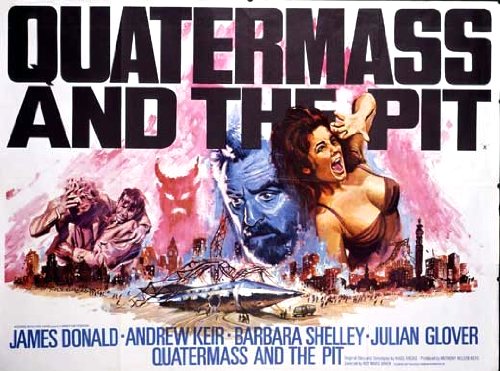
Andrew Keir proves arguably the best Professor Bernard Quatermass, in Hammer Films’ 1967 sci-fi horror movie second sequel Quatermass and the Pit [Five Million Years to Earth].
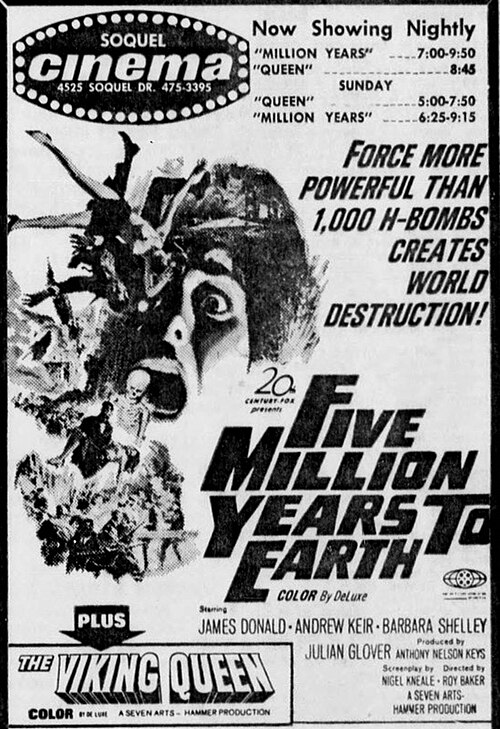
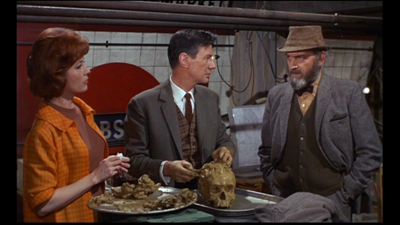
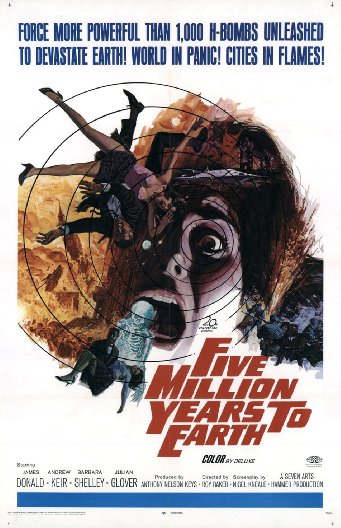
Director Roy Ward Baker’s 1967 British sci-fi horror movie Quatermass and the Pit [Five Million Years to Earth] is the third and last of the Hammer Films’ big-screen versions of writer Nigel Kneale’s Quatermass BBC television serials. James Donald stars as palaeontologist Dr Matthew Roney, Barbara Shelley plays his assistant and Andrew Keir takes over as Professor Bernard Quatermass. The screenplay is written by Nigel Kneale, based on his BBC TV serial Quatermass and the Pit, transmitted live in December 1958 and January 1959.
The story has London Underground excavation workers digging up ancient human remains buried at an Underground station called Hobbs End while building an extension to the Tube system. Palaeontologist Dr Matthew Roney (James Donald) identifies a skull as a five-million-year-old apeman. Believing part of a large metallic object uncovered nearby to be a London Blitz unexploded bomb, they call in an army bomb disposal team, who call for the aid of Colonel Breen (Julian Glover) and Quatermass joins him to attend the site. Another skull is found in a chamber of the metallic object, which therefore also must also date back five million years. Quatermass suspects the metallic object is of alien origin because it is imperviousness to heat.
Arguably the best of the series, Quatermass and the Pit is full of original author Nigel Kneale’s inventive ideas, running from plans for the colonisation of the Moon, to Martians colonising England, to the Missing Link, to the Devil, and is directed by Roy Ward Baker and filmed in Technicolor by cinematographer Arthur Grant with much imagination and style.
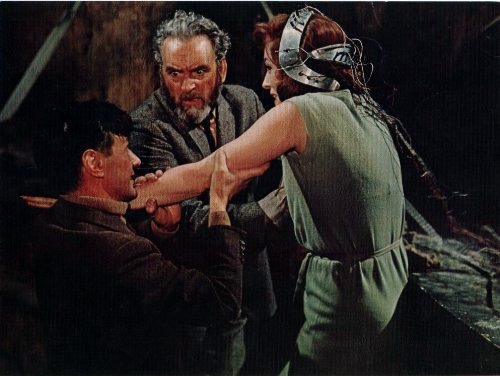
Though André Morrell (from the TV version of Quatermass and the Pit) and Brian Donlevy (from The Quatermass Xperiment and Quatermass 2) were both excellent in their very different ways, Andrew Keir proves arguably the best Professor Bernard Quatermass ever. The story grips, challenges and scares, and there is an exciting extended sequence with the Martians of the mind going on a rampage, attacking all those perceived as different, with stuff flying everywhere in deadly telekinetic displays of energy, followed by an entertaining climax when the Devil appears over London, giving Quatermass and Roney one last chance to save the world. Both these sequences are very well staged, though of course the film misses out on today’s state-of-the-art special effects, but the visual and practical effects are very attractive none the less.
Andrew Keir keeps his performance dangerously low key and interior thoughtful, but it works real nice. It is not a starry turn, but it still compels attention and admiration. It is close to Kneale’s idea of Quatermass. Top billed James Donald is excellent as Dr Mathew Roney, grave and serious too, a compelling presence, capable Barbara Shelley as loads of worthwhile stuff to as Roney’s tormented assistant Barbara Judd, Julian Glover is a good villain as the idiot Colonel Breen, Edwin Richfield as is a good villain as the blinkered government Minister, Duncan Lamont does impressively crazy as the terrified drill operator Sladden, and Bryan Marshall is a picture of sincere honesty as the army Captain Potter, balancing his superior’s stupidity.
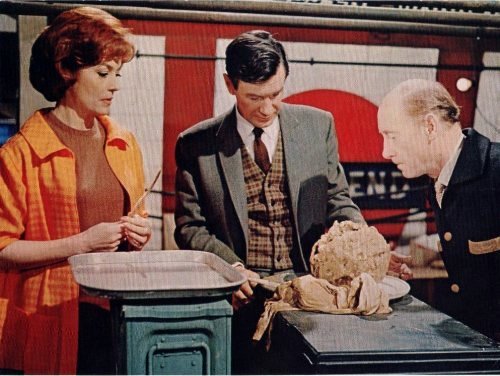
Also in the cast are Peter Copley, Maurice Good, Grant Taylor, Robert Morris, Sheila Steafel, Hugh Fletcher, Hugh Morton, Thomas Heathcoate, Noel Howlett, Hugh Manning, June Ellis, Keith Marsh, James Culliford, Bee Duffell, Roger Avon, Brian Peck, John Graham and Charles Lamb.
Eventually, there was more Quatermass. John Mills played Quatermass in a 1978 four-part TV film Quatermass (released in America and on British video as a parallel 107-minute feature The Quatermass Conclusion).
Roy Ward Baker recalled of Andrew Keir: ‘His performance was absolutely right in every detail and I was presenting him as the star of the picture.’ He isn’t actually the star, James Donald is, but yes he is definitely presented as the star of the picture, and rightly so, and yes his performance is right in every detail.
But Andrew Keir recalled: ‘Roy Ward Baker didn’t want me for the role. He wanted Kenneth More and it was a very unhappy shoot. Normally I enjoy going to work every day. But for seven-and-a-half weeks it was sheer hell.’ That’s a shame, because his hard work pays of on screen. Baker denied he wanted Kenneth More, saying he’d be wrong for Quatermass (‘too nice’ for the role), and of course that must be right. He claimed he was surprised to hear afterwards that Keir had been unhappy.
Kneale wrote the first draft of the screenplay in 1961, but American co-finance difficulties meant the film did not go into production until 1967. The screenplay is largely faithful to the TV original but the plot is condensed to fit the shorter running time, with the removal of a subplot involving the journalist James Fullalove and an altered climax to make it more cinematic.
Nigel Kneale disked Brian Donlevy’s interpretation of Quatermass and lobbied for another actor. André Morell’s performance as Quatermass on TV was much admired, and he was considered for the movie, but he not interested in revisiting a role he had already played on TV. Morell had previously turned the part down for the original TV serial The Quatermass Experiment in 1953 (where Quatermass was played by the experienced Reginald Tate). John Robinson played Quatermass in TV’s Quatermass II (1955) after Tate’s death.
Val Guest, the director of the first two films, was busy making Casino Royale (1967), so Roy Ward Baker took over as director.
Filming took place between 27 February 1967 and 25 April 1967 on a budget of £275,000. Again, they get so much value for so little, a Hammer speciality. Luckily, the production was relocated to the empty MGM Borehamwood studio and backlot where the crew had full access to all its facilities, including the exteriors of the Underground station and its street. This and the below level platform set are the two main locations of the film, used, and used very effectively for most of its running time. In truth they don’t look quite like a real street, a real Tube station or a real Tube platform but they are plenty good enough, rather charming actually.
The production team includes many Hammer regulars, including production designer Bernard Robinson and special effects supervisor Les Bowie. Tristram Cary provides the score, having developed an interest in electronic music while serving in the Royal Navy. The film is a huge credit to the detailed, painstaking, loving work of these guys.
John Trevelyan of the British Board of Film Censors said the film would require an X certificate and complained about the sound of the vibrations from the alien ship, the showing of the Martian massacre, scenes of destruction and panic as the Martian influence takes hold, and the image of the Devil, all the things that make the film fascinating.
It premiered on 9 November 1967 (UK) and went on general release in a double bill with Circus of Fear on 19 November. It was released in the US by 20th Century Fox as Five Million Years to Earth in March 1968.
Barbara Shelley was a regular leading lady for Hammer, but sadly this was her last film for them, though Roy Ward Baker said that he was ‘mad about her in the sense of love. We used to waltz about the set together, a great love affair.’ The love is up there on screen.
The cast
The cast are Andrew Keir as Professor Bernard Quatermass, Barbara Shelley as Barbara Judd, James Donald as Dr Matthew Roney, Julian Glover as Colonel Breen, Edwin Richfield as Minister, Duncan Lamont as Sladden, Bryan Marshall as Captain Potter, Peter Copley as Howell, Grant Taylor as Police Sergeant Ellis, Maurice Good as Sergeant Cleghorn, Robert Morris as Watson, Sheila Steafel as Journalist, Hugh Futcher as Sapper West, Hugh Morton as Elderly Journalist, Thomas Heathcote as Vicar, Noel Howlett as Abbey Librarian, Hugh Manning as Pub Customer, June Ellis as Blonde, Keith Marsh as Johnson, James Culliford as Corporal Gibson, Bee Duffell as Miss Dobson, Roger Avon as Electrician, Brian Peck as Technical Officer, John Graham as Inspector, Charles Lamb as Newsvendor.
© Derek Winnert 2015 Classic Movie Review 3,166
Check out more reviews on http://derekwinnert.com

Recent articles
- Sorry Angel [Plaire, aimer et courir vite] ****(Pierre Deladonchamps, Vincent Lacoste, Denis Podalydès, Thomas Gonzalez, 2018) – Classic Movie Review 14,02030 Aug 2026
- Date with Disaster *** (1957, Tom Drake, William Hartnell, Shirley Eaton, Maurice Kaufmann, Michael Golden, Richard Shaw) – Classic Movie Review 14,01929 Aug 2026
- Travis Mc Gee *** (1983, Sam Elliott, Richard Farnsworth, Gene Evans, Barry Corbin, Geoffrey Lewis, Amy Madigan, Vera Miles, Katharine Ross, Marshall R Teague) – Classic Movie Review 14,01825 Aug 2026
- Tethered Wings [Les ailes collées] *** (2025, Roby Schinasi, Jérémy Kapone, Émilie Caen, Max Libert, Alexis Rosenstiehl) – Classic Movie Review 14,01723 Aug 2026
- Child in the House ** (1956, Eric Portman, Phyllis Calvert, Stanley Baker, Mandy Miller) – Classic Movie Review 14,01622 Aug 2026
Recent comments
- The President’s Lady ** (1953, Charlton Heston, Susan Hayward, John McIntire, Fay Bainter) – Classic Movie Review 13,846 | Derek Winnert on The Buccaneer *** (1958, Yul Brynner, Claire Bloom, Charles Boyer, Inger Stevens, Henry Hull, Charlton Heston) – Classic Movie Review 13,844
- Straight Up *** (2019, James Sweeney, Katie Findlay, Dana Drori, James Scully, Tracie Thoms, Betsy Brandt, Randall Park) – Classic Movie Review 13,839 | Derek Winnert on Twinless **** (2025, Dylan O'Brien, James Sweeney, Aisling Franciosi) – Classic Movie Review 13,838
- Phantom Killer ** (1942, Dick Purcell, Joan Woodbury, John Hamilton, Warren Hymer) – Classic Movie Review 13,837 | Derek Winnert on The Sphinx ** (1933, Lionel Atwill, Sheila Terry, Theodore Newton) – Classic Movie Review 13,836
- Detour ***** (1945, Tom Neal, Ann Savage, Claudia Drake, Edmund MacDonald) – Classic Movie Review 1,547 | Derek Winnert on The Last Crooked Mile *** (1946, Don Barry, Ann Savage, Adele Mara, Tom Powers, Sheldon Leonard, Nestor Paiva) – Classic Movie Review 13,834
- Big ***** (1989, Tom Hanks, John Heard, Jared Rushton, Robert Loggia, David Moscow, Mercedes Ruehl, Jon Lovitz, Josh Clark, Kimberlee M Davis, Elizabeth Perkins) – Classic Movie Review 287 | Derek Winnert on 18 Again! *** (1988, George Burns, Charlie Schlatter, Tony Roberts, Anita Morris, Red Buttons, Pauly Shore) – Classic Movie Review 13,815