
Private Information **** (1952, Jill Esmond, Jack Watling, Carol Marsh, Gerard Heinz) – Classic Movie Review 13,756
Jill Esmond stars as a middle-aged English woman who battles against corruption in her local council, in the gripping, ambitious and intelligent 1952 British drama film Private Information.
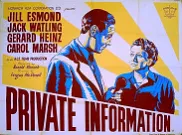
Jill Esmond, Jack Watling, Carol Marsh, and Gerard Heinz star in the gripping, ambitious and intelligent 1952 British drama film Private Information. The screenplay is written by Gordon Glennon, John Baines and Ronald Kinnoch, based on the play Garden City by Gordon Glennon. A drama about corruption in a local council is a difficult sell, but this film is exceptional in every way.
Jill Esmond stars as polite and charming English middle-aged mother Charlotte, a clergyman’s widow, who now lives on a new, jerry-built council estate, and comes to suspect that her local town council is corrupt and has built defective, leaking drains that could cause public health issues. Her son Hugh (Jack Watling) is the young assistant to the corrupt borough surveyor, who is in cohoots in bribes and back-handers with the mayor, who is Charlotte’s brother-in-law.
Lloyd Pearson as Mayor George Carson, Norman Shelley as the surveyor Herbert Freemantle, and Brenda de Banzie (in just one scene) as Dolly Carson are all fired up. Slightly less good are Mercy Haystead as the surveyor’s daughter Iris Freemantle, who is in love with Hugh but is loyal to her father, and Carol Marsh in an admittedly thankless role as Charlotte’s sickly would-be writer daughter Georgie Carson.
Jill Esmond is tremendous, relishing her caring, crusading role and grand speeches. and the rest of the cast are first rate in this splendidly done social awareness British drama film. Jack Watling is nice as her befuddled son, and Gerard Heinz is nice too as the local ‘foreign’ newspaper man on the case, an honourable and trustworthy man (what? a foreigner? a newspaper man?, trustworthy?) and a former doctor, helpfully for the plot. Maybe that gets suddenly over-heated in the final stretches of the film, but that does add drama and excitement, and makes it more of a movie.
Unusually, though it is based on the play, there is no sense of strain in the film adaptation, or talky whiff of the theatre anywhere.
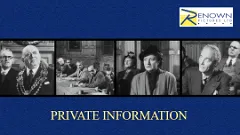
So much going on in just an hour, so much drama, so many issues. And so engrossing! Amazing that such a film could be made in the UK in 1952. We’ll never see its like again.
Release date: 1 May 1952.
Running time: 65 minutes.
It was made at Nettlefold Studios [Walton Studios], Walton-on-Thames, Surrey, England, by ACT Films, and Monarch Film Corporation. It is a great credit to ACT Films. Circumstantial Evidence (1952) was their third film, following Green Grow The Rushes (1950) and Night Was Our Friend (1951).
The Association of Cinematograph, Television and Allied Technicians (ACTT) decided at its 1949 annual general meeting to create ACT Films Limited which was established in 1950, with the support of the President of the Board of Trade, Harold Wilson, later UK Prime Minister.
© Derek Winnert 2025 – Classic Movie Review 13,756
Check out more reviews on http://derekwinnert.com


Recent articles
- Scream 4 [SCRE4M] ** (2011, Neve Campbell, Courteney Cox, David Arquette, Hayden Panettiere, Anthony Anderson, Alison Brie, Adam Brody, Rory Culkin) – Classic Movie Review 13,86428 Feb 2026
- Best zombie movies27 Feb 2026
- King of the Zombies *** (1941, Dick Purcell, Joan Woodbury, Mantan Moreland, Henry Victor, John Archer) – Classic Movie Review 13,86326 Feb 2026
- The Lamp in Assassin Mews *** (1962, Francis Matthews, Lisa Daniely, Ian Fleming, Amy Dalby) – Classic Movie Review 13,86224 Feb 2026
- Strange River [Estrany riu] **** (2025, Jan Monter, Nausicaa Bonnín, Jordi Oriol, Francesco Wenz, Bernat Solé, Roc Colell) – Classic Movie Review 13,86121 Feb 2026
Recent comments
- The President’s Lady ** (1953, Charlton Heston, Susan Hayward, John McIntire, Fay Bainter) – Classic Movie Review 13,846 | Derek Winnert on The Buccaneer *** (1958, Yul Brynner, Claire Bloom, Charles Boyer, Inger Stevens, Henry Hull, Charlton Heston) – Classic Movie Review 13,844
- Straight Up *** (2019, James Sweeney, Katie Findlay, Dana Drori, James Scully, Tracie Thoms, Betsy Brandt, Randall Park) – Classic Movie Review 13,839 | Derek Winnert on Twinless **** (2025, Dylan O'Brien, James Sweeney, Aisling Franciosi) – Classic Movie Review 13,838
- Phantom Killer ** (1942, Dick Purcell, Joan Woodbury, John Hamilton, Warren Hymer) – Classic Movie Review 13,837 | Derek Winnert on The Sphinx ** (1933, Lionel Atwill, Sheila Terry, Theodore Newton) – Classic Movie Review 13,836
- Detour ***** (1945, Tom Neal, Ann Savage, Claudia Drake, Edmund MacDonald) – Classic Movie Review 1,547 | Derek Winnert on The Last Crooked Mile *** (1946, Don Barry, Ann Savage, Adele Mara, Tom Powers, Sheldon Leonard, Nestor Paiva) – Classic Movie Review 13,834
- Big ***** (1989, Tom Hanks, John Heard, Jared Rushton, Robert Loggia, David Moscow, Mercedes Ruehl, Jon Lovitz, Josh Clark, Kimberlee M Davis, Elizabeth Perkins) – Classic Movie Review 287 | Derek Winnert on 18 Again! *** (1988, George Burns, Charlie Schlatter, Tony Roberts, Anita Morris, Red Buttons, Pauly Shore) – Classic Movie Review 13,815