
Impulse *** (1954, Arthur Kennedy, Constance Smith, Joy Shelton) – Classic Movie Review 13,771
Arthur Kennedy stars as a married American estate agent living in England, who fatefully gives a lift to a sultry, jewel thieving nightclub singer (Constance Smith), in the 1954 British crime film noir Impulse.
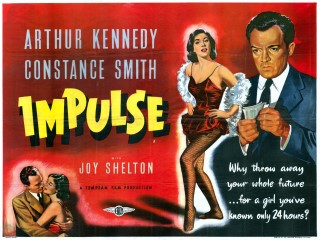
Writer/ director Cy Endfield’s Tempean Films 1954 British second feature crime film noir melodrama Impulse stars Arthur Kennedy, Constance Smith and Joy Shelton.
Impulse is directed by Cy Endfield (billed as “Charles de Lautour”) and written by Endfield (billed as “Jonathan Roach”) and Lawrence Huntington from an original story by Carl Nystrom and the film’s producer Robert S Baker.
Arthur Kennedy stars as American estate agent Alan Curtis, understandably dissatisfied with his boring humdrum life in England. He has a nice boss (Jack Allen as Freddie) and a nice wife too, and a decent suburban home. All very cosy. Joy Shelton plays his brisk and capable English wife Elizabeth, who takes off on a short break to visit her mother.
Life suddenly stops being humdrum for Alan when he follows a woman out of a bar and fatefully gives her lift when her car breaks down in the rain on a country road at night. She turns out to be sultry nightclub singer Lila (Constance Smith), who tells him that her brother is in trouble over a jewel robbery when he finds her stranded on the road at night. Thrilled, Alan falls head over heels for Lila, but she’s just after the stolen jewels, and starts a sequence of lying to him and manipulating him. He loves it.
The story is quite involving though it often defies belief and logic, but the dialogue is mostly kind of quirky and compelling, keeping up the level of interest and giving the actors good chances, which they grab greedily. Arthur Kennedy makes a whole lot out of his rather sad and pathetic character of Alan Curtis, hugely longing for excitement and greatly regretting it when he actually suddenly finds it. Some ‘hero’, eh?
The film turns out to be an advert for the cosy, safe life, a dire warning against risking leaving the humdrum and the sweet married life. That’s a shame, and not really in the spirit of film noir. The femme fatale turns out to have a bit of a conscience and a deep-down heart of gold, and that’s a shame too. Constance Smith plays Lila for all she’s worth and a bit more. She absolutely persuades you that Alan would go crazy for her. Joy Shelton makes the best of what she has in the thankless role of the nice, dull wife. She’s definitely the consolation prize, and the one that eternal loser Alan is going to end up with.
Jean St Clair has quite a lot to do as Curtis’s next-door nosy neighbour, the incongruous comedy relief, making an amusing job of it, though why it’s there at all, heaven knows. It slows down the plot, and so does Constance Smith’s cabaret song at the club where she works, a modest song at best, extended beyond its welcome. There’s a fairly short running time of 80 minutes, so we need to get pacing ahead with the story.
The rest of the acting from the reliable players is very quirky and jolly. Jack Allen stands out in support as affable estate agent Freddie, hero’s friend. By the way, you don’t get many estate agents as heroes, do you? I wonder why?
Impulse is good, not great maybe, but definitely very good. It is not routine, average or ordinary in any way. That is just not right. It is a cut above all that. Tempean Films were lucky to be able to tempt over to the UK underrated, undervalued, forgotten star Arthur Kennedy, giving a surprisingly subtle, honest and natural performance, even in some contrived scenes, which makes the whole film work. He must have wondered how his career had led down to these humble circumstances but he gives it his all. He turns from affable and smiley to hurt and damaged, and on to angry and violent quite suddenly and persuasively.
Cast: Arthur Kennedy as Alan Curtis, Constance Smith as Lila, Joy Shelton as Elizabeth Curtis, Jack Allen as Freddie, James Carney as Jack Forrester, Cyril Chamberlain as Gray, Cameron Hall as Joe Bruce Beeby as Harry Winters, Charles Lamb as Palmer, Sam Kydd as train ticket inspector, Kenneth Cope as hotel desk clerk, Michael Balfour as sailor, John Horsley as police officer, Peter Swanwick as ship’s captain, Victor Harrington as nightclub patron, Guy Standeven as nightclub patron, and Jean St Clair as Curtis’ next-door neighbour.
It is shot at Nettlefold Studios, Walton-on-Thames, Surrey, UK, with sets designed by art director Wilfred Arnold. But there is some precious outside filming, showing the cute England of the day, and its cute cars too. It is shot by Jonah Jones, who manages some striking noir images, simple but effective. More location shooting would be even better, but this will do nicely. The sets are also simple but effective.
Endfield had come to work in Britain to escape the Hollywood blacklist. To allow him to direct, the UK Association of Cinematograph, Television and Allied Technicians trade union required that a paid ACTT director be appointed, to do nothing on set but to be credited with direction. Endfield chose documentary filmmaker Charles de Lautour, and paid him £35 a week to do nothing.
The Association of Cinematograph, Television and Allied Technicians (ACTT) was a trade union in the UK from 1933 to 1991.
Arthur Kennedy (February 17, 1914 – January 5, 1990) won the 1949 Tony Award for Best Featured Actor in a Play for Arthur Miller’s Death of a Salesman. He won the Golden Globe for Best Supporting Actor for the 1955 film Trial, and was a five-time Academy Award nominee.
Tempean Films was a British film production company formed in 1948 by Robert S Baker and Monty Berman. Their many B-movies were distributed by Eros Films. The Trollenberg Terror (US title The Crawling Eye) is their 1958 highspot.
© Derek Winnert 2025 – Classic Movie Review 13,771
Check out more reviews on http://derekwinnert.com


Recent articles
- Hammer the Toff *** (1952, John Bentley, Patricia Dainton, Valentine Dyall) – Classic Movie Review 13,86501 Mar 2026
- Scream 4 [SCRE4M] ** (2011, Neve Campbell, Courteney Cox, David Arquette, Hayden Panettiere, Anthony Anderson, Alison Brie, Adam Brody, Rory Culkin) – Classic Movie Review 13,86428 Feb 2026
- Best zombie movies27 Feb 2026
- King of the Zombies *** (1941, Dick Purcell, Joan Woodbury, Mantan Moreland, Henry Victor, John Archer) – Classic Movie Review 13,86326 Feb 2026
- The Lamp in Assassin Mews *** (1962, Francis Matthews, Lisa Daniely, Ian Fleming, Amy Dalby) – Classic Movie Review 13,86224 Feb 2026
Recent comments
- The President’s Lady ** (1953, Charlton Heston, Susan Hayward, John McIntire, Fay Bainter) – Classic Movie Review 13,846 | Derek Winnert on The Buccaneer *** (1958, Yul Brynner, Claire Bloom, Charles Boyer, Inger Stevens, Henry Hull, Charlton Heston) – Classic Movie Review 13,844
- Straight Up *** (2019, James Sweeney, Katie Findlay, Dana Drori, James Scully, Tracie Thoms, Betsy Brandt, Randall Park) – Classic Movie Review 13,839 | Derek Winnert on Twinless **** (2025, Dylan O'Brien, James Sweeney, Aisling Franciosi) – Classic Movie Review 13,838
- Phantom Killer ** (1942, Dick Purcell, Joan Woodbury, John Hamilton, Warren Hymer) – Classic Movie Review 13,837 | Derek Winnert on The Sphinx ** (1933, Lionel Atwill, Sheila Terry, Theodore Newton) – Classic Movie Review 13,836
- Detour ***** (1945, Tom Neal, Ann Savage, Claudia Drake, Edmund MacDonald) – Classic Movie Review 1,547 | Derek Winnert on The Last Crooked Mile *** (1946, Don Barry, Ann Savage, Adele Mara, Tom Powers, Sheldon Leonard, Nestor Paiva) – Classic Movie Review 13,834
- Big ***** (1989, Tom Hanks, John Heard, Jared Rushton, Robert Loggia, David Moscow, Mercedes Ruehl, Jon Lovitz, Josh Clark, Kimberlee M Davis, Elizabeth Perkins) – Classic Movie Review 287 | Derek Winnert on 18 Again! *** (1988, George Burns, Charlie Schlatter, Tony Roberts, Anita Morris, Red Buttons, Pauly Shore) – Classic Movie Review 13,815