
Deadly Nightshade *** (1953, Emrys Jones, Zena Marshall, John Horsley, Joan Hickson) – Classic Movie Review 13,546
John Gilling’s 1953 British second feature mystery thriller film Deadly Nightshade stars Emrys Jones as a convict on the run who switches identities with a lookalike, and finds himself in even deeper trouble.
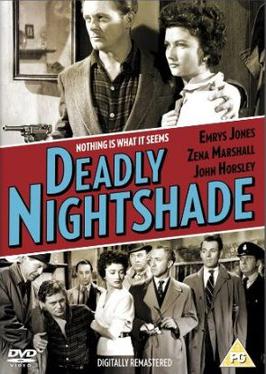
Director John Gilling’s 1953 British second feature mystery crime thriller film Deadly Nightshade stars Emrys Jones in a dual role and Zena Marshall. There is some tremendously good work on a budget in this fast-moving, intricate and involving crime drama with some excellent performances. John Horsley and Victor Platt are super-good playing police Inspector Clements and the police Sergeant who investigate.
Emrys Jones stars most smoothly as Robert Matthews, who is mistakenly arrested by police believing he is the lookalike Barlow, a convict on the run who has escaped from jail after being convicted of drunken manslaughter while driving. After they realise their mistake, the police release Matthews and then Barlow (also Emrys Jones) turns up in his cottage, plotting to kidnap him and assume his identity. Matthews resists when Barlow approaches with a gun, and Matthews is shot dead.
Barlow then takes on the identity of the lookalike dead man he has killed, and lives in his cottage, dumping the body in a locked woodshed outhouse and, in haste, leaving the luger lethal weapon in his coat pocket hanging on the front door. A ship explodes and sinks at sea, as a result of sabotage, it turns out, and the police get Barlow to put up overnight three surviving victims: Colonel Smythe (Roger Maxwell), Mrs Smythe (Lesley Deane) and the young and lovely Ann Farrington (Zena Marshall), who turns out to have been Barlow’s girlfriend, who rejected him, causing him to take to drink, leading to the fatal road accident.
Ann quickly realises that Barlow isn’t Matthews as he insists, and says she will help him. But canny police Inspector Clements also soon realises that Barlow isn’t Matthews too. Then villains turn up (Hector Ross as Canning, George Pastell as Ferrari, Marne Maitland as Heinz), espionage terrorist men Matthews were involved with. For unfortunately Matthews turns out to have been a spy and a traitor, and things go from bad to worse for Barlow.
Barlow’s had a lot of bad luck: he’s killed two people accidentally! Oh, and he looks like a spy who has killed lots of people!
The pleasing cast (with Joan Hickson highly entertaining as the busy-body housekeeper Mrs Fenton, comedy relief but not over-done) helps Lawrence Huntington’s entirely ingenious, neat and busy mystery thriller script with a heck of a lot of plot in just 61 minutes. Emrys Jones, Zena Marshall, John Horsley, and Joan Hickson are all very good company, giving excellent, well-judged performances, all of them effectively low key. The other character actors are exceptional too, with Ian Fleming notable in his one scene as the doctor attending Zena Marshall’s sprained ankle.
Hickson has some good lines. Mrs Fenton says ‘Every time you pick up a newspaper you read about some corpse or other.’ Mrs Fenton recalls she was once attacked: ‘It was awful. He said if I didn’t do what he wanted me to do, he’d kill me.’ When asked ‘What happened?’, she replies ‘Well Sir, I’m still here.’ Lawrence Huntington goes for another non-PC joke. A male character opines: ‘I like the stuttering girls… by the time they say No it’s too late.’
The pleasing cast are Emrys Jones as Matthews / Barlow, Zena Marshall as Ann Farrington, John Horsley as Inspector Clements, Joan Hickson as Mrs Fenton, Hector Ross as Canning, Victor Platt as police sergeant, Roger Maxwell as Colonel Smythe, Lesley Deane as Mrs Smythe, Marne Maitland as Heinz, Frederick Piper as Mr Pritchard, Edward Evans as the Publican, Alan Gordon, Ian Fleming as Dr Wilson, George Pastell as Ferrari, and Martin Wyldeck as M.I.5 man.
Deadly Nightshade is directed by John Gilling, runs 61 minutes, is made by Kenilworth Film Productions, is released by General Film Distributors (UK), is written by Lawrence Huntington, is shot in black and white by Monty Berman, is produced by Robert S Baker and Monty Berman, and is scored by John Lanchbery.
It was released in March 1953 (UK).
It is shot at Southall Studios, Southall, Middlesex, England. and on location Hammersmith, London, and where it is set in Looe, Cornwall.
The theme tune is the same as for The Quiet Woman (1950), in which John Horsley also appeared.
You’d have to be very eagle eyed to notice this, but someone has! When Barlow is given a lift home in a car driven by Inspector Clements, the back projection is the same one used earlier when Barlow was transported home in the police car.
Zena Marshall (1 January 1926 – 10 July 2009)
John Emrys Whittaker Jones (22 September 1915 – 10 July 1972)
© Derek Winnert 2025 – Classic Movie Review 13,546
Check out more reviews on http://derekwinnert.com

Recent articles
- Moment of Indiscretion *** (1958, Ronald Howard, Lana Morris, John Van Eyssen, Denis Shaw, Ann Lynn) – Classic Movie Review 13,84826 Jan 2026
- Il Vuoto [Empty] ** (2023, Gianluca Galati, Kevin Di Sole, Paola Lavini) – Classic Movie Review 13,84722 Jan 2026
- The President’s Lady ** (1953, Charlton Heston, Susan Hayward, John McIntire, Fay Bainter) – Classic Movie Review 13,846 20 Jan 2026
- The Buccaneer *** (1938, Fredric March, Akim Tamiroff, Walter Brennan, Douglass Dumbrille, Anthony Quinn) – Classic Movie Review 13,84520 Jan 2026
- The Buccaneer *** (1958, Yul Brynner, Claire Bloom, Charles Boyer, Inger Stevens, Henry Hull, Charlton Heston) – Classic Movie Review 13,84420 Jan 2026
Recent comments
- The President’s Lady ** (1953, Charlton Heston, Susan Hayward, John McIntire, Fay Bainter) – Classic Movie Review 13,846 | Derek Winnert on The Buccaneer *** (1958, Yul Brynner, Claire Bloom, Charles Boyer, Inger Stevens, Henry Hull, Charlton Heston) – Classic Movie Review 13,844
- Straight Up *** (2019, James Sweeney, Katie Findlay, Dana Drori, James Scully, Tracie Thoms, Betsy Brandt, Randall Park) – Classic Movie Review 13,839 | Derek Winnert on Twinless **** (2025, Dylan O'Brien, James Sweeney, Aisling Franciosi) – Classic Movie Review 13,838
- Phantom Killer ** (1942, Dick Purcell, Joan Woodbury, John Hamilton, Warren Hymer) – Classic Movie Review 13,837 | Derek Winnert on The Sphinx ** (1933, Lionel Atwill, Sheila Terry, Theodore Newton) – Classic Movie Review 13,836
- Detour ***** (1945, Tom Neal, Ann Savage, Claudia Drake, Edmund MacDonald) – Classic Movie Review 1,547 | Derek Winnert on The Last Crooked Mile *** (1946, Don Barry, Ann Savage, Adele Mara, Tom Powers, Sheldon Leonard, Nestor Paiva) – Classic Movie Review 13,834
- Big ***** (1989, Tom Hanks, John Heard, Jared Rushton, Robert Loggia, David Moscow, Mercedes Ruehl, Jon Lovitz, Josh Clark, Kimberlee M Davis, Elizabeth Perkins) – Classic Movie Review 287 | Derek Winnert on 18 Again! *** (1988, George Burns, Charlie Schlatter, Tony Roberts, Anita Morris, Red Buttons, Pauly Shore) – Classic Movie Review 13,815