
Pushover **** (1954, Fred MacMurray, Kim Novak, Philip Carey, Dorothy Malone, E G Marshall) – Classic Movie Review 7,614
Richard Quine’s enjoyable 1954 film noir suspense thriller Pushover stars Fred MacMurray, but is perhaps most notable as a springboard to stardom for 20-year-old Kim Novak, in her first credited film.
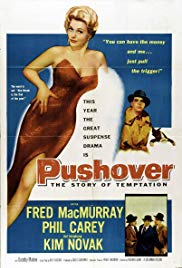
Director Richard Quine’s 1954 film noir suspense thriller Pushover stars Fred MacMurray as Paul Sheridan, an undercover policeman on the case of a $250,000 bank robbery, who falls for blonde bombshell crook’s moll Lona McLane (Kim Novak) and soon finds himself seduced into a downward spiral of corruption and murder as they double-cross the bank robbing crook and the cops.
Quine’s enjoyable thriller is perhaps notable chiefly for acting as a springboard to stardom for 20-year-old Columbia Pictures studio favourite Novak, in her first credited film. She looks a million, gorgeously gowned throughout, her car, apartment and coat all paid for by the bank robber (Paul Richards). Novak is extremely alluring. The camera loves her and eats her up. She responds with a strong, confident, magnetic performance. But MacMurray is the main star, and gratifyingly he is in Double Indemnity mode, balancing charm with an inner heart of darkness. Novak might seem like the femme fatale, but actually MacMurray is the homme fatale.
However, these iconic appearances aside, Pushover is also a very efficient and compelling feature in its own right. Unusually, it is adapted (by Roy Huggins) from two novels, The Night Watch (1952) by Thomas Walsh and Rafferty (1953) by Bill [William] S Ballinger.
The film gets off immediately to a cracking start with the bank robbery, in which one of the crooks, Harry Wheeler (Paul Richards) shoots and kills a bank guard before getting away with a bagful of $250,000.
Next Lona McLane (Kim Novak) leaves a cinema and walks to her car, which won’t start. Paul Sheridan (Fred MacMurray), who has followed her out of the cinema, suddenly appears at her car window. He says he can’t fix the car, so he takes her to a bar while a mechanic is called to repair it. The duo click and spend the night together.
But next morning, it is revealed that Sheridan is not a creep or a stalker but an undercover cop sent to seduce Lona to lead the police to her boyfriend, Wheeler.
There may be no great surprises, but it is blessed with an overall atmosphere of noir-style seediness, a solid ‘hero’ in MacMurray, a striking, layered femme fatale in Novak and some charismatic support acting from the fine cast of very reliable actors. MacMurray is wonderfully sweaty, seedy and dubious, at his best playing bad guys. Beady eyed and crinkly round the chin and neck, he looks a bit old for Novak, or maybe she looks a bit young for him, but they make it work.
Meanwhile second billed Phil Carey’s Rick McAllister is part of the police stakeout spying on Novak from the same building in a room across the way. But he is more interested in spying on her next door neighbour, cute young nurse Ann Stewart (Dorothy Malone). Lona and Ann are as different as chalk and cheese, but Ann definitely has her charms too, more homely maybe, but still alluring (she wears smart frocks instead of gowns). Younger than MacMurray, world-weary Carey nevertheless looks a bit old for Dorothy Malone too, but again they make it work.
E G Marshall is a super actor, but he’s not ideally cast as Police Lieutenant Carl Eckstrom. Someone gruffer and grouchier, tougher and bulkier, is needed to give the role edge and impact. Phil Carey is quite dull, though the role doesn’t offer him much of a chance. That leaves it all down to MacMurray, Novak and Malone, and that’s way enough.
The voyeur aspect of the film is fascinating. A lot of the shortish running time (it’s just under 90 minutes) is spent on the rather primitive surveillance, with a tape recorder and binoculars. The cops might be quite clever but they are not as clever as they think they are. Carey is supposed to be on police business spying on the guilty Novak but he’s much more interested in spying on the innocent Malone. So, he’s easily distracted then. MacMurray was undercover, supposed to be out to catch Novak, whose boyfriend has just committed the bank robbery and killed a guard. But MacMurray is easily seduced by Novak’s charms, and also her connection to the money from the robbery. Novak is a bad lot but MacMurray is a much worse lot. MacMurray and Carey’s older cop buddy, Paddy Dolan (Allen Nourse), fatally it turns out, nips out to a nearby bar for a drink when he’s supposed to be watching from his car in the street, just when the action happens. So, he’s also easily distracted then. In each case the distraction becomes the main point.
By the way, the missing $250,000 and the bank robber are MacGuffins. The film seems to be all about the search for them but it’s not about that at all. It’s all about Lona.
The noir photography by by Lester B White is grand, the camera constantly prowling, often positioned in odd places and at odd angles. A view askew. There is some thrilling outside filming, and great and extensive use is made of the huge Columbia studio street set, in an impressive low budget production designed by Walter Holscher. The score by Arthur Morton is good in places, just right, though over-insistent in others, and there is too much of it, no silence at all when that would help tension. The gowns and costumes are designed by Guy O Shircliff, bringing allure and glamour to the production.
The film’s ending is a bit of a letdown, a product of the era when the bad guys couldn’t get away with it. It’s a bit pat and smug, and doesn’t quite fit into the noir world we’ve just explored. Shame. A more complex, cynical conclusion would make this film even more satisfying.
Interestingly, producer Jules Schermer crucially interfered with Roy Huggins’s script. Schermer recalled: ‘He did not give me exactly what I wanted and I didn’t like the ending. So I took some things from a previous film that I had done (1947’s Framed) and borrowed from that. Much of it is the same, even to the ending, with the same dialogue. When Huggins eventually saw a rough cut of Pushover, he said “You’ve ruined my picture” because of what I had borrowed from Framed. Fortunately, nobody else thought so.’ Shame.
What are we meant to make of the title. It’s brilliant, but just who or what is the Pushover?
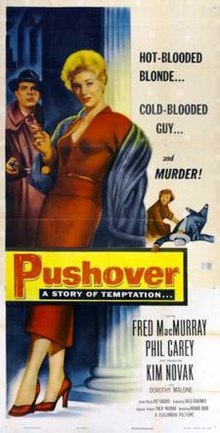
It also stars Phil Carey [Philip Carey] as Rick McAllister, Dorothy Malone as Ann Stewart, and E G Marshall as Police Lieutenant Carl Eckstrom. Also in the cast are Allen Nourse, Phil Chambers, Alan Dexter, Robert Forrest, Don C Harvey, Paul Richards, Ann Morriss, K L Smith, Paul Picerni, Mel Welles, Dick Crockett, and Robert Carson.
Pushover is directed by Richard Quine, runs 88 minutes, is made and released by Columbia Pictures, is written by Roy Huggins, based on the novels The Night Watch by Thomas Walsh and Rafferty by Bill [William] S Ballinger, is shot in black and white by Lester B White, is produced by Jules Schermer, is scored by Arthur Morton, and is designed by Walter Holscher.
The working title was The Killer Wore a Badge. MacMurray was paid $75,000 out of the total $400,000 budget. It was shot at Columbia/ Sunset Gower Studios, 1438 N Gower Street, Hollywood, and exteriors were filmed on the streets of Burbank, California, where you can see the old Magnolia Theater, on Magnolia Street. For vintage flavour, there are many classic car shots.
Kim Novak appeared in small roles in two films for RKO before her first credited role in Pushover while she was working as a model: The French Line (1954) and Son of Sinbad (filmed in 1953, released in 1955). Her appearance in these films led to her being signed by Columbia Pictures. She was using her real name Marilyn Novak when she worked as an extra in Los Angeles. Columbia Pictures studio chief Harry Cohn insisted she change her first name because of the popularity of Marilyn Monroe, suggesting ‘Kit Marlowe’ instead, but she fought to keep her surname and the name Kim Novak was a compromise.
Kim Novak was born on February 13, 1933, and Pushover was released on August 6, 1954. She was only 20 when filming took place in 1953.
Kim was engaged to director Richard Quine in 1959, and they also made Bell, Book and Candle together in 1958, Strangers When We Meet (1960), and The Notorious Landlady (1962).
The cast
The cast are Fred MacMurray as Paul Sheridan, Kim Novak as Lona McLane, Phil Carey [Philip Carey] as Rick McAllister, Dorothy Malone as Ann Stewart, and E G Marshall as Police Lieutenant Carl Eckstrom, Allen Nourse as Paddy Dolan, Phil Chambers as Briggs, Alan Dexter, Robert Forrest, Don C Harvey, Paul Richards as Harry Wheeler, Ann Morriss, K L Smith, Paul Picerni as Elegant man, Mel Welles as Detective, Dick Crockett as Mr Crockett, Marion Ross as Mrs Crockett, James Anderson as Berry, Robert Stevenson as Billings, Mort Mills as Bartender, and Robert Carson as Bartender.
© Derek Winnert 2018 Classic Movie Review 7,614
Check out more reviews on http://derekwinnert.com

Recent articles
- Sorry Angel [Plaire, aimer et courir vite] ****(Pierre Deladonchamps, Vincent Lacoste, Denis Podalydès, Thomas Gonzalez, 2018) – Classic Movie Review 14,02030 Aug 2026
- Date with Disaster *** (1957, Tom Drake, William Hartnell, Shirley Eaton, Maurice Kaufmann, Michael Golden, Richard Shaw) – Classic Movie Review 14,01929 Aug 2026
- Travis Mc Gee *** (1983, Sam Elliott, Richard Farnsworth, Gene Evans, Barry Corbin, Geoffrey Lewis, Amy Madigan, Vera Miles, Katharine Ross, Marshall R Teague) – Classic Movie Review 14,01825 Aug 2026
- Tethered Wings [Les ailes collées] *** (2025, Roby Schinasi, Jérémy Kapone, Émilie Caen, Max Libert, Alexis Rosenstiehl) – Classic Movie Review 14,01723 Aug 2026
- Child in the House ** (1956, Eric Portman, Phyllis Calvert, Stanley Baker, Mandy Miller) – Classic Movie Review 14,01622 Aug 2026
Recent comments
- The President’s Lady ** (1953, Charlton Heston, Susan Hayward, John McIntire, Fay Bainter) – Classic Movie Review 13,846 | Derek Winnert on The Buccaneer *** (1958, Yul Brynner, Claire Bloom, Charles Boyer, Inger Stevens, Henry Hull, Charlton Heston) – Classic Movie Review 13,844
- Straight Up *** (2019, James Sweeney, Katie Findlay, Dana Drori, James Scully, Tracie Thoms, Betsy Brandt, Randall Park) – Classic Movie Review 13,839 | Derek Winnert on Twinless **** (2025, Dylan O'Brien, James Sweeney, Aisling Franciosi) – Classic Movie Review 13,838
- Phantom Killer ** (1942, Dick Purcell, Joan Woodbury, John Hamilton, Warren Hymer) – Classic Movie Review 13,837 | Derek Winnert on The Sphinx ** (1933, Lionel Atwill, Sheila Terry, Theodore Newton) – Classic Movie Review 13,836
- Detour ***** (1945, Tom Neal, Ann Savage, Claudia Drake, Edmund MacDonald) – Classic Movie Review 1,547 | Derek Winnert on The Last Crooked Mile *** (1946, Don Barry, Ann Savage, Adele Mara, Tom Powers, Sheldon Leonard, Nestor Paiva) – Classic Movie Review 13,834
- Big ***** (1989, Tom Hanks, John Heard, Jared Rushton, Robert Loggia, David Moscow, Mercedes Ruehl, Jon Lovitz, Josh Clark, Kimberlee M Davis, Elizabeth Perkins) – Classic Movie Review 287 | Derek Winnert on 18 Again! *** (1988, George Burns, Charlie Schlatter, Tony Roberts, Anita Morris, Red Buttons, Pauly Shore) – Classic Movie Review 13,815