
Any Number Can Play ** (1949, Clark Gable, Alexis Smith, Wendell Corey, Audrey Totter, Mary Astor) – Classic Movie Review 6,709
MGM’s 1949 drama movie Any Number Can Play stars Clark Gable as a casino owner who has problems over his health, his wife (Alexis Smith) and his son.
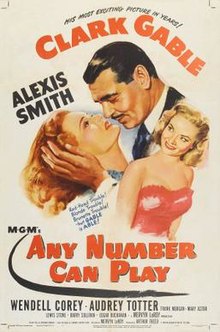
‘Red-Head Trouble! Blonde Trouble! Brunette Trouble! – but GABLE is ABLE!’ The Any Number Can Play poster sells sex but the trailer sells adventure: ‘Never more rugged. Never more romantic.’
Director Mervyn LeRoy’s 1949 MGM movie Any Number Can Play is an odd and under-powered drama from screen-writer Richard Brooks starring Clark Gable as a casino owner called Charley Enley Kyng who has problems over his health (his doctor diagnoses him with a heart disease and tells him to slow down), his wife (Alexis Smith) and his son (Darryl Hickman), who is ashamed of his father’s line of work.
As so often at MGM around this period, the screenplay is interesting but lacking. Mind you, script problems are not specific to MGM in the Forties! However, the film is lifted by the performances of MGM’s top stars and character cast, and its meticulous production.
Any Number Can Play is based on a 1945 novel by Edward Harris Heth, and the all too obviously novel-derived film is very claustrophobic and stifling, refusing stubbornly to move from its casino basis and studio filming. Yet LeRoy’s polished direction and the charismatic acting of the star quintet of Clark Gable, Alexis Smith, Wendell Corey, Audrey Totter and Mary Astor still do manage to cast a little spell.
The estimable Mary Astor as casino worker Ada, Wendell Corey as Robbin Elcott, Audrey Totter as Alice Elcott, Lewis Stone as Ben Gavery Snelerr, Frank Morgan as as Jim Kurstyn, Marjorie Rambeau, Barry Sullivan, Edgar Buchanan, Leon Ames and William Conrad all go into their familiar turns with a will, and it would be worth watching just for that.
Also in the cast are Mickey Knox, Richard Rober, Caleb Peterson, Dorothy Comingore, Art Baker, Murray Alper, Charles Arnt, Griff Barnett, Benny Bartlett, Barbara Billingsley, George M Carleton, Cliff Clark, Harry Cody, Douglas Fowley, Jack Gargan, William Haade, Ralph Hodges, Helen Lynd, John Skins Miller, Frank Mills, Ralph Montgomery, David Opatoshu, William Bill Phillips, Isobel Randolph, Mary Jane Smith, Arthur Space, William Tannen, Lillian West, Joe Whitehead, and Robert Williams.
It premiered in
Any Number Can Play runs 112 minutes, is made and released by MGM, is written by Richard Brooks, based on Edward Harris Heth’s novel, is shot in black and white by Harold Rosson, produced by Arthur Freed, is scored by Lennie Hayton, and is designed by Cedric Gibbons and Urie McCleary.
It still made a profit of $763,000, less than usual perhaps for a film with the King of Hollywood starring. It cost $1.3 million and earned $3.2 million, so the distribution and promotion costs must have been high.
The film’s screen-writer Richard Brooks was also intended to direct but was dumped when Clark Gable was cast. He recalled that he was told: ‘Well, now it’s a Gable picture, and you can’t expect to direct Gable.’
Darryl Hickman replaced Scotty Beckett, whose photograph can still be seen on Clark Gable’s desk.
Whatever Mary Astor was filmed as saying to Clark Gable about 5o minutes into the film is evidently dubbed with two different lines.
Clark Gable’s character here has a severe heart condition, and in real life the actor died from a heart attack on November 16, 1960, aged 59.
The cast are Clark Gable as Charley Enley Kyng, Alexis Smith as Lon Kyng, Wendell Corey as Robbin Elcott, Audrey Totter as Alice Elcott, Frank Morgan as Jim Kurstyn, Mary Astor as Ada, Lewis Stone as Ben Gavery Snelerr, Barry Sullivan as Tycoon, Marjorie Rambeau as Sarah Calbern, Edgar Buchanan as Ed, Leon Ames as Dr Palmer, Mickey Knox as Pete Senta, Richard Rober as Lew ‘Angie ‘Debretti, William Conrad as Frank Sistina, Darryl Hickman as Paul Enley Kyng, Caleb Peterson as Sleigh, Dorothy Comingore as Mrs Purcell, Art Baker as Mr Reardon, Helen Lynd as Ellen, Murray Alper, Charles Arnt, Griff Barnett, Benny Bartlett, Barbara Billingsley, George M Carleton, Cliff Clark, Harry Cody, Douglas Fowley, Jack Gargan, William Haade, Ralph Hodges, John Skins Miller, Frank Mills, Ralph Montgomery, David Opatoshu, William Bill Phillips, Isobel Randolph, Mary Jane Smith, Arthur Space, William Tannen, Lillian West, Joe Whitehead, and Robert Williams.
Plus two different character actors named William O’Brien, William H O’Brien and William J O’Brien, appear as gamblers. William H O’Brien (1891-1981) made 660 screen appearances as an actor (mostly uncredited) and William J O’Brien (1884-1953) made 198 screen appearances as an actor (mostly uncredited).
© Derek Winnert 2018 Classic Movie Review 6,709
Check out more reviews on http://derekwinnert.com

Recent articles
- Dry Wind [Vento Seco] ** (2020, Leandro Faria Lelo, Allan Jacinto Santana, Renata Carvalho, Rafael Teóphilo) – Classic Movie Review 14,02201 Sep 2026
- Black Patch *** (1957, George Montgomery, Diane Brewster, Tom Pittman, Leo Gordon, Sebastian Cabot, Lynn Cartwright) – Classic Movie Review 14,02131 Aug 2026
- Sorry Angel [Plaire, aimer et courir vite] ****(Pierre Deladonchamps, Vincent Lacoste, Denis Podalydès, Thomas Gonzalez, 2018) – Classic Movie Review 14,02030 Aug 2026
- Date with Disaster *** (1957, Tom Drake, William Hartnell, Shirley Eaton, Maurice Kaufmann, Michael Golden, Richard Shaw) – Classic Movie Review 14,01929 Aug 2026
- Travis Mc Gee *** (1983, Sam Elliott, Richard Farnsworth, Gene Evans, Barry Corbin, Geoffrey Lewis, Amy Madigan, Vera Miles, Katharine Ross, Marshall R Teague) – Classic Movie Review 14,01825 Aug 2026
Recent comments
- The President’s Lady ** (1953, Charlton Heston, Susan Hayward, John McIntire, Fay Bainter) – Classic Movie Review 13,846 | Derek Winnert on The Buccaneer *** (1958, Yul Brynner, Claire Bloom, Charles Boyer, Inger Stevens, Henry Hull, Charlton Heston) – Classic Movie Review 13,844
- Straight Up *** (2019, James Sweeney, Katie Findlay, Dana Drori, James Scully, Tracie Thoms, Betsy Brandt, Randall Park) – Classic Movie Review 13,839 | Derek Winnert on Twinless **** (2025, Dylan O'Brien, James Sweeney, Aisling Franciosi) – Classic Movie Review 13,838
- Phantom Killer ** (1942, Dick Purcell, Joan Woodbury, John Hamilton, Warren Hymer) – Classic Movie Review 13,837 | Derek Winnert on The Sphinx ** (1933, Lionel Atwill, Sheila Terry, Theodore Newton) – Classic Movie Review 13,836
- Detour ***** (1945, Tom Neal, Ann Savage, Claudia Drake, Edmund MacDonald) – Classic Movie Review 1,547 | Derek Winnert on The Last Crooked Mile *** (1946, Don Barry, Ann Savage, Adele Mara, Tom Powers, Sheldon Leonard, Nestor Paiva) – Classic Movie Review 13,834
- Big ***** (1989, Tom Hanks, John Heard, Jared Rushton, Robert Loggia, David Moscow, Mercedes Ruehl, Jon Lovitz, Josh Clark, Kimberlee M Davis, Elizabeth Perkins) – Classic Movie Review 287 | Derek Winnert on 18 Again! *** (1988, George Burns, Charlie Schlatter, Tony Roberts, Anita Morris, Red Buttons, Pauly Shore) – Classic Movie Review 13,815