
The Triumph of Sherlock Holmes *** (1935, Arthur Wontner, Ian Fleming, Lyn Harding, Roy Emerton, Leslie Perrins, Jane Carr, Charles Mortimer, Michael Shepley) – Classic Movie Review 4,477
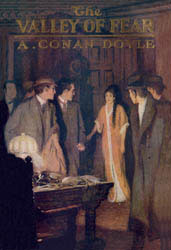
Arthur Wontner stars for the fourth time as Sherlock Holmes, confronting evil nemesis Professor Moriarty (Lyn Harding) in the enjoyable 1935 British mystery film The Triumph of Sherlock Holmes, based on Arthur Conan Doyle’s 1915 novel The Valley of Fear.
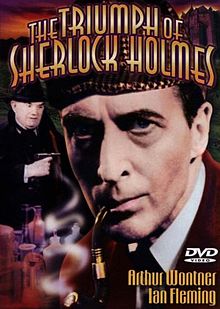
Director Leslie S Hiscott’s 1935 entertaining British crime drama mystery thriller film The Triumph of Sherlock Holmes stars the excellent Arthur Wontner, who is back for his fourth of his five ideal performances as Sherlock Holmes in this tale which is a satisfying and very accurate adaptation of Sir Arthur Conan Doyle’s 1915 novel The Valley of Fear.
That is Doyle’s fourth and final Holmes novel, inspired by the real-life Molly Maguires and Pinkerton agent James McParland, and first published in the Strand Magazine between September 1914 and May 1915. However, like all Wontner’s films as Holmes, it has a then contemporary Thirties setting. There were also 56 Holmes short stories.
In the screenplay by H Fowler Mear, Cyril Twyford and Wontner, Sherlock Holmes retires from Baker Street to the Sussex countryside, but soon comes out of retirement to investigate and reveal the weird facts behind a mysterious revenge murder at a nearby stately home of Birlstone Manor that is connected to a US secret society of coal miners. Dr Watson (Ian Fleming), who has taken up the Baker Street rooms full-time with his wife, happens to be visiting Holmes, and he and investigating Inspector Lestrade (Charles Mortimer), both baffled as usual, join Holmes in his task.
Holmes finds that members of an American criminal organisation called The Scowrers have arranged for his arch nemesis Professor Moriarty (Lyn Harding) to wreak deadly vengeance on neighbouring country gentleman John Douglas (Leslie Perrins), an undercover detective informer who landed them in prison.
Lestrade arrives to tell Holmes that Douglas was ‘horribly murdered’ the night before. At Birlstone, Holmes, Watson and Lestrade examine the body, the sawn-off shotgun murder weapon, a brand on Douglas’s arm and his wedding ring missing, and interview Douglas’s friend Cecil Barker (Michael Shepley) and Douglas’s wife Ettie (Jane Carr), both of them seemingly plenty dodgy.
An extended, rather over-extended, flashback sequence, narrated to Holmes by Ettie, that pits Douglas against the Scowrers is based on Pinkerton operative James McParland’s infiltration of the Molly Maguires in the 1870s. It is interesting in itself, but it slows down momentum of the thriller, seems like it’s from a different film, and keeps Holmes off screen way too much.
Wonter’s age at 59 was too difficult to hide, especially as he dumped the toupée that he wore in the first three films to hide his bald spot, so that is why Holmes is shown as coming out of retirement. He does look old, especially facially, but in a good, characterful way, and he still moves well, springing into action when it is needed. He is still an excellent Holmes, and certainly the classiest thing about the film. It is really only good when he’s on screen,
Ian Fleming is again memorable as Dr Watson, providing a masterclass in kindly bafflement. Lyn Harding (taking over the role from Norman McKinnel) gets more to do this time in a fine lip-smacking study in villainy, imposing and menacing as evil mastermind Professor Moriarty. He’s even there at the start, arriving at Baker Street to congratulate Holmes on his wise decision to retire permanently or else he’d have to take extreme measures. And he’s the centre of attention at the end too.
Charles Mortimer takes over the role of the surprisingly agreeable and tolerant Inspector Lestrade from Philip Hewland. This is a relaxed, agreeable turn.
Jane Carr as Ettie Douglas, Michael Shepley as Cecil Barker and Ben Welden as Ted Balding are less good, and much less convincing, but then their roles are less interesting.
The plot is engrossing and suitably baffling, though eventually quite clear and even quite simple and straightforward finally, once the wood is cleared from the trees. The screenplay is complex but clean and direct, making sure we’re all up to speed, at least Watson’s and Lestrade’s speed, if not Holmes’s. The film’s dark, largely serious tone helps a lot, and it all ends in a dark place too, very satisfactorily. Mrs Hudson (Minnie Rayner) joins Holmes in the country, but she hardly appears, sadly, so there is no comedy relief, and that is quite a relief.
Also in the cast are Jane Carr as Ettie Douglas, Minnie Rayner as housekeeper Mrs Hudson, Michael Shepley as Cecil Barker, Ben Welden as Ted Balding and Roy Emerton as Boss McGinty, with Conway Dixon as Ames, Wilfrid Caithness as Colonel Sebastian Moran, Edmund D’Alby as Captain Marvin, and Ernest Lynds as Jacob Shafter.
It runs 84 minutes but it was cut to 75 minutes in the US. It is available on DVD and free on the Internet Archive.
Wontner was first cast at the age of 56 in the role for The Sleeping Cardinal in 1931 after having been told for years that he resembled Doyle’s character, though Holmes retired at 50 in the novels. It was followed by The Missing Rembrandt (now a lost film) and The Sign of Four: Sherlock Holmes’ Greatest Case.
The Triumph of Sherlock Holmes has very much the feeling of a final case for Sherlock, ending with a big full point, but it received rave reviews and popular acclaim, leading to a final film, Silver Blaze, in 1937.
In October 2014 it was announced that Sherlock Holmes, a long believed lost 1916 feature starring stage performer and playwright William Gillette as Holmes, has been discovered in the vaults of the Cinémathèque Française.
The Wontner Sherlock Holmes series: The Sleeping Cardinal (1931), The Missing Rembrandt (1932), The Sign of Four (1932), The Triumph of Sherlock Holmes (1935), Silver Blaze (1937).
The Irish 19th-century secret society The Molly Maguires were best known for their activism among Irish-American and Irish immigrant coal miners in Pennsylvania. In 1877 and 1878, 20 suspected Molly Maguires were convicted of murder and other crimes and were hanged.
Irish-American private detective and Pinkerton agent James McParland became a private detective and labour spy, successful against coal mining labour organisations in Pennsylvania.
The Triumph of Sherlock Holmes is directed by Leslie S Hiscott, runs 84 minutes, is made by Real Art Productions [Julius Hagen Productions] and Flamingo Films, is released by Gaumont British Distributors Olympic Pictures (US), is written by H Fowler Mear and Cyril Twyford, is shot in black and white by William Luff, is produced by Julius Hagen, is scored by W L Trytel, and is designed by James A Carter.
© Derek Winnert 2016 Classic Movie Review 4,477
Check out more reviews on http://derekwinnert.com

Recent articles
- Three Days to Live [Trois jours à vivre] ** (1957, Daniel Gélin, Jeanne Moreau, Lino Ventura, Georges Flamant) – Classic Movie Review 14,02503 Sep 2026
- Le cave se rebiffe [The Counterfeiters] [The Counterfeiters of Paris] **** (1961, Jean Gabin, Bernard Blier, Martine Carol, Franck Villard, Maurice Biraud, Françoise Rosay) – Classic Movie Review 14,02402 Sep 2026
- House of Boys *** (2009, Layke Anderson, Benn Northover, Udo Kier, Stephen Fry, Steven Webb) – Classic Movie Review 14,02301 Sep 2026
- Dry Wind [Vento Seco] ** (2020, Leandro Faria Lelo, Allan Jacinto Santana, Renata Carvalho, Rafael Teóphilo) – Classic Movie Review 14,02201 Sep 2026
- Black Patch *** (1957, George Montgomery, Diane Brewster, Tom Pittman, Leo Gordon, Sebastian Cabot, Lynn Cartwright) – Classic Movie Review 14,02131 Aug 2026
Recent comments
- The President’s Lady ** (1953, Charlton Heston, Susan Hayward, John McIntire, Fay Bainter) – Classic Movie Review 13,846 | Derek Winnert on The Buccaneer *** (1958, Yul Brynner, Claire Bloom, Charles Boyer, Inger Stevens, Henry Hull, Charlton Heston) – Classic Movie Review 13,844
- Straight Up *** (2019, James Sweeney, Katie Findlay, Dana Drori, James Scully, Tracie Thoms, Betsy Brandt, Randall Park) – Classic Movie Review 13,839 | Derek Winnert on Twinless **** (2025, Dylan O'Brien, James Sweeney, Aisling Franciosi) – Classic Movie Review 13,838
- Phantom Killer ** (1942, Dick Purcell, Joan Woodbury, John Hamilton, Warren Hymer) – Classic Movie Review 13,837 | Derek Winnert on The Sphinx ** (1933, Lionel Atwill, Sheila Terry, Theodore Newton) – Classic Movie Review 13,836
- Detour ***** (1945, Tom Neal, Ann Savage, Claudia Drake, Edmund MacDonald) – Classic Movie Review 1,547 | Derek Winnert on The Last Crooked Mile *** (1946, Don Barry, Ann Savage, Adele Mara, Tom Powers, Sheldon Leonard, Nestor Paiva) – Classic Movie Review 13,834
- Big ***** (1989, Tom Hanks, John Heard, Jared Rushton, Robert Loggia, David Moscow, Mercedes Ruehl, Jon Lovitz, Josh Clark, Kimberlee M Davis, Elizabeth Perkins) – Classic Movie Review 287 | Derek Winnert on 18 Again! *** (1988, George Burns, Charlie Schlatter, Tony Roberts, Anita Morris, Red Buttons, Pauly Shore) – Classic Movie Review 13,815