
The Story of Esther Costello *** (1957, Joan Crawford, Heather Sears, Rossano Brazzi, Ron Randell, Lee Patterson, Fay Compton, John Loder, Denis O’Dea, Sidney James) – Classic Movie Review 3,252
Joan Crawford stars as a wealthy woman who aids a deaf-blind teen orphan (Heather Sears) from her Irish village, in the high-anguish 1957 British drama film The Story of Esther Costello.
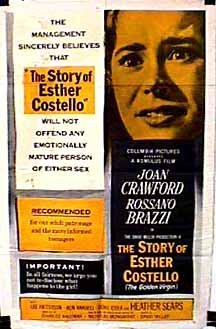
Director David Miller’s awkward but very sincere, well-acted and watchable 1957 British drama film The Story of Esther Costello stars Joan Crawford as rich society lady Margaret Landi, who finds herself coming to the aid of 18-year-old girl Esther Costello (Heather Sears, aged 22), deaf and blind since the accident which killed her mother.
Talked into helping, Margaret uses all her charms to make the young Esther happy, grows to love her as a daughter, and tries educate and possibly heal her, and sets up a charitable trust to help other little girls live a better life.
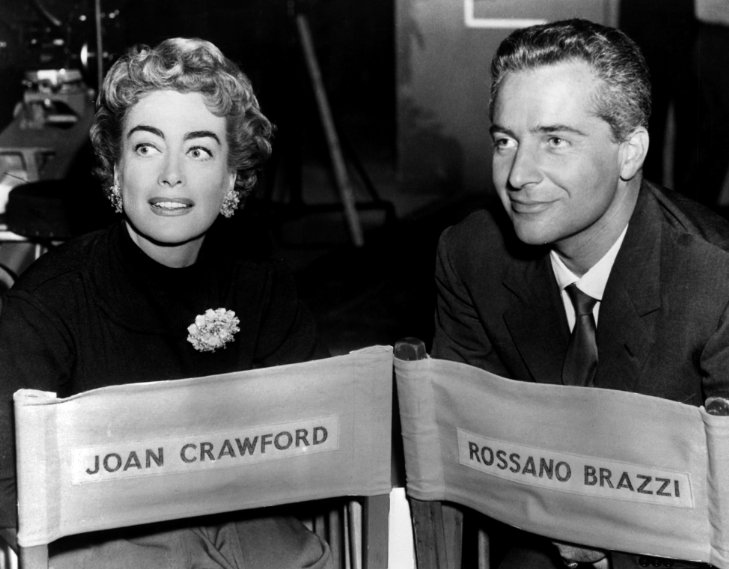
There are loads of tears, the odd smile and a warm tone to help this tall story adapted by screen-writer Charles Kaufman from the 1952 novel by Nicholas Monsarrat, the author of The Cruel Sea, to go down quite palatably.
Crawford and young Sears (in her star debut after a couple of small roles) are exceptional, even when the screenplay and handling wobble, uncertain both of pitch and volume.
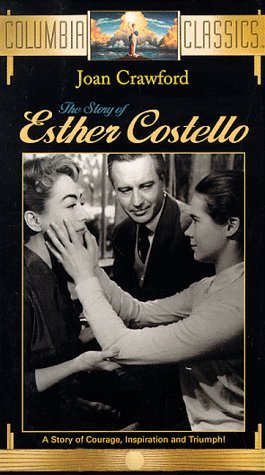
It is set in Esther’s village in Ireland, but is filmed at the London Film Studios, Denham Studio, Denham, Buckinghamshire, England. Unexpectedly, the famously difficult Crawford got on very well with the upcoming English actress Sears.
Rossano Brazzi co-stars as Margaret Landi’s womanising husband Carlo Landi, and there are key star support roles for Lee Patterson as Harry Grant and Ron Randell as Frank Wenzel.
It also stars Fay Compton, John Loder, Denis O’Dea, Sidney James, and Bessie Love.
Also in the cast are Robert Ayres, Maureen Delaney, Estelle Brody, June Clyde, Sally Smith, Megs Jenkins, Andrew Cruickshank, Diane Day, Victor Rietti, Sheila Manahan, Tony Quinn, Janina Faye and Harry Hutchinson.
Crawford, then on the Pepsi-Cola board of directors, ensured that Pepsi is prominently displayed on signs in an airport lobby.
Film debut of Peter Brown as Boy in Airport (uncredited) and June Clyde’s last movie as Mrs Forbes.
It premiered in
Imagine advertising a film like this these days: ‘This powerful story is UNUSUAL but will not offend any emotionally mature person of either sex.’ Or this: ‘RECOMMENDED for our adult patronage, and the most informed teenagers.’ However, it was reported as a tremendous money spinner at the British box office in 1957.
The cast include Joan Crawford as Margaret Landi, Rossano Brazzi as Carlo Landi, Heather Sears as Esther Costello, Lee Patterson as Harry Grant, Ron Randell as Frank Wenzel, Fay Compton as Mother Superior, John Loder as Paul Marchant, Denis O’Dea as Father Devlin, Sidney James as Ryan, Bessie Love as Matron in Art Gallery, Robert Ayres as Mr Wilson, June Clyde as Mrs Forbes. Sally Smith as Susan North, Maureen Delaney as Jennie Costello, Harry Hutchinson as Irish publican, Tony Quinn as Irish pub customer, Janina Faye as Esther Costello, as a child, Victor Rietti as Signor Gatti Megs Jenkins as Nurse Evans Andrew Cruickshank as Dr Stein, Sheila Manahan as Esther’s Mother, Charles Lloyd Pack as Dr Blake, Ewen Solon as Christine Brown’s Father, Peter Brown as Boy in Airport, and Wilfrid Brambell as man in pub.
The Story of Esther Costello [The Golden Virgin] is directed by David Miller, runs 104 minutes, is made by Romulus Films and Valiant Films, is released by Columbia Pictures, is written by Charles Kaufman, based on the novel by Nicholas Monsarrat, is shot in black and white by Robert Krasker, is produced by Jack Clayton, David Miller and James Woolf, is scored by Georges Auric, and is designed by George Provis and Tony Masters.
There was an uncredited first screenplay by Samuel Fuller.
It was released on DVD by Turner Classics on 25 November 2014 as part of their Joan Crawford in the 1950s collection.
© Derek Winnert 2014 Classic Movie Review 3,252
Link to Derek Winnert’s home page for more reviews: http://derekwinnert.com/

Recent articles
- Date with Disaster *** (1957, Tom Drake, William Hartnell, Shirley Eaton, Maurice Kaufmann, Michael Golden, Richard Shaw) – Classic Movie Review 14,01929 Aug 2026
- Travis Mc Gee *** (1983, Sam Elliott, Richard Farnsworth, Gene Evans, Barry Corbin, Geoffrey Lewis, Amy Madigan, Vera Miles, Katharine Ross, Marshall R Teague) – Classic Movie Review 14,01825 Aug 2026
- Tethered Wings [Les ailes collées] *** (2025, Roby Schinasi, Jérémy Kapone, Émilie Caen, Max Libert, Alexis Rosenstiehl) – Classic Movie Review 14,01723 Aug 2026
- Child in the House ** (1956, Eric Portman, Phyllis Calvert, Stanley Baker, Mandy Miller) – Classic Movie Review 14,01622 Aug 2026
- Death of a Corrupt Man [Mort d’un pourri] **** (1977, Alain Delon, Ornella Muti, Stéphane Audran, Klaus Kinski, Mireille Darc, Maurice Ronet) – Classic Movie Review 14,01522 Aug 2026
Recent comments
- The President’s Lady ** (1953, Charlton Heston, Susan Hayward, John McIntire, Fay Bainter) – Classic Movie Review 13,846 | Derek Winnert on The Buccaneer *** (1958, Yul Brynner, Claire Bloom, Charles Boyer, Inger Stevens, Henry Hull, Charlton Heston) – Classic Movie Review 13,844
- Straight Up *** (2019, James Sweeney, Katie Findlay, Dana Drori, James Scully, Tracie Thoms, Betsy Brandt, Randall Park) – Classic Movie Review 13,839 | Derek Winnert on Twinless **** (2025, Dylan O'Brien, James Sweeney, Aisling Franciosi) – Classic Movie Review 13,838
- Phantom Killer ** (1942, Dick Purcell, Joan Woodbury, John Hamilton, Warren Hymer) – Classic Movie Review 13,837 | Derek Winnert on The Sphinx ** (1933, Lionel Atwill, Sheila Terry, Theodore Newton) – Classic Movie Review 13,836
- Detour ***** (1945, Tom Neal, Ann Savage, Claudia Drake, Edmund MacDonald) – Classic Movie Review 1,547 | Derek Winnert on The Last Crooked Mile *** (1946, Don Barry, Ann Savage, Adele Mara, Tom Powers, Sheldon Leonard, Nestor Paiva) – Classic Movie Review 13,834
- Big ***** (1989, Tom Hanks, John Heard, Jared Rushton, Robert Loggia, David Moscow, Mercedes Ruehl, Jon Lovitz, Josh Clark, Kimberlee M Davis, Elizabeth Perkins) – Classic Movie Review 287 | Derek Winnert on 18 Again! *** (1988, George Burns, Charlie Schlatter, Tony Roberts, Anita Morris, Red Buttons, Pauly Shore) – Classic Movie Review 13,815