
Bad Girl **** (1931, Sally Eilers, James Dunn, Minna Gombell, William Pawley, Frank Darien) – Classic Movie Review 13,963
Frank Borzage’s double Oscar-winning 1931 film Bad Girl is based on the notorious 1928 novel by Viña Delmar, and stars Sally Eilers and James Dunn.

Director Frank Borzage’s 1931 American pre-Code drama film Bad Girl is based on the notorious 1928 novel by Viña Delmar, and stars Sally Eilers and James Dunn, with Minna Gombell, William Pawley, and Frank Darien. It won Oscars for Best Director and Best Adapted Screenplay.
Bad Girl is a deservedly admired and much-liked sentimental tale from director Frank Borzage about two befuddled, bothered and bemused New York kids who must marry after just one night of love and face a life of hardship.
Sally Eilers stars as the rather good girl Dorothy Haley who gets married to nice young store clerk Eddie Collins (New York stage actor James Dunn in his screen debut), and both players are very appealing. So is Minna Gombell, who plays Dorothy’s store model friend Edna Driggs.
The now underrated director Frank Borzage won an Oscar at the 5th Academy Awards in 1932 (for films screened in Los Angeles from 1 August 1931 to 31 July 1932) for his honest and sensitive work, and Edwin J Burke’s sterling adapted screenplay, adroitly mixing melodrama with comedy, won for best writing. The movie was also nominated as Best Motion Picture.
Bad Girl is a forgotten gem.
It was shot between June 1 and July 4, 1931, and premiered at the Roxy Theatre in New York City on August 14, 1931.
Runtime: 90 minutes.
The film shot Eilers and Dunn to stardom, though now they are largely forgotten again. Eilers was popular in1930s Hollywood but by the end of the decade, her popularity had waned, and her later film appearances were few. She made her final film Stage to Tucson in 1950. Apparently, she enjoyed a reputation for using ‘the filthiest language in Hollywood’.
Follow-ups with Dunn and Eilers: Over the Hill (1931), Dance Team (1932), Sailor’s Luck (1933), and Hold Me Tight (1933).
Elia Kazan picked Dunn as the dreamy alcoholic father in A Tree Grows in Brooklyn (1945), which earned him the Best Supporting Actor Oscar, but the Oscar failed to advance his film career, and he worked on Broadway and became a TV character actor, struggling with alcoholism and his finances.
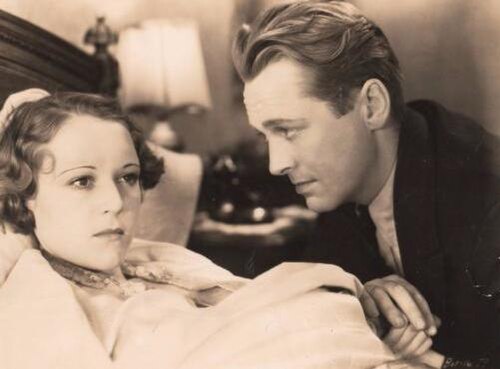
Edwin J Burke’s screenplay was adapted from the 1928 novel by Viña Delmar and the 1930 play by Delmar and Brian Marlowe. Pre-Code it may be, but the film required extensive purging and rewriting of the material to conform to the demands of the Hays Office, who described the novel as a ‘nauseating story of doctors, illnesses, etc’ and as ‘cheap and shoddy writing about cheap and shoddy people’. The Fox studio came up with a treatment that avoided the scandalous elements of the story and smoothed over the especially scandalous issue of Dorothy and Eddie’s late night premarital sex in his apartment, avoiding the implications of their night together.
So the new plot concentrates on the era’s poverty and deprivation themes, with the two young, working-class characters’ fears about earning money and paying for their needs, and follows their courtship and marriage, and misunderstandings from not having learned to trust and communicate with one another.
All that remains of the ‘cheap and shoddy’ content of the novel is the title.
All this paid off big time for Fox. On a budget of under $100,000, it earned $1.1 million at the US box office.
Cast: Sally Eilers as Dorothy Haley, James Dunn as Eddie Collins, Minna Gombell as Edna Driggs, Frank Austin as upstairs tenement neighbour, Irving Bacon as expectant father, Frank Darien as Lathrop, Jesse De Vorska as expectant father, Paul Fix as nervous expectant father, Guy Edward Hearn as male nurse, Aggie Herring as seamstress, Claude King as Dr Burgess, Louis Natheaux as Mr Thompson, Sarah Padden as Mrs Gardner, William Pawley as Jim Haley, Charles Sullivan as Mike the prizefighter, William Watson as Floyd.
© Derek Winnert 2026 – Classic Movie Review 13,963
Check out more reviews on http://derekwinnert.com

Recent articles
- Darker than Amber **½ (1970, Rod Taylor, Suzy Kendall, Theodore Bikel, William Smith, Ahna Capri, James Booth, Jane Russell, Janet MacLachlan) – Classic Movie Review 14,00309 Aug 2026
- Eve Knew Her Apples ** (1945, Ann Miller, William Wright, Robert B Williams) – Classic Movie Review 14,00204 Aug 2026
- Like Sheep Among Wolves [Come pecore in mezzo ai lupi] ** (2023, Isabella Ragonese, Andrea Arcangeli, Clara Ponsot, Tommaso Ragno, Carolina Michelangeli, Gennaro Di Colandrea) – Classic Movie Review 14,00104 Aug 2026
- Leviticus *** (2026, Joe Bird, Stacy Clausen, Mia Wasikowska, Tyallah Bullock, Jeremy Blewitt, Ewen Leslie) – Classic Movie Review 14,00003 Aug 2026
- My Stepmother Is an Alien *** (1988, Kim Basinger, Dan Aykroyd, Jon Lovitz, Alyson Hannigan) – Classic Movie Review 13,99903 Aug 2026
Recent comments
- The President’s Lady ** (1953, Charlton Heston, Susan Hayward, John McIntire, Fay Bainter) – Classic Movie Review 13,846 | Derek Winnert on The Buccaneer *** (1958, Yul Brynner, Claire Bloom, Charles Boyer, Inger Stevens, Henry Hull, Charlton Heston) – Classic Movie Review 13,844
- Straight Up *** (2019, James Sweeney, Katie Findlay, Dana Drori, James Scully, Tracie Thoms, Betsy Brandt, Randall Park) – Classic Movie Review 13,839 | Derek Winnert on Twinless **** (2025, Dylan O'Brien, James Sweeney, Aisling Franciosi) – Classic Movie Review 13,838
- Phantom Killer ** (1942, Dick Purcell, Joan Woodbury, John Hamilton, Warren Hymer) – Classic Movie Review 13,837 | Derek Winnert on The Sphinx ** (1933, Lionel Atwill, Sheila Terry, Theodore Newton) – Classic Movie Review 13,836
- Detour ***** (1945, Tom Neal, Ann Savage, Claudia Drake, Edmund MacDonald) – Classic Movie Review 1,547 | Derek Winnert on The Last Crooked Mile *** (1946, Don Barry, Ann Savage, Adele Mara, Tom Powers, Sheldon Leonard, Nestor Paiva) – Classic Movie Review 13,834
- Big ***** (1989, Tom Hanks, John Heard, Jared Rushton, Robert Loggia, David Moscow, Mercedes Ruehl, Jon Lovitz, Josh Clark, Kimberlee M Davis, Elizabeth Perkins) – Classic Movie Review 287 | Derek Winnert on 18 Again! *** (1988, George Burns, Charlie Schlatter, Tony Roberts, Anita Morris, Red Buttons, Pauly Shore) – Classic Movie Review 13,815