
The Hangman Waits *** (1947, John Turnbull, Hylton Allen, Beatrice Campbell) – Classic Movie Review 13,921
A cinema organist murders an usherette, leaving her still-bleeding torso in a case at London’s Victoria Station, in the 1947 British B-film thriller The Hangman Waits.
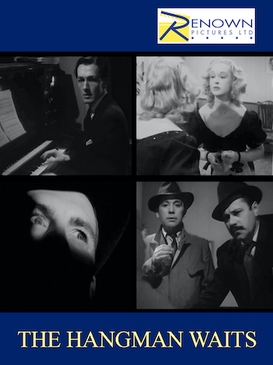
Writer/ producer/ director A Barr-Smith 1947 semi-documentary-style British murder thriller short feature film The Hangman Waits stars John Turnbull and Hylton Allen. It has to cover a lot of ground but it runs just 58 minutes.
Barr-Smith’s story of grisly murders by a limping cinema organist, and the role of a newspaper (the Daily Clarion, standing in for the News of the World, though that was weekly would not fit the story) and Scotland Yard in tracking him down. is intriguing but very basic, hardly developed at all beyond its original concept. The film’s prologue even says: ‘The story selected is an old one.’ Ah, well, all stories are old, it’s just the way you tell them, finding a new spin. This one wants to be the ‘story of real newspaper life’, and that’s its new spin, and now its main interest, printing presses long gone, and the News of the World too, and newspapers on their way out. Hardly anyone must be getting their news from their daily paper any more!
The performances are exaggerated and stagey, enjoyable but not truthful, which is disappointing, especially considering the film’s well cultivated documentary style. Hylton Allen is particularly guilty of this as the Daily Clarion’s Night Editor, hamming away amusing. Less guilty but still guilty is John Turnbull as the Scotland Yard Inspector leading the case. Beatrice Campbell is good as the cinema usherette, but needs much more to do than just be the attractive murder victim.
The grisly elements of the film add much interest, and some conviction, as the limping cinema organist decides to chop up the body of the cinema usherette (Beatrice Campbell) he has murdered and leave the torso in a case at the left luggage office at London’s Victoria Station, take the train from there, and dump the rest from a boat at sea. The torso is still bleeding. After a little while left luggage office notices blood dripping from the case. This must have been going a fair old way for a Brit film of 1947.
The documentary style pays off big time, providing precious views of the cinema, Victoria Station, the News of the World printing plant in Fleet Street, and bombed out central London streets. It is the best thing about the movie, by far.
An already mature looking John Le Mesurier appears uncredited in his first cinema film, as Newspaper Office Worker, with a visor and barely a few lines. Vi Kaley has a brief moment as the old woman in the crowd outside the Queens Theatre, ditto Leonard Sharp as Joe, at the Victoria Station left luggage office. But the film is short on famous old faces.
There are some excellent train shots, looking great, in a film that generally looks noir stylish. But the stock footage of the trains supposedly taken by the killer after the murder further lets down realism. The engines are two different class locomotives, and the trains in the night shots are American, fitted with a centre headlight.
The film is a throwback to an even earlier era, with its hints of Hitchcock’s very early works, and his dark sense of humour. Sometimes it runs like a silent movie. The sound and dialogue that are there is barely needed. If the film is ghoulish, that is good, it’s a proper murder story, but the film is a bit of a missed opportunity, mainly through budget constraints, though it is fun and entertaining anyway. If you want to know what a newspaper print room looked like back in the day, this is the film for you.
Albert Ferber’s rather incongruous score and Denys Coop’s shadowy cinematography are of considerable note, definitely assets to the film.
It is made by Five Star Films at Viking Studios, Kensington, London, for release by Butcher’s Film Service.
It starts (untruthfully) like this: ‘This story is true. By that we do not mean these events actually happened. We mean that it is a story of real newspaper life.’ The title is untruthful too. Given that title, there is an entirely unexpected ending.
Release date: May 20, 1947 (London).
The Renown Pictures digital restoration has left us with a print that could do with considerable further clean-up, both sound and vision.
British stage and film actor John Turnbull (5 November 1880 – 23 February 1956) enjoyed an immensely long and prolific career in films from 1920 to 1950.
© Derek Winnert 2026 – Classic Movie Review 13,921
Check out more reviews on http://derekwinnert.com

Recent articles
- Travis Mc Gee *** (1983, Sam Elliott, Richard Farnsworth, Gene Evans, Barry Corbin, Geoffrey Lewis, Amy Madigan, Vera Miles, Katharine Ross, Marshall R Teague) – Classic Movie Review 14,01825 Aug 2026
- Tethered Wings [Les ailes collées] *** (2025, Roby Schinasi, Jérémy Kapone, Émilie Caen, Max Libert, Alexis Rosenstiehl) – Classic Movie Review 14,01723 Aug 2026
- Child in the House ** (1956, Eric Portman, Phyllis Calvert, Stanley Baker, Mandy Miller) – Classic Movie Review 14,01622 Aug 2026
- Death of a Corrupt Man [Mort d’un pourri] **** (1977, Alain Delon, Ornella Muti, Stéphane Audran, Klaus Kinski, Mireille Darc, Maurice Ronet) – Classic Movie Review 14,01522 Aug 2026
- Town Tamer *** (1965, Dana Andrews, Terry Moore, Pat O’Brien, Lon Chaney Jr, Bruce Cabot, Lyle Bettger, Richard Arlen) – Classic Movie Review 14,01420 Aug 2026
Recent comments
- The President’s Lady ** (1953, Charlton Heston, Susan Hayward, John McIntire, Fay Bainter) – Classic Movie Review 13,846 | Derek Winnert on The Buccaneer *** (1958, Yul Brynner, Claire Bloom, Charles Boyer, Inger Stevens, Henry Hull, Charlton Heston) – Classic Movie Review 13,844
- Straight Up *** (2019, James Sweeney, Katie Findlay, Dana Drori, James Scully, Tracie Thoms, Betsy Brandt, Randall Park) – Classic Movie Review 13,839 | Derek Winnert on Twinless **** (2025, Dylan O'Brien, James Sweeney, Aisling Franciosi) – Classic Movie Review 13,838
- Phantom Killer ** (1942, Dick Purcell, Joan Woodbury, John Hamilton, Warren Hymer) – Classic Movie Review 13,837 | Derek Winnert on The Sphinx ** (1933, Lionel Atwill, Sheila Terry, Theodore Newton) – Classic Movie Review 13,836
- Detour ***** (1945, Tom Neal, Ann Savage, Claudia Drake, Edmund MacDonald) – Classic Movie Review 1,547 | Derek Winnert on The Last Crooked Mile *** (1946, Don Barry, Ann Savage, Adele Mara, Tom Powers, Sheldon Leonard, Nestor Paiva) – Classic Movie Review 13,834
- Big ***** (1989, Tom Hanks, John Heard, Jared Rushton, Robert Loggia, David Moscow, Mercedes Ruehl, Jon Lovitz, Josh Clark, Kimberlee M Davis, Elizabeth Perkins) – Classic Movie Review 287 | Derek Winnert on 18 Again! *** (1988, George Burns, Charlie Schlatter, Tony Roberts, Anita Morris, Red Buttons, Pauly Shore) – Classic Movie Review 13,815