
Obsession [The Hidden Room] **** (1948, Robert Newton, Sally Gray, Phil Brown, Naunton Wayne) – Classic Movie Review 13,770
Edward Dmytryk’s 1948 British crime film Obsession [The Hidden Room] stars Robert Newton, Sally Gray, Phil Brown and Naunton Wayne. Similarities to the real-life ‘Acid Bath Murderer’ John Haigh landed it in hot water with the Film Censors.
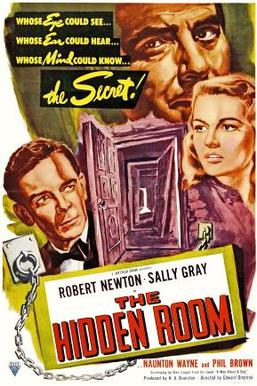
Director Edward Dmytryk’s 1948 British crime film Obsession [The Hidden Room] stars Robert Newton, Sally Gray, Phil Brown and Naunton Wayne.
Obsession is an involving, suspenseful and gripping – though hugely unlikely – thriller about jealous husband Doctor Clive Riordan (Robert Newton)’s acid-bath plans to get rid of his wife (Sally Gray)’s latest American boyfriend (Phil Brown), first abducting him and concealing him chained in a cellar hidden room in a bomb damaged area of London.
Wealthy London psychiatrist Clive Riordan decides to exact revenge on the duo by committing the perfect murder of his wife Storm’s lover Bill Kronin. So he kidnaps him at gunpoint and keeps him prisoner for months in a hidden room accessed via his garage near by, intending to kill him with poison, chop him up and put the pieces in a bath full of acid. Riordan plans to keep Kronin alive till his disappearance is more or less forgotten so that he can kill him when he judges no one suspects any connexion to himself. It’s really all very dark and grisly. Oh, and ingenious enough too.
Newton, first seen with a drink in his hand, is splendidly smooth, silky and sinister in a brio turn at the central core, with a lovely ripe and fruity speaking voice, commanding and menacing. Naunton Wayne is a total scene-stealer as Scotland Yard Superintendent Finsbury (appearing after 50 minutes), polite and affable yet threatening. Newton and Wayne are first-rate sparring partners in their cleverly concocted little scenes together.
There is gutsy acting by Gray, Brown, James Harcourt as the Riordans’ deaf butler Aitkin and especially Monty the Dog, and a nifty yarn that is carefully tipped to make you hope Newton gets way with it, mostly because the wife is portrayed in the most unpleasant light possible, and the boyfriend in the most boring light possible. But also by the smarmy, smug nature of the police detective, making the killer the film’s most sympathetic character!
And the package is tensely directed by Dmytryk, though it is occasionally a bit stagey and theatrical with long dialogue stretches, but with plenty of atmosphere of teasing menace and smouldering suspense. It’s good that the story keeps its sharp, dark edge to the end, though with a slyly humorous undercurrent. There are also a couple of satirically amusing scenes at Riordan’s club, involving Ronald Adam, Allan Jeayes, Lyonel Watts and Roddy Hughes as clubmen, which go well. Another key character is Storm’s little dog Monty, who trails Riordan to the garage. Monty is also quite the scene-stealer.
Happily, the film ends the same way it proceeds, chilly but with an undertow of humour. There’s an ironic happy ending of sorts, probably not the one anyone is expecting.
There’s some imaginative camerawork by C M Pennington-Richards to spark things up visually, quite noirish, and a really odd, sometimes rather intrusive, sometimes effective score by Nino Rota, which feels like it was written for an entirely different movie.
The main triumph, however, must be down to Robert Newton and his month on the wagon. Dmytryk recalled that Newton had to place a £20,000 bond guaranteeing his sobriety during the 30 days of production and that Newton started drinking only on the last day of filming. Newton suffered from chronic alcoholism and died of a heart attack on 25 March 1956, age 50.
Alec Coppel writes the script from his 1947 novel A Man About a Dog, later a 1949 play, and is also credited as dialogue director.
The plot involves disposing a body by dissolving it in acid. Because of its similarities to the crimes of the real-life ‘Acid Bath Murderer’ John Haigh, the British Board of Film Censors initially refused to grant the film a certificate, delaying its release, causing particular grief to its troubled director. However, the film invokes the story of Dr Crippen, with Riordan intending to profit from his mistakes to fool the police.
Cast: Robert Newton as Dr Clive Riordan, Sally Gray as Storm Riordan, Phil Brown as Bill Kronin, Naunton Wayne as Superintendent Finsbury, James Harcourt as the butler Aitkin, Olga Lindo as Mrs Humphries, Ronald Adam as clubman, Michael Balfour as American sailor, Allan Jeayes as clubman, Russell Waters as Flying Squad detective, Sam Kydd as club steward, Betty Cooper as receptionist Miss Stevens, Roddy Hughes as clubman, Lyonel Watts as clubman, Stanley Baker as Policeman, Guy Kingsley Poynter as American sailor, and Ernest Clark.
Obsession is the original UK title and The Hidden Room is the US title.
The original play premiered in London’s West End in May 1949, starring Griffith Jones, but it ran only three weeks. Coppel wrote the story as a play while living in Sydney, Australia, in World War Two, but adapted it as a novel while travelling to London.
Release date: 3 August 1949.
Running time: 96 minutes.
Canadian-born American Edward Dmytryk had recently left Hollywood after appearing before House Un-American Activities Committee. In 1947, he was named as one of the Hollywood Ten, blacklisted film industry professionals who refused to testify to the HUAC. He travelled to England in mid-1948 and was granted a work permit by the UK Ministry of Labour the under the foreign directors’ quota agreement between producers and trade unions. In 1951, Dmytryk testified to the HUAC and named individuals whose careers were destroyed for many years, in order to rehabilitate his own career.
The delay in releasing the film was agonising for the director and his actress wife Jean Porter. Dmytryk recalled that the film ‘was eventually released to good reviews and decent box-office returns. But it was seven months before the film was in the bag, and in those seven months, Jean and I learned how to triumph over adversity — at least temporarily — kept afloat by a weird mixture of grief and happiness, of love and anxiety, but never hope. Still, it was a period of small victories that permits us to remember it with a certain nostalgia, and when compared to the year and a half that followed, it was a picnic.’
Why didn’t they stay safe in the UK? Now, as it is, Dmytryk is remembered as a good director but a bad man, though a victim of the evil HUAC, certainly, but someone who made the wrong choices.
Born in Cambridge, Massachusetts, Phil Brown helped to found the Actors’ Laboratory in Hollywood, but later its members fell under the scrutiny of the HUAC. Brown was blacklisted in 1952, and in 1953 felt compelled to relocate with his family to the UK until 1993.
Filming took place at Pinewood Studios, Iver Heath, Buckinghamshire, England, and on location near the Grosvenor House Hotel, and Grosvenor Square, Mayfair, London; and Coppel’s home, which became a temporary dressing room.
© Derek Winnert 2025 – Classic Movie Review 13,770
Check out more reviews on http://derekwinnert.com

Recent articles
- Eve Knew Her Apples ** (1945, Ann Miller, William Wright, Robert B Williams) – Classic Movie Review 14,00204 Aug 2026
- Like Sheep Among Wolves [Come pecore in mezzo ai lupi] ** (2023, Isabella Ragonese, Andrea Arcangeli, Clara Ponsot, Tommaso Ragno, Carolina Michelangeli, Gennaro Di Colandrea) – Classic Movie Review 14,00104 Aug 2026
- Leviticus *** (2026, Joe Bird, Stacy Clausen, Mia Wasikowska, Tyallah Bullock, Jeremy Blewitt, Ewen Leslie) – Classic Movie Review 14,00003 Aug 2026
- My Stepmother Is an Alien *** (1988, Kim Basinger, Dan Aykroyd, Jon Lovitz, Alyson Hannigan) – Classic Movie Review 13,99903 Aug 2026
- Lurker ** (2025, Théodore Pellerin, Archie Madekwe, Sunny Suljic) – Classic Movie Review 13,99802 Aug 2026
Recent comments
- The President’s Lady ** (1953, Charlton Heston, Susan Hayward, John McIntire, Fay Bainter) – Classic Movie Review 13,846 | Derek Winnert on The Buccaneer *** (1958, Yul Brynner, Claire Bloom, Charles Boyer, Inger Stevens, Henry Hull, Charlton Heston) – Classic Movie Review 13,844
- Straight Up *** (2019, James Sweeney, Katie Findlay, Dana Drori, James Scully, Tracie Thoms, Betsy Brandt, Randall Park) – Classic Movie Review 13,839 | Derek Winnert on Twinless **** (2025, Dylan O'Brien, James Sweeney, Aisling Franciosi) – Classic Movie Review 13,838
- Phantom Killer ** (1942, Dick Purcell, Joan Woodbury, John Hamilton, Warren Hymer) – Classic Movie Review 13,837 | Derek Winnert on The Sphinx ** (1933, Lionel Atwill, Sheila Terry, Theodore Newton) – Classic Movie Review 13,836
- Detour ***** (1945, Tom Neal, Ann Savage, Claudia Drake, Edmund MacDonald) – Classic Movie Review 1,547 | Derek Winnert on The Last Crooked Mile *** (1946, Don Barry, Ann Savage, Adele Mara, Tom Powers, Sheldon Leonard, Nestor Paiva) – Classic Movie Review 13,834
- Big ***** (1989, Tom Hanks, John Heard, Jared Rushton, Robert Loggia, David Moscow, Mercedes Ruehl, Jon Lovitz, Josh Clark, Kimberlee M Davis, Elizabeth Perkins) – Classic Movie Review 287 | Derek Winnert on 18 Again! *** (1988, George Burns, Charlie Schlatter, Tony Roberts, Anita Morris, Red Buttons, Pauly Shore) – Classic Movie Review 13,815