
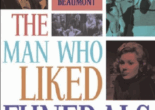
The Man Who Liked Funerals **** (1959, Leslie Phillips, Susan Beaumont, Bill Fraser, Brian Tyler, Anthony Green, Paul Stassino) – Classic Movie Review 13,763
Leslie Phillips stars as a printer who begins attending funerals and blackmails the relatives of the recently deceased to raise money to save a boys‘ club, in the 1958 British comedy B-film gem The Man Who Liked Funerals.

Directed by David Eady’s 1958 British comedy B-film The Man Who Liked Funerals is written by Margot Bennett, Cecily Finn and Joan O’Connor, and stars Leslie Phillips, Susan Beaumont and Bill Fraser.
To help save a boys’ youth club (in Keeley Street) that needs £4,000 to stop it from closure, printer Leslie Phillips begins attending funerals and blackmails the relatives of the recently deceased to raise the money, threatening to publish their scandalous memoirs he has forged but says they have written. It all goes well for a while with the foolish and simpleminded first victims, stacking up the proceeds nicely, though he is getting a bit addicted to funerals. However, just when his £4,000 is in sight, he finds himself in mortal danger when he tries to blackmail the family of an apparently just deceased London Italian gangster.
You couldn’t make up a plot like that, could you? No, wait, somebody did!
The Man Who Liked Funerals (1959) is a quirky and funny, rich and strange, very British, very Fifties, farcical comedy, fast paced, intricate and very satisfying. There’s an interesting dark side to the story, and many sly remarks and cynical jokes. It’s all rather adult in its way, for a farcical comedy set in a boys’ youth club, a nice mix of daft and provocative. It’s farce for grown-ups, and that’s unusual. It’s certainly unusual to make a success of it. Ealing comedies come to mind: Kind Hearts and Coronets and The Ladykillers. Of course this one isn’t in their league, but it’s not too very far behind. It’s a little gem.

Leslie Phillips is exceptionally good in a precision piece of acting, as the devious printer Simon Hurd. How skilled is Leslie Phillips here! No mugging, no over-acting, just acting. Bill Fraser is an essential co-star as his bluff boss Jeremy Bentham, keeping his turn commendably low key. He seems like he’s going to be the monster boss, the film’s villain, but Fraser makes him a sympathetic character. And there are several gratifyingly funny performances in support, especially from Anita Sharp-Bolster as Lady Hunter, Mary Mackenzie as Hester Waring, Hester Paton-Brown as Senior Mistress, Thelma Ruby as junior mistress, Lily Lapidus as Ma Morelli, and Marianne Stone as Bentham’s secretary. Brian Tyler and Anthony Green are amusing as the fighting club boys Nutter and Tommy.
Susan Beaumont is wasted as Phillips’s love interest Stella, a truly dull role. Shaun O’Riordan is rather ordinary as the club leader, the Reverend Pitt, another dull role. Charles Clay as Colonel Hunter and Paul Stassino as gangster Nick Morelli are both adequate enough, but no more, in potentially lively roles.
Alastair Hunter is okay as the rabid Communist Party leader (a bit of political comment here), but Arthur Mullard has nothing to do as gang henchman Renny Fiasco. Poor young Jimmy Thompson overplays his hand campily and stagily in the film’s weakest performance, though admittedly in a tricky role as the ballet dancing army man Lieutenant Hunter.
Scottish-born screenwriter and author of crime and thriller novels Margot Bennett makes a highly amusing job of the saucy screenplay, taking an obvious relish in its outrageous plot.
Nothing is made of it in the film, but Keeley Street is a small, significant street in the West End of London, home to the City Lit adult education college.
© Derek Winnert 2025 – Classic Movie Review 13,763
Check out more reviews on http://derekwinnert.com

Recent articles
- House of Boys *** (2009, Layke Anderson, Benn Northover, Udo Kier, Stephen Fry, Steven Webb) – Classic Movie Review 14,02301 Sep 2026
- Dry Wind [Vento Seco] ** (2020, Leandro Faria Lelo, Allan Jacinto Santana, Renata Carvalho, Rafael Teóphilo) – Classic Movie Review 14,02201 Sep 2026
- Black Patch *** (1957, George Montgomery, Diane Brewster, Tom Pittman, Leo Gordon, Sebastian Cabot, Lynn Cartwright) – Classic Movie Review 14,02131 Aug 2026
- Sorry Angel [Plaire, aimer et courir vite] ****(Pierre Deladonchamps, Vincent Lacoste, Denis Podalydès, Thomas Gonzalez, 2018) – Classic Movie Review 14,02030 Aug 2026
- Date with Disaster *** (1957, Tom Drake, William Hartnell, Shirley Eaton, Maurice Kaufmann, Michael Golden, Richard Shaw) – Classic Movie Review 14,01929 Aug 2026
Recent comments
- The President’s Lady ** (1953, Charlton Heston, Susan Hayward, John McIntire, Fay Bainter) – Classic Movie Review 13,846 | Derek Winnert on The Buccaneer *** (1958, Yul Brynner, Claire Bloom, Charles Boyer, Inger Stevens, Henry Hull, Charlton Heston) – Classic Movie Review 13,844
- Straight Up *** (2019, James Sweeney, Katie Findlay, Dana Drori, James Scully, Tracie Thoms, Betsy Brandt, Randall Park) – Classic Movie Review 13,839 | Derek Winnert on Twinless **** (2025, Dylan O'Brien, James Sweeney, Aisling Franciosi) – Classic Movie Review 13,838
- Phantom Killer ** (1942, Dick Purcell, Joan Woodbury, John Hamilton, Warren Hymer) – Classic Movie Review 13,837 | Derek Winnert on The Sphinx ** (1933, Lionel Atwill, Sheila Terry, Theodore Newton) – Classic Movie Review 13,836
- Detour ***** (1945, Tom Neal, Ann Savage, Claudia Drake, Edmund MacDonald) – Classic Movie Review 1,547 | Derek Winnert on The Last Crooked Mile *** (1946, Don Barry, Ann Savage, Adele Mara, Tom Powers, Sheldon Leonard, Nestor Paiva) – Classic Movie Review 13,834
- Big ***** (1989, Tom Hanks, John Heard, Jared Rushton, Robert Loggia, David Moscow, Mercedes Ruehl, Jon Lovitz, Josh Clark, Kimberlee M Davis, Elizabeth Perkins) – Classic Movie Review 287 | Derek Winnert on 18 Again! *** (1988, George Burns, Charlie Schlatter, Tony Roberts, Anita Morris, Red Buttons, Pauly Shore) – Classic Movie Review 13,815