
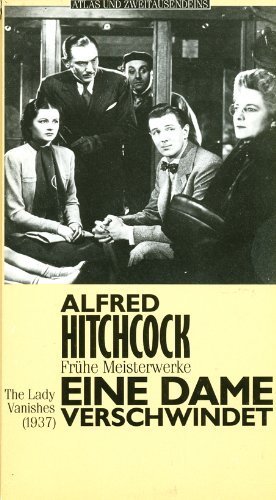
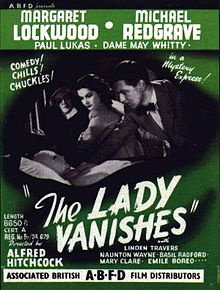
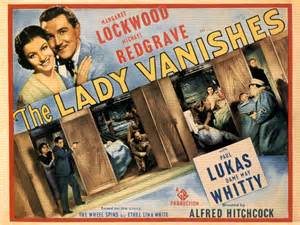
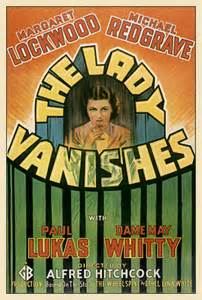
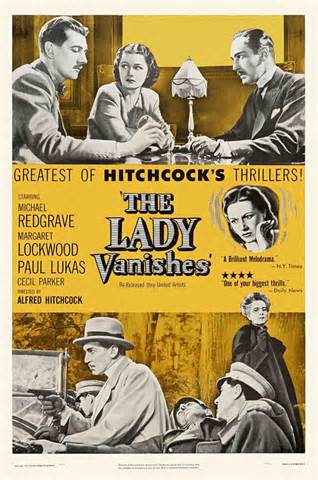
The Lady Vanishes ***** (1938, Margaret Lockwood, Michael Redgrave, Paul Lukas, Dame May Whitty, Basil Radford, Naunton Wayne, Cecil Parker, Linden Travers, Catherine Lacey, Googie Withers, Mary Clare) – Classic Movie Review 118
The 1938 treasure The Lady Vanishes is (arguably) by a narrow margin Alfred Hitchcock’s best British movie before he left for America.
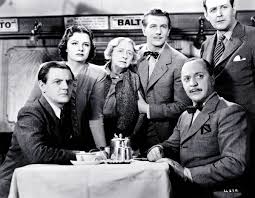
Fighting off strong competition from The 39 Steps, the 1938 treasure The Lady Vanishes is (arguably) by a narrow margin Alfred Hitchcock’s best British movie before he left for America to make Rebecca in 1940 and was lost to Hollywood. It’s a divinely inspired comedy thriller that focuses on a trainload of British folks trying to escape back home just as war is breaking out.
It starts when they’re delayed by an avalanche for a day while they’re taking the trans-Europe train out of mountainous Mandrika. And they’re forced to put up at a jam-packed inn, where they get to know each other a bit too well. Over-share, but they’ll get through it in the proper British spirit.

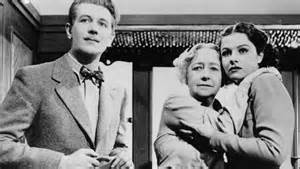
Next day it’s all aboard for England and they optimistically set off. But, when fellow English passenger, Miss Froy (Dame May Whitty), who says she’s a governess, vanishes on the trans-Europe train, a young English gel called Iris Henderson (Margaret Lockwood), with whom she had tea, can’t convince anybody that she was actually on the train and that Nazi spies are responsible for her disappearance. Iris was hit on the head by a flowerpot just before boarding the train, so everyone says that delayed concussion has started a delusion.
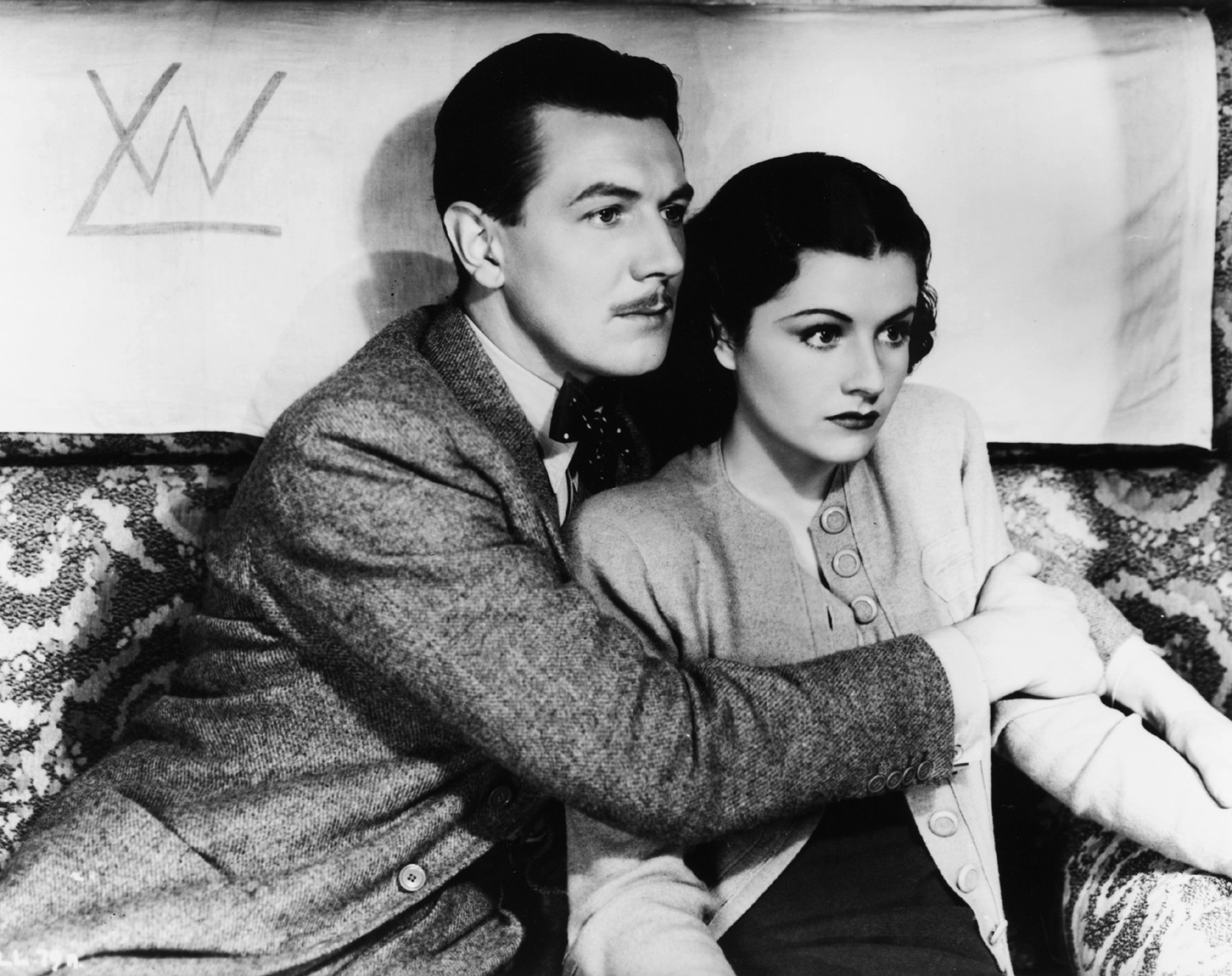
But, soon, Iris persuades her fellow passenger, handsome and charming wisecracking young musicologist Gilbert (Michael Redgrave), to believe her and they start to investigate. Eventually all the true British characters, including cricket-obsessed buffoons Charters and Caldicott (Basil Radford and Naunton Wayne), are fighting off the Nazi spies.
The performances are delicious, achieved with a breezy lightness of touch that is the equal of the best of the American sophisticated comedies of the 1930s. Ideally paired, delightfully polished Lockwood and Redgrave prove a perfect match, giving the brightest of performances. Lockwood is lovely and feisty: Redgrave smooth and charming. Both are at their peak. Radford and Wayne turn playing cricket bores into an art form, while Whitty charismatically steals all her scenes as the courageous spirit of Britain under attack.
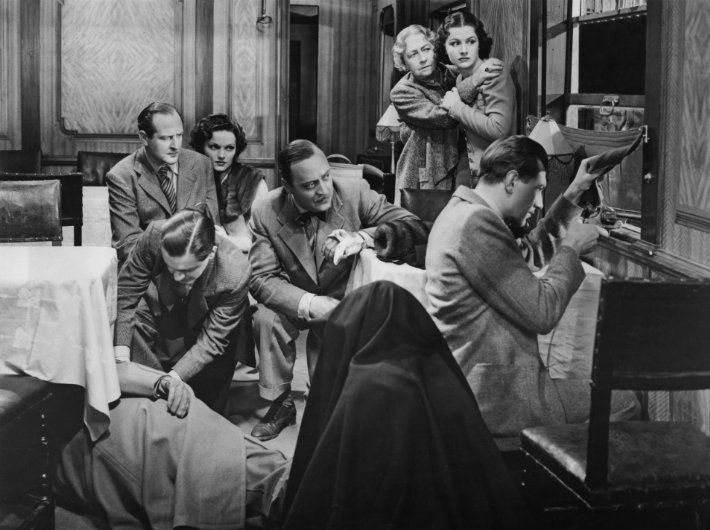
And then there are those awful foreigners like Dr Hartz (Paul Lukas) and (worse) the indifferent or scared British, like cowardly Mr Todhunter (Cecil Parker). These are certainly not men to have around you in a crisis. In a great ensemble cast of characters, Linden Travers’s Mrs Todhunter, Catherine Lacey’s rather unusual Nun, Googie Withers’s Blanche and Mary Clare’s Baroness are all essential passengers on the train.
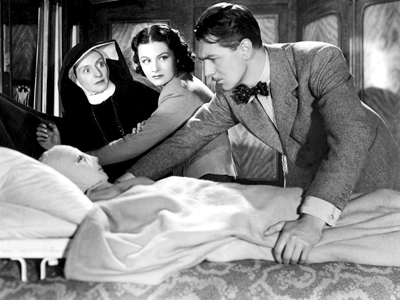
Based freely on Ethel Lina White’s 1936 novel The Wheel Spins, Frank Launder and Sidney Gilliat’s screenplay is one of those rare gems, astonishingly funny, exciting and resonant. Hitchcock never once lets up on the dynamism till it’s all over, attending to pace, detail and mood with the eye of the master that he was. The charmingly inadequate train model work aside, and actually even with that, this is a perfect film.
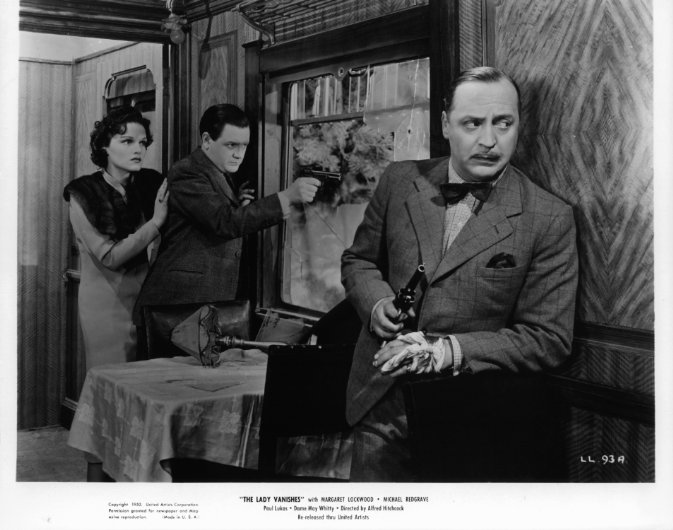
It was made at Gaumont-British’s Lime Grove studios, Shepherd’s Bush, West London, later the home of the BBC, and at North London’s Islington Studios, as well as on location in Hampshire at Longmoor Military Camp, the site of the Longmoor Military Railway, and Woolmer Forest, Hampshire, England.
Radford and Wayne reprised their incredibly popular roles three more times, first in the similar Night Train to Munich, then in Crook’s Tour and Millions Like Us, and made several other movies together.
Hitchcock said: ‘The first script was written by Sidney Gilliat and Frank Launder, a very good team. I made some changes and we added the whole last episode. The climax was great and the build-up was very neat.’ Hitchcock forgot to point out that his wife, Alma Reville, a dab hand at polishing up a script, did just that along with him, and she is credited for additional dialogue.
Hitchcock clearly inherited a fine, sprightly and inventive screenplay, with their plot considerably different from White’s novel. And yet… Whatever work Hitchcock and Reville did to tighten up the opening and ending of the script, and liven up the dialogue may not have been that much, but it is significant and turns it into a true Hitchcock film.
Producer Edward Black had hired director Roy William Neill to make the film back when it was called The Lost Lady. A film crew was sent to Yugoslavia but they were expelled after the local police discovered that they were adversely shown in the script. Edward Black shelved the film for a year until he offered The Lost Lady to Hitchcock, who was under contract to him.
Michael Redgrave was a rising stage star but, persuaded to do it by John Gielgud, who had starred in Hitchcock’s 1936 Secret Agent, his first leading movie role made him an international film star. Redgrave wanted more rehearsal time but Hitchcock valued spontaneity and the two men never worked together again.
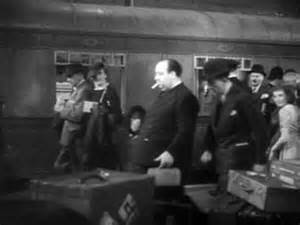
Hitchcock can be seen making his habitual cameo appearance at London’s Victoria Station, wearing a black coat and smoking a cigarette, near the end of the film.
It was remade for absolutely no good reason (and horribly Americanised) in 1979 as The Lady Vanishes with Elliott Gould, Cybill Shepherd and Angela Lansbury as Miss Froy and again for TV by the BBC in 2013.
The cast are Margaret Lockwood as Iris Henderson, Michael Redgrave as Gilbert, Paul Lukas as Dr Hartz, Dame May Whitty as Miss Froy, Cecil Parker as Mr Todhunter, Linden Travers as Mrs Todhunter, Naunton Wayne as Caldicott, Basil Radford as Charters, Mary Clare as Baroness, Emile Boreo as Hotel Manager, Googie Withers as Blanche, Sally Stewart as Julie, Philip Leaver as Signor Doppo, Selma Vaz Dias as Signora Doppo, Catherine Lacey as The Nun, Josephine Wilson as Madame Kummer, Charles Oliver as the Officer, and Kathleen Tremaine as Anna.
Release date: 7 October 1938 (London) and 1 November 1938 (US).
The Lady Vanishes is directed by Alfred Hitchcock, runs 96 minutes, is made by Gainsborough Pictures, is released by MGM British (UK) and Gaumont British Picture Corporation of America (US), is written by Sidney Gilliat, Frank Launder and Alma Reville, is shot in black and white by Jack E Cox, is produced by Edward Black, is scored by Louis Levy (composer and musical director), Charles Williams (composer) and Cecil Milner (orchestrator), and is designed by Alex Vetchinsky (settings), Maurice Carter (assistant art director) and Albert Jullion (assistant art director).
For realism, Hitchcock decided that there should be no background music except at the beginning and the end of the film, so the composers are uncredited.
The British Board of Film Censors, worrying about international diplomacy even with war inevitably brewing, refused to allow the foreign villains to be identified in the script as Germans.
One of the biggest changes for the film is the duo of Charters and Caldicott, who do not appear in the novel.
I leave you with an excellent question: Who erases the name ‘Froy’ written in the train’s window fog after the train goes in a tunnel?
http://derekwinnert.com/the-39-steps-classic-film-review-119/
© Derek Winnert 2013 Classic Movie Review 118
Check out more reviews on http://derekwinnert.com/

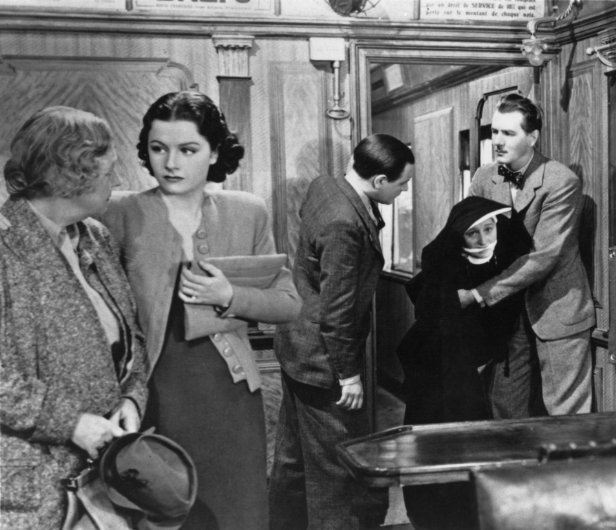
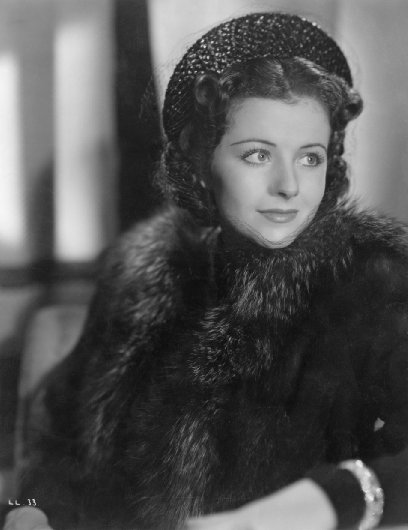


Recent articles
- Scream 4 [SCRE4M] ** (2011, Neve Campbell, Courteney Cox, David Arquette, Hayden Panettiere, Anthony Anderson, Alison Brie, Adam Brody, Rory Culkin) – Classic Movie Review 13,86428 Feb 2026
- Best zombie movies27 Feb 2026
- King of the Zombies *** (1941, Dick Purcell, Joan Woodbury, Mantan Moreland, Henry Victor, John Archer) – Classic Movie Review 13,86326 Feb 2026
- The Lamp in Assassin Mews *** (1962, Francis Matthews, Lisa Daniely, Ian Fleming, Amy Dalby) – Classic Movie Review 13,86224 Feb 2026
- Strange River [Estrany riu] **** (2025, Jan Monter, Nausicaa Bonnín, Jordi Oriol, Francesco Wenz, Bernat Solé, Roc Colell) – Classic Movie Review 13,86121 Feb 2026
Recent comments
- The President’s Lady ** (1953, Charlton Heston, Susan Hayward, John McIntire, Fay Bainter) – Classic Movie Review 13,846 | Derek Winnert on The Buccaneer *** (1958, Yul Brynner, Claire Bloom, Charles Boyer, Inger Stevens, Henry Hull, Charlton Heston) – Classic Movie Review 13,844
- Straight Up *** (2019, James Sweeney, Katie Findlay, Dana Drori, James Scully, Tracie Thoms, Betsy Brandt, Randall Park) – Classic Movie Review 13,839 | Derek Winnert on Twinless **** (2025, Dylan O'Brien, James Sweeney, Aisling Franciosi) – Classic Movie Review 13,838
- Phantom Killer ** (1942, Dick Purcell, Joan Woodbury, John Hamilton, Warren Hymer) – Classic Movie Review 13,837 | Derek Winnert on The Sphinx ** (1933, Lionel Atwill, Sheila Terry, Theodore Newton) – Classic Movie Review 13,836
- Detour ***** (1945, Tom Neal, Ann Savage, Claudia Drake, Edmund MacDonald) – Classic Movie Review 1,547 | Derek Winnert on The Last Crooked Mile *** (1946, Don Barry, Ann Savage, Adele Mara, Tom Powers, Sheldon Leonard, Nestor Paiva) – Classic Movie Review 13,834
- Big ***** (1989, Tom Hanks, John Heard, Jared Rushton, Robert Loggia, David Moscow, Mercedes Ruehl, Jon Lovitz, Josh Clark, Kimberlee M Davis, Elizabeth Perkins) – Classic Movie Review 287 | Derek Winnert on 18 Again! *** (1988, George Burns, Charlie Schlatter, Tony Roberts, Anita Morris, Red Buttons, Pauly Shore) – Classic Movie Review 13,815